How to Detect a Hidden Camera With a Flashlight
Key takeaway
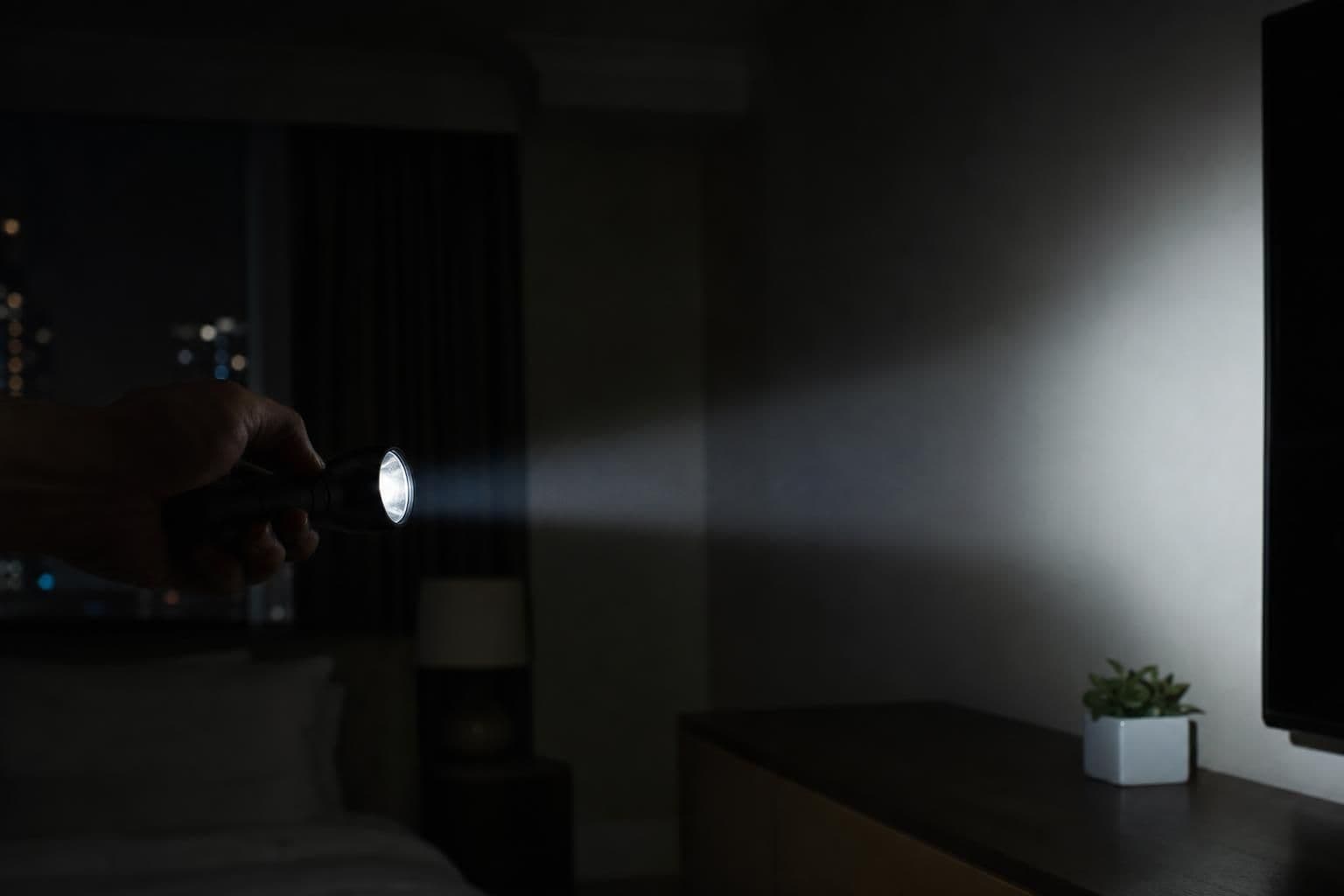
To detect a hidden camera with a flashlight, darken the room, hold the light close to your eye, and slowly scan walls, shelves, and small objects at a low angle — camera lenses reflect light straight back to the source, showing up as a tiny, sharp glint that doesn't move when you shift the beam slightly. This works because most hidden camera lenses are small, round, and reflective, so light bounces off them differently than off fabric, wood, or plastic. It's a quick, no-cost first check, though it won't catch every device, especially ones with pinhole lenses tucked behind mesh or fabric.
Key takeaways
- Turn off all lights, hold a flashlight beside your eye, and scan slowly at a low angle — the glint from a lens holds steady while surrounding light moves.
- Focus on objects with a clear sightline to the areas you'd expect privacy: smoke detectors, clocks, outlets, and shelf clutter.
- A flashlight check is a good first pass, but a dedicated detector or a phone camera check catches devices a flashlight alone can miss.
Why a Flashlight Reveals Camera Lenses
Camera lenses are built to gather light efficiently, which means they also reflect it back toward its source — the same principle behind a cat's eyes glowing in headlights, or a bike reflector lighting up at night. This effect is called retroreflection. A flat wall or a piece of fabric scatters light in many directions, but a small glass or plastic lens sends a concentrated point of light back at you, which is why it appears as a distinct sparkle instead of a general glow.
This is the same physical principle used in traffic signage and safety reflectors, which the U.S. Department of Transportation relies on for nighttime visibility — light bounces back toward the source rather than dispersing.
Step-by-Step: Scanning a Room With a Flashlight
- Turn off every light source in the room, including screens, nightlights, and sunlight through curtains.
- Hold a small flashlight (a phone flashlight works) right next to your eye, pointed outward — this keeps the reflected glint aligned with your line of sight.
- Move slowly, sweeping the beam across one section of the room at a time, roughly at eye level and then again closer to the floor.
- Watch for a pinpoint of light that stays fixed and bright as you move the beam slightly, rather than a soft reflection that shifts or fades.
- Check suspicious objects up close: smoke detectors, air purifiers, alarm clocks, picture frames, and anything with a small dark opening.
Doing a full sweep of an average bedroom or Airbnb-style room typically takes two to three minutes if you move methodically rather than rushing.
What a Camera Glint Actually Looks Like
The reflection you're hunting for is small — usually under 2mm across, since that's roughly the size of the lens openings used in compact and hidden cameras. It tends to look sharper and whiter than reflections off glass, metal, or plastic trim, which usually spread out or dim as you move the light. If you're unsure whether what you're seeing is a lens or just a stray reflection off a screw head or bit of glass, cover the object and see if the glint disappears — a true lens glint will vanish completely once blocked.
For a broader walkthrough that covers spots people overlook, like vents and charging ports, see this guide to finding hidden cameras in a room.
Where Flashlight Scanning Falls Short
The flashlight method is fast and requires no special equipment, but it has real limits:
- Ambient light ruins it. Any stray light source — a streetlight, a TV, even a charging LED — makes the glint much harder to spot.
- Angle matters a lot. If the lens is pointed away from where you're standing, no amount of scanning from your position will catch the reflection.
- Tiny pinhole lenses can hide behind mesh, fabric, or textured plastic, which scatters light before it reaches the lens at all.
- It only detects the lens itself, not the signal a camera might be transmitting, so it won't tell you whether a device is actively recording or connected to Wi-Fi.
When a Dedicated Detector Makes More Sense
If you're checking a rental, a changing room, or any space you don't fully control on a regular basis, a flashlight scan is a reasonable starting point, but it isn't a complete check. A dedicated tool like Valenza's Hidden Camera Detector is built to pick up both lens reflections through an LED array and RF signals from wireless cameras, which covers more ground than a phone flashlight on its own. For a deeper explanation of how detectors like this actually work — including the difference between lens detection and signal detection — see this breakdown of hidden camera detector technology.
Legal and Privacy Considerations
Checking a space you're staying in or renting for hidden cameras is generally a reasonable safety step, but laws about recording, surveillance, and privacy expectations vary significantly by state and country. Some places restrict recording in areas where people have a reasonable expectation of privacy, such as bathrooms or changing rooms, regardless of who installed the device. If you find a camera and suspect it was placed without consent, documenting it and contacting local law enforcement or the property manager is safer than removing or tampering with it yourself, since it may be evidence. The Reporters Committee for Freedom of the Press maintains state-by-state guides on recording laws that are useful for understanding how consent rules differ across the U.S. This is a detection and safety topic, not a tool for monitoring or recording another person without their knowledge.
Frequently Asked Questions
Q: Does a phone flashlight work as well as a real flashlight for finding hidden cameras?
Yes, a phone flashlight works on the same principle — a concentrated beam held close to your eye will still cause a lens to glint. A slightly wider, less diffused beam from a small handheld flashlight can sometimes make the glint easier to spot, but a phone is a fine starting point.
Q: How do I tell the difference between a camera lens and a normal reflective object?
Cover the suspicious spot with your hand or a piece of paper and shine the light again. A true lens glint disappears completely when blocked, while reflections off screws, glass, or trim usually just shift position.
Q: Can a flashlight detect cameras that are turned off?
Yes, because the flashlight method relies on the physical lens reflecting light, not on the camera being powered on or transmitting. This is actually an advantage over signal-based detectors, which only catch cameras that are actively broadcasting.
Q: What areas of a room should I check first?
Start with objects that have a clear view of the bed, shower, or changing area — smoke detectors, alarm clocks, wall outlets, tissue boxes, and shelf decorations are common hiding spots because they blend into a room without drawing attention.
Q: Is it legal to search a hotel room or rental for hidden cameras?
Checking your own temporary living space for hidden cameras is generally legal, since you're not recording anyone. What varies by location is what happens next if you find one — some jurisdictions require reporting to authorities rather than removing the device yourself, so it's worth checking local rules if you're traveling internationally.