Quartzite vs Granite: Which Countertop Wins for Oahu Kitchens?
Key takeaway
Quartzite is generally harder and more heat- and scratch-resistant than granite, while granite offers a wider range of colors and patterns at a somewhat lower material cost. Both are natural stones that hold up well in Hawaii's humidity and salt air when properly sealed, so the better choice usually comes down to how the slab looks, how it's used, and how much sealing upkeep you're willing to do.
Key takeaways
- Quartzite scores harder on the Mohs scale (about 7) than granite (about 6–6.5), making it more resistant to scratching from knives and pots.
- Both stones are porous and need periodic sealing — skipping this step is the most common cause of staining in island kitchens with high humidity.
- Granite typically comes in a broader range of bold colors and patterns; quartzite tends toward whites, grays, and soft veining closer to marble.
What Actually Separates Quartzite From Granite
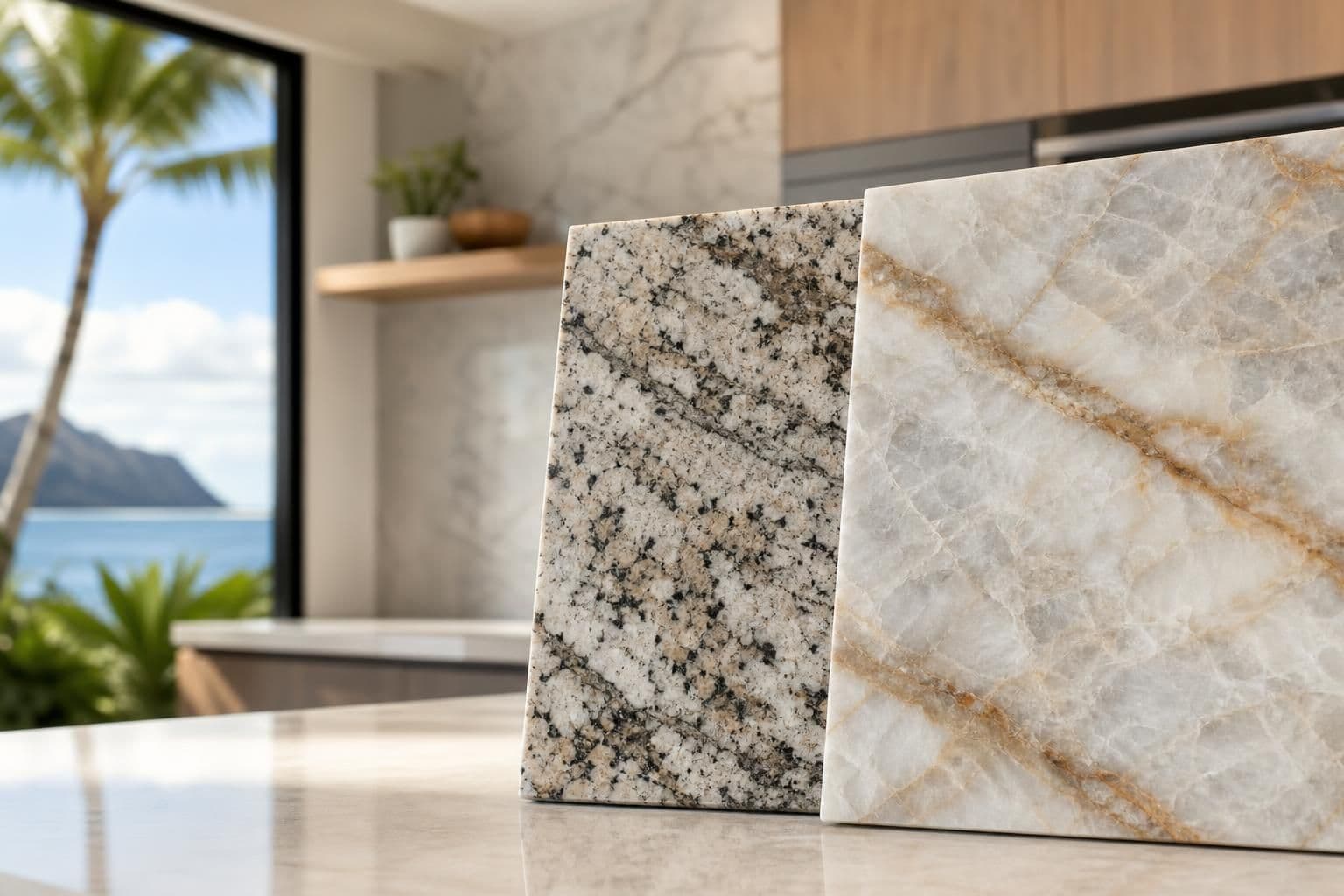
Granite is an igneous rock that forms as molten magma cools slowly underground, which is why it often shows a speckled, granular pattern of interlocking mineral crystals. Quartzite starts as sandstone and is transformed by heat and pressure deep in the earth's crust into a much denser, harder rock — a process called metamorphism. That geologic difference is why quartzite tends to have a more linear, marble-like veining, while granite shows a more uniform speckle. The Natural Stone Institute publishes background on how these classifications are defined, since "quartzite" is sometimes mislabeled by suppliers selling dolomite or marble under the same name.
Durability in Hawaii's Climate
Salt air, high humidity, and near-constant sun exposure make Hawaii kitchens and lanai counters harder on materials than a typical mainland home. Granite and quartzite both resist fading and don't warp from moisture the way wood surfaces can, which is part of why they're popular in condo and vacation-rental remodels across Oahu. Quartzite's higher hardness (close to 7 on the Mohs hardness scale) gives it a slight edge against scratching from cutting directly on the surface or dragging heavy cookware, though neither stone should be treated as scratch-proof. Heat resistance is strong on both — you can generally set a hot pan down without damage — but using trivets still protects the sealant layer over time.
Sealing and Everyday Maintenance
Both stones are porous at a microscopic level, meaning liquids can seep in and cause staining if the surface isn't sealed. Granite is typically sealed once every one to two years depending on the specific slab's porosity, while quartzite — being denser — can sometimes go longer between sealing, though manufacturers still recommend checking annually. A quick way to test either surface: put a few drops of water on the counter, and if it beads up rather than soaking in within a few minutes, the seal is still doing its job. If your countertops are already showing dullness or spotting from hard water buildup, this guide on removing hard water stains from countertops walks through safe cleaning steps before you reseal.
Look, Color, and Kitchen Design Fit
Granite comes in an extensive range of colors — from deep blacks and blues to warm golds and reds — because its mineral makeup varies widely by quarry. Quartzite leans toward whites, grays, and soft creams with flowing veins, which is why it's often chosen to mimic the look of marble without marble's softness and staining tendency. For island homes leaning into a bright, breezy aesthetic, quartzite's lighter palette tends to pair well with open, tropical-modern layouts, while granite's deeper tones can anchor a kitchen with warmer wood cabinetry. If you're also updating cabinet finishes as part of the project, it helps to think through how cabinet colors work with your flooring before locking in a slab, since undertones in the stone will influence what reads well against both.
Side-by-Side Comparison
| Factor | Quartzite | Granite |
|---|---|---|
| Hardness (Mohs scale) | About 7 | About 6–6.5 |
| Formation | Metamorphosed sandstone | Cooled igneous magma |
| Typical color range | Whites, grays, soft veining | Wide range — dark, warm, and bold tones |
| Sealing frequency | Roughly annually, sometimes less | Every 1–2 years |
| Best suited for | Marble-look kitchens, heavy daily use | Bold statement counters, varied budgets |
Which One Fits Your Project
If you're renovating a rental unit or a heavily used family kitchen where durability and low maintenance matter most, quartzite's added hardness can be worth the investment. If you want a wider palette of colors to match a specific design vision, or you're working with a tighter material budget, granite still delivers excellent long-term performance for the price. Because both are natural stone, no two slabs are identical — seeing the actual slab in person, rather than a small sample chip, is the only reliable way to judge veining and color before installation. Material costs for both stones run higher in Hawaii than mainland averages because slabs are shipped in and skilled fabrication labor is limited locally, so getting a local quote is the most accurate way to compare real numbers for your kitchen.
Frequently Asked Questions
Q: Is quartzite more expensive than granite?
Quartzite is often priced higher than granite because it's rarer to quarry and more difficult to cut due to its hardness, though pricing varies significantly by slab origin and availability. Getting quotes on both for the same kitchen layout is the most reliable way to compare.
Q: Can quartzite or granite crack in Hawaii's heat and humidity?
Both stones are dimensionally stable and don't expand or contract enough from heat and humidity to crack under normal household use. Cracks typically come from improper installation support, such as inadequate cabinet bracing under a sink cutout, rather than climate exposure.
Q: Does quartzite stain more easily than granite?
Unsealed quartzite can actually stain more noticeably than granite in some cases because certain quartzite varieties are more porous than they look. Sealing on schedule and wiping up acidic spills like citrus or wine promptly prevents most staining on either stone.
Q: How do I know if a slab labeled "quartzite" is the real thing?
True quartzite will resist scratching from a steel knife blade, while dolomite or marble sold under the same name will scratch more easily. Reputable stone suppliers can confirm a slab's mineral composition before you buy.
Q: Do quartzite and granite need different cleaning products?
No — both should be cleaned with a pH-neutral stone cleaner rather than acidic or abrasive products, which can wear down the sealant on either surface over time. Avoid vinegar-based cleaners on both stones for this reason.