What Is Terrazzo Flooring? A Guide for Hawaii Homes
Key takeaway
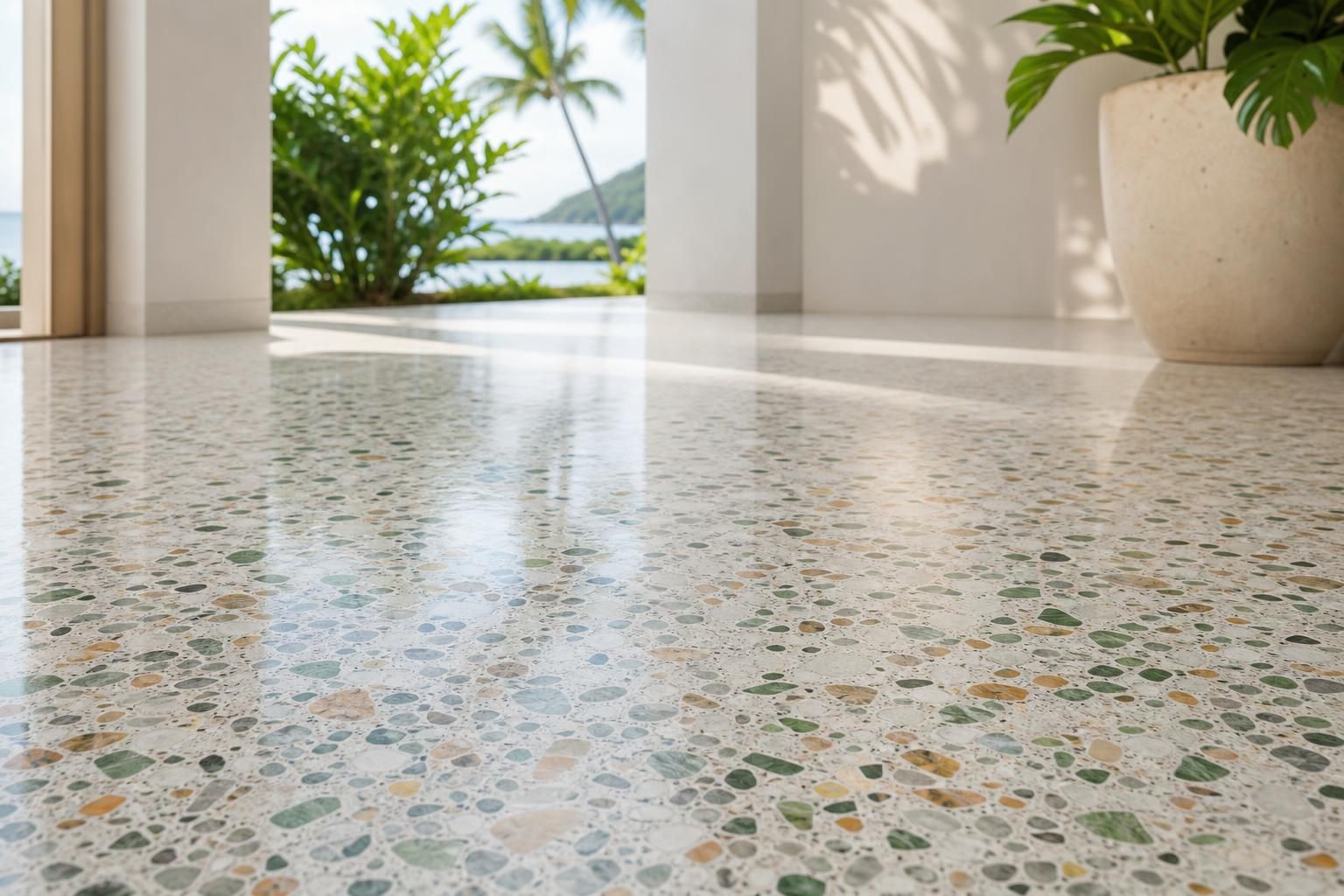
Terrazzo flooring is a composite surface made by embedding chips of marble, quartz, granite, or glass into a binder — traditionally cement, now often epoxy resin — then grinding and polishing the surface to a smooth, speckled finish. It's been used for centuries in warm, humid climates because it's hard, water-resistant, and doesn't support mold growth the way porous materials can. In Hawaii specifically, terrazzo shows up in older plantation-era homes, government buildings, and resort lobbies, and it's seeing renewed interest for kitchens, lanais, and condo renovations.
Key takeaways
- Terrazzo is chips (marble, quartz, glass, or granite) set in cement or epoxy binder, then ground flat and polished.
- Epoxy terrazzo cures faster and resists moisture better than cement terrazzo, making it a stronger fit for Oahu's humidity.
- It's extremely durable and easy to clean, but installation requires skilled labor and a properly prepped, stable subfloor.
How Terrazzo Is Made
Terrazzo starts as a slurry: aggregate chips mixed into a liquid binder and poured over a substrate, either directly onto a concrete slab or into a pre-set system of metal or plastic divider strips that control pattern and control cracking. Once cured, the surface is ground down in stages with progressively finer abrasives, then sealed and polished to reveal the chip pattern beneath. This grinding step is what distinguishes terrazzo from a simple poured floor — it's the same basic principle used to finish polished concrete, applied with decorative aggregate mixed in.
There are two main binder types:
- Cement-based terrazzo — the traditional formula, thicker and heavier, typically poured in place over days.
- Epoxy terrazzo — a thinner, resin-based system that cures faster, accepts a wider color range, and is generally more resistant to moisture intrusion.
For humid environments, epoxy terrazzo is usually the more practical choice, since cement is naturally more porous and can be more vulnerable to moisture-related staining if not sealed consistently.
Why Terrazzo Shows Up in Older Hawaii Buildings
Terrazzo has a long history in tropical and Mediterranean construction, dating back to Venetian artisans who originally used marble remnants set in clay before the method evolved into cement-based systems in the 18th and 19th centuries, according to the National Terrazzo and Mosaic Association. It made its way into island architecture for practical reasons: it holds up in heat, doesn't warp with moisture the way some wood products can, and stays cool underfoot — a real advantage in non-air-conditioned plantation homes. That legacy is part of why some remodelers on Oahu treat an existing terrazzo floor as a feature worth restoring rather than tearing out.
Durability and Maintenance in a Humid Climate
Properly installed and sealed terrazzo is one of the more durable flooring surfaces available — it doesn't scratch easily, doesn't fade from UV exposure the way some vinyl or laminate can, and resists the kind of moisture damage that's common in Hawaii's rainy season. Routine care is straightforward:
- Sweep or dust-mop regularly to prevent grit from dulling the polished finish.
- Use a pH-neutral cleaner; acidic or highly alkaline products can etch the sealer over time.
- Reseal periodically, since the sealer — not the terrazzo itself — is what wears down first and allows staining.
For homeowners comparing long-term flooring options for Oahu's climate, it's worth reading through a broader look at the most durable flooring for Hawaii homes before deciding between terrazzo, tile, or waterproof vinyl plank.
Terrazzo vs. Other Hard-Surface Flooring
Terrazzo sits in a similar durability category as natural stone or quartz surfacing, but it's applied as a flooring system rather than installed in slab form. A few comparison points:
- Versus tile: Terrazzo has no grout lines, which means fewer places for moisture, mold, or grime to collect — a meaningful advantage in Hawaii's humidity.
- Versus natural stone flooring: Terrazzo is manufactured, so color and pattern consistency can be controlled more precisely across a large area.
- Versus vinyl plank: Terrazzo is far more rigid and permanent; it's poured or set in place rather than floated over a subfloor, and removal is far more involved.
Homeowners weighing terrazzo against engineered stone surfaces for a kitchen remodel may find it useful to compare it with the pros and cons of quartz countertop material, since both are engineered composites built around a binder and aggregate, just applied to different surfaces.
Where Terrazzo Works Well on Oahu
Terrazzo performs well in spaces that see heavy foot traffic, moisture, or both — entryways, lanais, bathrooms, and condo common areas. Its seamless, non-porous surface (once properly sealed) is part of why it's historically been specified in institutional and commercial buildings where sanitation and longevity matter, a point echoed in guidance from the U.S. General Services Administration on terrazzo's use in federal buildings. For a vacation rental or multi-unit condo where floors take a beating from rotating guests, that resilience can offset the higher upfront installation effort.
It's less commonly chosen for ground-level additions where seismic or structural movement is a concern, since cement terrazzo in particular can be prone to cracking if the substrate shifts — one reason divider strips are built into the pour to control where hairline cracks form.
What Installation Involves
Terrazzo installation is more labor-intensive than most flooring types because it's built in place rather than delivered pre-finished. A typical epoxy terrazzo installation involves prepping and priming the subfloor, setting divider strips to define the pattern, pouring and troweling the terrazzo mix, curing, then multiple passes of grinding and polishing before sealing. Because it's a wet-applied system, subfloor moisture and flatness matter enormously — any irregularity telegraphs through the finished surface. This is also why terrazzo work is typically handled by specialists rather than a general flooring crew.
Given the shipping costs for specialty aggregates and resins, plus the skilled labor required, terrazzo installation in Hawaii tends to run higher than on the mainland. A local design consultation is the most reliable way to get a realistic scope and timeline for a specific space.
Frequently Asked Questions
Q: Is terrazzo flooring the same as polished concrete?
No. Polished concrete is ground concrete with no added decorative aggregate, while terrazzo specifically embeds marble, quartz, granite, or glass chips into the binder before grinding, creating a speckled pattern rather than a uniform gray surface.
Q: Does terrazzo crack easily in a humid or shifting climate?
Cement-based terrazzo can develop hairline cracks if the subfloor moves, which is why divider strips are built into the pour to control cracking; epoxy terrazzo is more flexible and generally more resistant to this issue.
Q: Can terrazzo be installed over an existing floor?
In some cases a thin epoxy terrazzo topping can be applied over a sound, properly prepped subfloor, but cement terrazzo typically requires a dedicated slab. A site evaluation is needed to confirm what the existing substrate can support.
Q: Is terrazzo slippery when wet?
Polished terrazzo can be slick when wet, similar to other polished stone surfaces, which is why many installations use a honed rather than high-gloss finish in bathrooms, lanais, or entryways.
Q: How long does terrazzo flooring typically last?
Well-maintained terrazzo is known for lasting for decades, since the material itself doesn't wear the way softer flooring does — most of its long-term performance depends on periodically resealing the surface rather than replacing the terrazzo itself.