Best Enrichment Toys for Indoor Cats: A Buyer's Guide
Key takeaway
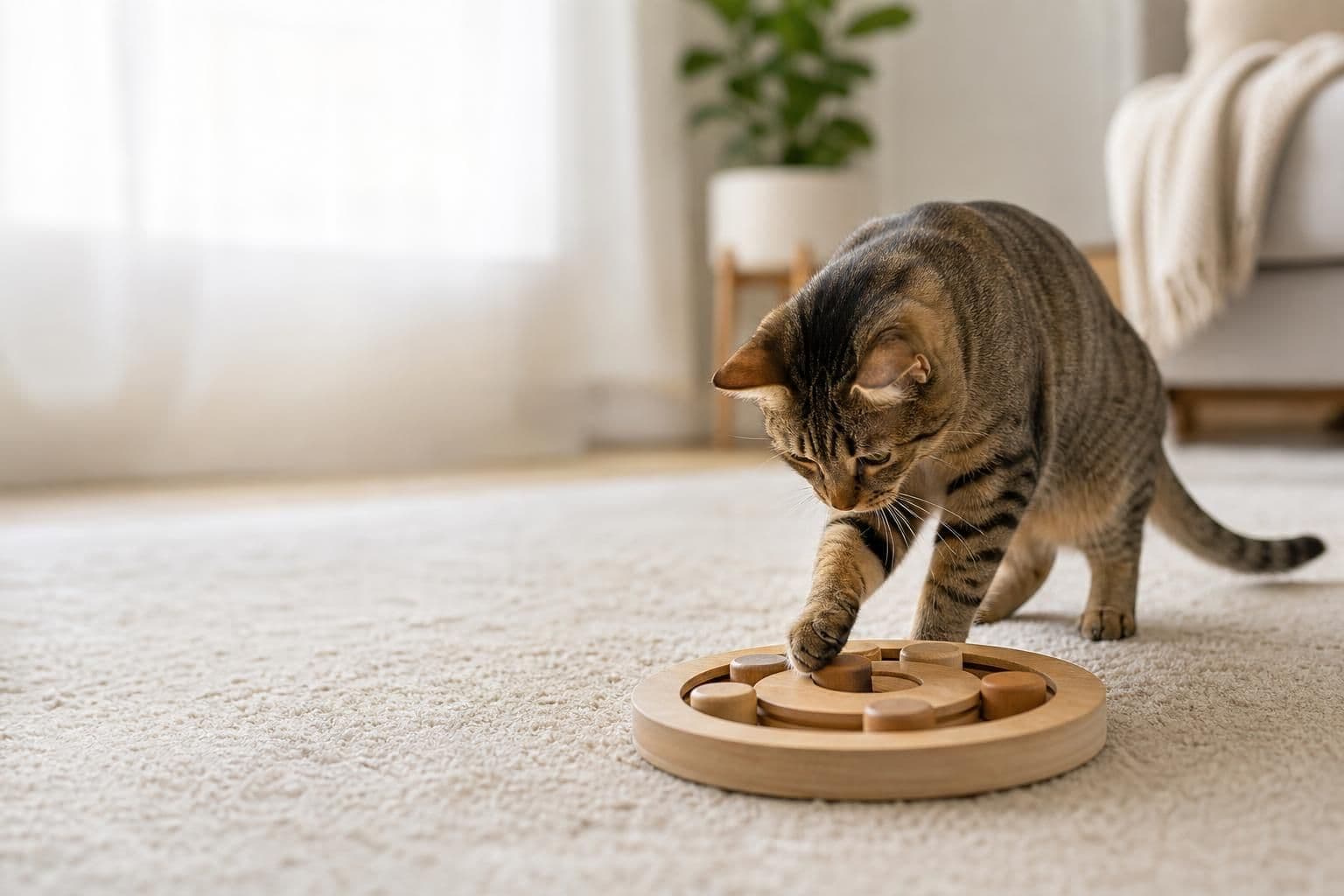
The best enrichment toys for indoor cats combine a hunting-style challenge with a real reward, so puzzle feeders, wand teasers, and motion-triggered toys tend to outperform static plush toys that a cat bats once and ignores. A good enrichment setup usually mixes at least one food-based puzzle, one interactive chase toy, and one solo toy the cat can use unsupervised. Rotating a handful of toys every week or two keeps novelty high without requiring a large toy collection.
Key takeaways
- Pick one toy from each category — food puzzle, interactive chase, and solo/independent play — rather than buying several of the same type.
- Rotate 3-5 toys on a weekly basis instead of leaving everything out at once; novelty matters more than quantity.
- Match toy size and texture to your cat's actual hunting style (pouncers want movement, chewers want texture, food-driven cats want puzzles).
Why indoor cats need enrichment toys specifically
Indoor cats don't get the varied sensory input that outdoor hunting provides — no scent trails, no unpredictable prey movement, no changing terrain. Without that stimulation, a cat's normal hunting sequence (stalk, chase, pounce, catch) has nowhere to go, which is often behind pacing, over-grooming, or attention-seeking at odd hours. The Cornell Feline Health Center notes that environmental enrichment is a core part of feline wellness, not an optional extra, precisely because cats are obligate predators whose instincts stay active even when they're fully domesticated and well-fed.
Toys that mimic the stalk-and-catch sequence give an indoor cat a way to complete that behavior loop safely indoors. That's different from simple entertainment — it's closer to a job the cat's brain expects to do daily.
The three toy categories worth stocking
Not all "enrichment" toys do the same job. Splitting them into categories makes it easier to build a rotation that actually covers a cat's needs instead of buying five versions of the same toy.
- Food puzzles — treats or kibble dispensed through a maze, roller, or lift-the-flap design. These slow down fast eaters and turn a meal into a 10-20 minute activity.
- Interactive chase toys — wand teasers, feather toys, and LED or laser pointers that require a human (or a motion sensor) to create movement. These are the closest match to real prey behavior because the "prey" moves unpredictably.
- Solo/independent toys — catnip-filled toys, springs, and battery-free toys a cat can bat, carry, or chew without supervision. Useful for the hours nobody's home to run a wand toy.
At Ziva Paws, toys are grouped roughly this way, and two staff cats, Ai and Dudu, test each one before it's listed — which mostly means checking whether a toy holds up to real claws and teeth, and whether it actually gets chased more than once.
What makes a cat toy safe, not just fun
Safety matters more with cat toys than it looks, mostly because of small detachable parts. The ASPCA advises checking toys regularly for loose strings, bells, or eyes that could be chewed off and swallowed, and retiring any toy once it starts fraying. A few concrete checkpoints:
- No loose string longer than a couple of inches — cats can swallow linear material, which is a genuine choking and intestinal-obstruction risk.
- Feathers and small attachments should be stitched, not glued, so they don't detach after repeated bites.
- Battery compartments on electronic toys need a screw-secured cover, not a snap-on lid a determined cat can pop open.
- Catnip pouches should use a fabric your cat can't tear open in one session, since loose catnip itself is harmless but the fabric scraps aren't meant to be eaten.
If your cat is a heavy chewer rather than just a batter-and-abandon type, the same durability logic used for safe chew toys for aggressive chewers applies loosely here too — thicker, reinforced materials last longer under real jaw pressure.
Comparing common enrichment toy types
| Toy type | Best for | Supervision needed | Typical play style |
|---|---|---|---|
| Food puzzle / slow feeder toy | Food-motivated cats, slowing down fast eaters | Low | Independent, paw/nose manipulation |
| Wand teaser | Active cats, bonding play sessions | High | Interactive chase and pounce |
| LED/laser teaser ball | Cats home alone during the day | Medium (check for motion-sensor auto-off) | Chase, with occasional physical toy needed for the "catch" |
| Catnip plush or fish | Solo downtime play | Low | Batting, carrying, kicking |
| Motorized/robotic toy | Cats needing extra daytime stimulation | Medium | Chase, unpredictable movement |
How to build a rotation that actually works
Buying more toys isn't the same as enriching a cat — the trick is rotation. Leaving every toy out permanently causes most cats to habituate and ignore all of them within days. A simpler approach: keep 3-5 toys accessible at a time, box up the rest, and swap the active set weekly. Reintroducing a toy after a break often gets the same excited reaction as when it was new.
Pairing toys with a scratching outlet also rounds out the setup, since scratching is its own instinctive behavior separate from hunting play — if you haven't set one up yet, choosing the right scratching post is worth doing alongside a toy rotation rather than instead of one.
Where toys fit into a bigger enrichment plan
Toys are one piece of a larger picture that also includes vertical space, hiding spots, and a comfortable place to retreat after a play session winds down. A cat that's just finished a chase-and-catch sequence often wants a soft, enclosed spot to settle into — which is part of why bedding matters more for cats than owners tend to assume; see do cats need beds for what that actually looks like in practice. Feeding-based enrichment also overlaps here: slow feeders and puzzle feeders sold in a feeding collection double as both a mealtime tool and a genuine enrichment toy.
Frequently Asked Questions
Q: How many enrichment toys does an indoor cat actually need?
Most cats do well with 3-5 accessible toys at a time, covering a food puzzle, a chase toy, and a solo toy, rotated every one to two weeks rather than a large permanent pile.
Q: Are laser pointers bad for cats since they never "catch" anything?
Laser toys work best paired with a physical toy at the end of a session so the cat gets an actual catch; using only a laser with no physical follow-up can leave the hunting sequence unfinished and frustrate some cats over time.
Q: How often should cat toys be replaced?
Replace a toy as soon as stitching frays, stuffing shows, or small parts loosen — there's no fixed timeline, since it depends entirely on how hard an individual cat plays with it.
Q: Do puzzle feeders help with overweight or fast-eating cats?
Yes — puzzle feeders slow down eating speed and add physical movement to a meal, which is why they're commonly recommended alongside portion control rather than as a replacement for it.
Q: What's the difference between enrichment toys and regular cat toys?
Enrichment toys are specifically designed to engage a cat's natural hunting or foraging instincts (puzzles, chase, scent), while a generic toy may just be something to bat around without that instinctual match.