Interactive Puzzle Toys for Bored Cats: A Buyer's Guide
Key takeaway
The best interactive puzzle toys for bored cats are ones that match your cat's hunting instincts — treat-dispensing puzzles, motion-triggered toys, and multi-compartment boxes that reward paws-on effort with food or a moving target. A cat that paces, over-grooms, or knocks things off shelves for attention is often understimulated, and puzzle feeders redirect that energy into a task with a payoff. Start with an easy difficulty level so your cat learns the toy works, then increase the challenge as they catch on.
Key takeaways
- Choose a puzzle that matches your cat's current skill level — too hard, too fast, and most cats walk away for good.
- Rotate 2-3 puzzle types weekly so novelty stays high without buying constantly.
- Treat-based puzzles double as slower, more engaging meals for food-motivated cats.
Why Bored Cats Need More Than a Feather Wand
Cats evolved as solitary hunters who spend a large part of their day stalking, chasing, and dismantling prey — behavior that doesn't disappear just because dinner shows up in a bowl. The American Association of Feline Practitioners points to environmental enrichment as a core part of feline welfare, not an optional extra, because understimulated indoor cats commonly develop stress behaviors like overeating, aggression, or excessive vocalizing. Puzzle toys give that hunting sequence somewhere to go: locate, manipulate, "catch."
A wand toy delivers a few minutes of chase but needs a human on the other end. Puzzle toys let a cat work independently, which matters most during the hours you're at work or asleep — exactly when bored cats tend to get into trouble.
Types of Interactive Puzzle Toys, and What Each One Trains
Not all puzzles ask the same thing of a cat, so it helps to know the categories before buying:
- Roll-and-release feeders: A ball or cylinder drops kibble as it's batted around. Good starter puzzle for cats new to food puzzles.
- Multi-compartment boxes: Sliding or lift-lid compartments hide treats at different depths, building problem-solving over time.
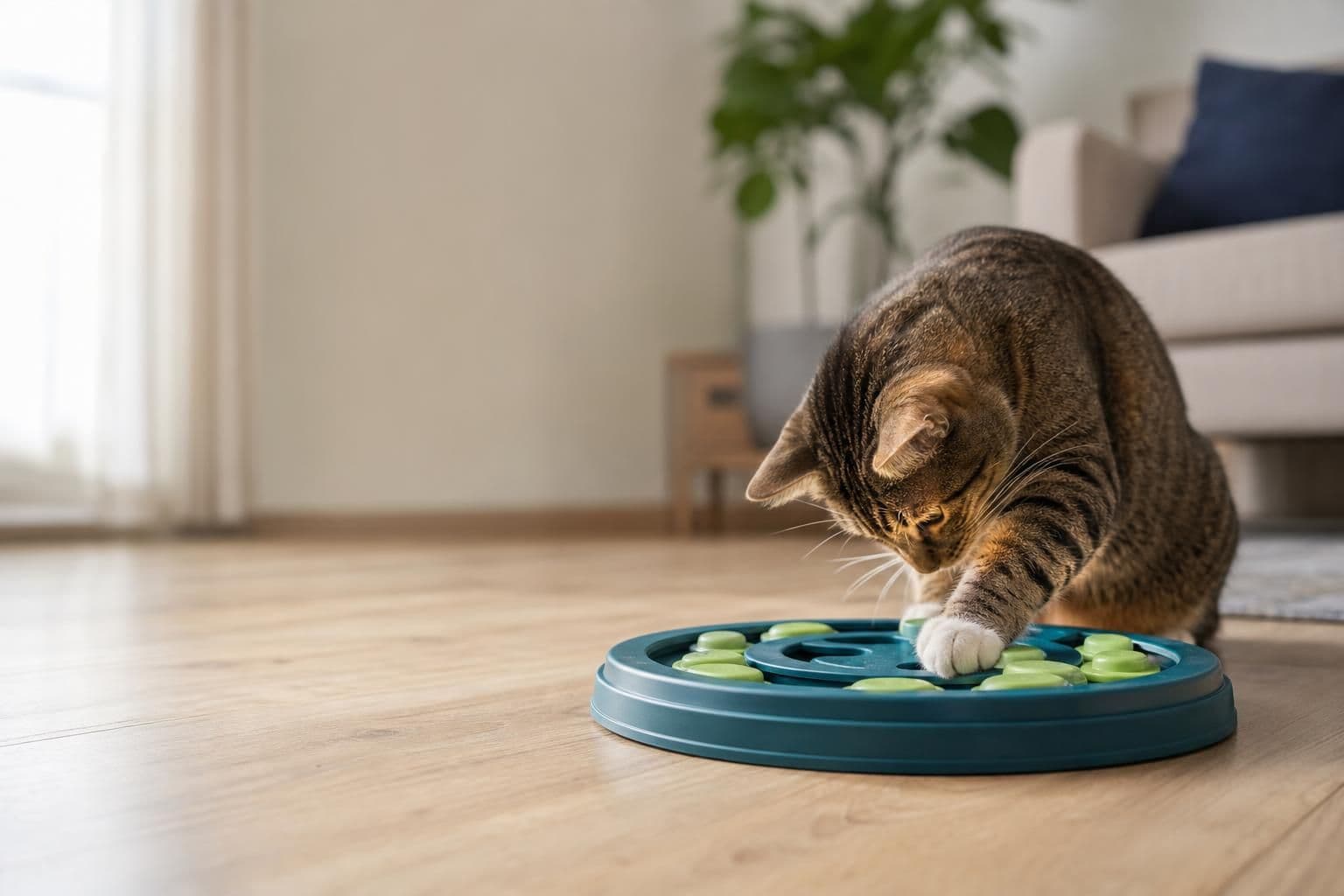
- Push-button or spinner puzzles: Fixed base with turning discs or buttons covering wells — closer to a tabletop game than a toy that rolls away.
- Motion-based toys: LED teaser balls or automated wand-style toys that move unpredictably, appealing to cats more driven by chase than food.
- Snuffle-style mats: Fabric folds that hide kibble for cats who prefer nosing and pawing over lifting lids.
Because cats specialize, a toy that gets ignored isn't necessarily "bad" — it may just be the wrong category for that particular cat. Ai and Dudu, the two cats who test products before Ziva Paws lists them, consistently go for the lift-lid compartment style over spinning discs, while still checking every roll-away feeder at least once before deciding it's beneath them.
Matching Difficulty to Your Cat's Experience Level
Most cats need an on-ramp. A puzzle that's too hard right away gets written off as broken, not challenging, and many cats won't return to it a second time.
- Level 1 – visible reward. Treats sit in open or shallow wells so the cat can see and easily reach them; this builds the habit of engaging with the object at all.
- Level 2 – single-step effort. A lid must be nudged, slid, or lifted to access the treat.
- Level 3 – multi-step effort. Several compartments require different motions (sliding one direction, lifting another) before the reward drops.
If your cat sniffs a puzzle, bats it once, and walks off, drop back a level rather than assuming they "don't like puzzles." Success at an easy stage is what teaches a cat the toy is worth returning to.
Puzzle Feeders vs. Free Feeding: What Changes
Swapping even part of a meal into a puzzle feeder changes more than boredom levels. Eating from a puzzle slows intake, which the Cornell Feline Health Center notes can help with weight management in cats prone to fast, large-volume eating. It also breaks up the day: instead of one or two feeding events, a cat working a puzzle across several short sessions gets more total activity from the same amount of food.
If your cat is already on a schedule with a slow feeder bowl, a puzzle toy is a natural next step rather than a replacement — some owners use a slow feeder bowl for water or wet food and a puzzle for a portion of dry kibble, splitting the meal between the two.
Safety Checks Before You Buy
A few concrete things to look at before adding a puzzle to the cart:
- Piece size: small discs, balls, or tabs should be too large to swallow whole, and shouldn't detach with normal batting force.
- Material: BPA-free hard plastics or silicone hold up better to teeth and claws than thin, brittle plastic that can crack into sharp edges.
- Weight and stability: a puzzle that slides across hard floors when nudged is harder for a cat to learn, since the reward mechanism itself keeps moving away.
- Washability: anything holding wet food or treats needs to come apart for a real wash, not just a wipe-down, or bacteria builds up in grooves and hinges.
If your cat is a determined chewer as well as a puzzle-solver, the same size-and-material logic used for chew toys applies — this guide on choosing safe chew toys for aggressive chewers covers how to judge durability, and much of it carries over to puzzle toys that get gnawed on between rounds.
How Many Puzzle Toys Does One Cat Actually Need
You don't need a shelf full of puzzles for one cat — rotation matters more than volume. Keeping two or three types in circulation and swapping which ones are out each week keeps a puzzle "new" far longer than leaving five out permanently. The same logic that applies to a dog's toy box applies here: this piece on how many toys a pet actually needs walks through why rotation, not accumulation, is what keeps enrichment working.
Pair puzzle time with a short active-play session — a wand toy or LED teaser ball for a few minutes — right before the puzzle comes out. Cats that get a brief "hunt" first are often calmer and more focused when it's time to work for the food reward, echoing the natural hunt-catch-eat-rest sequence.
Frequently Asked Questions
Q: How do I know if my cat is bored enough to need a puzzle toy?
Signs include excessive sleeping beyond normal cat napping, pacing, over-grooming bald patches, knocking objects down for attention, or eating too fast out of habit rather than hunger. If several of these show up together, adding structured play and a puzzle feeder is a reasonable first step before assuming it's a medical issue.
Q: What's the easiest interactive puzzle toy for a first-time cat?
A roll-and-release feeder or a shallow open-compartment box is easiest, since the cat can see the treat and doesn't need to learn a hidden mechanism. Start there before moving to lift-lid or multi-step puzzles.
Q: Can kittens use puzzle toys safely?
Yes, as long as pieces are sized so nothing can be swallowed and the difficulty starts at the lowest level, since kittens are still learning basic problem-solving and paw coordination. Supervise the first few sessions to confirm they're engaging with it safely rather than chewing off small parts.
Q: Do puzzle toys help with cat obesity?
They can help indirectly by slowing eating speed and adding activity around mealtime, though they're one part of a broader weight plan rather than a standalone fix. A vet visit is the right place to confirm whether a cat's weight is actually a concern before restructuring meals around puzzles.
Q: How often should I rotate puzzle toys to keep a cat interested?
Roughly weekly works for most cats — swapping which two or three puzzles are accessible keeps novelty high without needing a large collection. Watch engagement rather than following a strict schedule; a cat still working a puzzle after two weeks doesn't need it swapped yet.