Best Slow Feeder Bowl for Dogs: A Buyer's Guide
Key takeaway
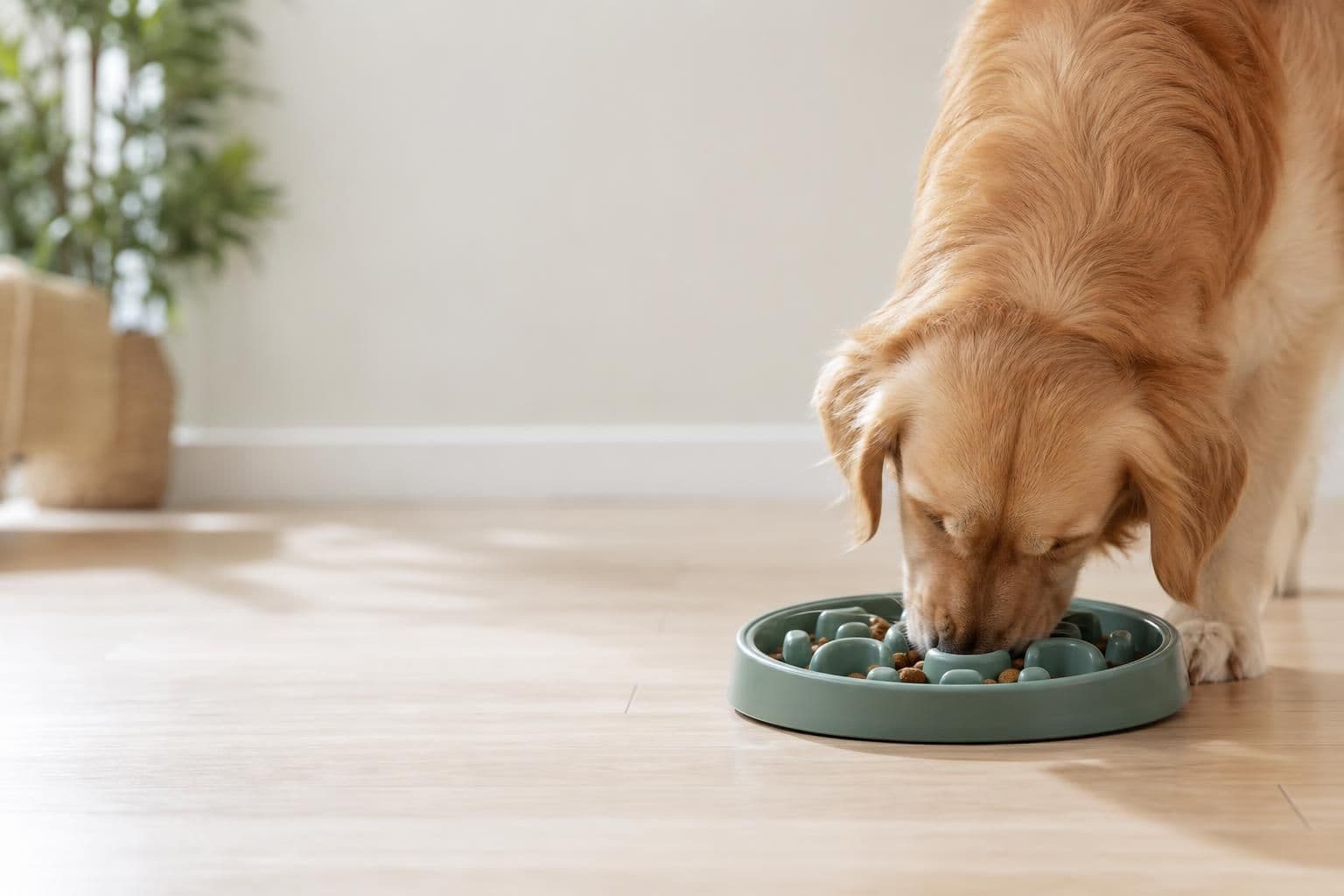
The best slow feeder bowl for dogs is one with a maze or ridge pattern deep enough to slow gulping without blocking access to food, made from food-safe, chew-resistant material, and sized to your dog's snout and typical meal portion. For most dogs, a textured interior that forces 8-10 minutes of eating (versus 1-2 minutes with a flat bowl) is enough to reduce gulping, bloating risk, and post-meal vomiting.
Key takeaways
- Choose a maze depth and pattern that matches your dog's snout shape — flat-faced breeds need shallower, wider channels.
- Stainless steel or food-grade silicone hold up better than thin plastic, which can crack under determined chewing.
- Match bowl capacity to your dog's actual meal size; an oversized maze bowl can still let a fast eater plow through in minutes.
Why Slow Feeder Bowls Matter
Dogs that eat too quickly swallow excess air along with their food, which can contribute to bloating, gas, and occasional regurgitation shortly after meals. The American Kennel Club notes that large, deep-chested breeds are at higher risk for gastric dilatation-volvulus (bloat), a serious condition where slowing down mealtime is one of several risk-reduction strategies vets recommend. A slow feeder bowl works by adding physical obstacles — ridges, mazes, or raised islands — that force your dog to eat around them rather than in one continuous gulp.
This isn't just a comfort issue. Rapid eating followed by immediate activity is one of the commonly cited risk factors for bloat, according to veterinary guidance from the Cornell University College of Veterinary Medicine. A slow feeder bowl addresses the eating-speed half of that equation directly.
What to Look for in a Slow Feeder Bowl
Not all maze patterns are created equal, and the wrong one can frustrate a dog rather than help them.
- Maze depth: Deeper channels (roughly ¾ inch or more) slow down determined eaters better than shallow grooves, which fast eaters learn to lick around within days.
- Pattern complexity: Spiral or zigzag patterns tend to outlast simple raised dots, since dogs adapt to repetitive obstacles quickly.
- Material: Stainless steel resists scratching and bacteria buildup better than plastic; food-grade silicone is a middle ground that's dishwasher-safe and less prone to tipping thanks to a heavier, non-slip base.
- Size relative to snout: A narrow-snouted dog (like a Collie or Greyhound) needs different spacing than a flat-faced breed (like a Pug or Bulldog), who may struggle to reach food in tight channels.
- Non-slip base: Rubber feet or a wide, low profile prevent the bowl from sliding across the floor mid-meal, which can turn eating into a chase rather than a slow-down exercise.
Slow Feeder vs. Regular Bowl vs. Puzzle Feeder
| Feature | Regular Bowl | Slow Feeder Bowl | Interactive Puzzle Feeder |
|---|---|---|---|
| Typical eating time | 1-2 minutes | 8-10+ minutes | 10-20+ minutes |
| Mental stimulation | None | Minimal | High |
| Best for | Normal-paced eaters | Fast gulpers, bloat-prone breeds | Bored or under-stimulated dogs |
| Cleaning ease | Very easy | Moderate (grooves need scrubbing) | Often requires disassembly |
| Portability | High | High | Lower (bulkier designs) |
If your dog eats fine at a normal pace but seems understimulated at mealtime, a puzzle-style feeder may serve you better than a simple maze bowl — the two solve different problems.
Sizing and Portion Considerations
A slow feeder only works if it matches your dog's actual meal size. If a bowl's maze is too shallow for the volume of kibble it holds, food pools on top of the ridges and your dog can still eat quickly. As a general guide:
- Small breeds (under 20 lbs) typically do well with bowls holding 1-2 cups per fill.
- Medium breeds (20-50 lbs) often need 2-3 cup capacity with moderate maze depth.
- Large breeds (50+ lbs) usually need wider bowls with deeper, more complex mazes to actually slow a big mouth down.
Ziva Paws' feeding collection includes slow feeder bowls alongside stainless steel and automatic dispenser options, so you can match bowl style to your dog's size and eating habits rather than guessing from a generic label. Sizing frustration isn't limited to feeding gear, either — the same guesswork shows up in pet clothing sizing, which is why measuring your dog directly, rather than trusting a vague size label, tends to produce better results across categories.
Introducing a Slow Feeder Without Stressing Your Dog
Switching bowls abruptly can confuse or frustrate a dog who's used to fast, easy access to food.
- Start with the same meal amount your dog already eats, just in the new bowl.
- Choose the shallowest maze pattern first if your dog seems confused or gives up, then increase difficulty gradually.
- Watch the first few meals — if your dog is pawing at the bowl or losing interest before finishing, the maze may be too complex for their current skill level.
- Keep water nearby, since slower eating can make some dogs thirstier mid-meal.
Our resident cats, Ai and Dudu, aren't the intended audience for dog-sized feeders, but the same principle applies across species when Ziva Paws tests feeding gear: a texture or obstacle that's too aggressive gets abandoned within a meal or two, while a moderate one gets used consistently. That pattern is a useful gut-check when picking maze complexity for your own dog.
Cleaning and Maintenance
Maze bowls trap food residue in their grooves more than flat bowls do, so a rinse alone often isn't enough. Stainless steel and silicone versions typically tolerate dishwasher cycles, while textured plastic bowls may need a bottle brush to reach into narrow channels. Letting food residue sit in ridges for multiple meals can encourage bacterial buildup, so a daily wash — not just a weekly one — is worth the extra minute.
When a Slow Feeder Isn't Enough
If your dog still gulps food within a minute or two despite a well-matched maze bowl, or shows signs of distress like retching, a visibly bloated abdomen, or repeated unproductive vomiting after meals, that warrants a call to your veterinarian rather than a different bowl. Slow feeders reduce risk; they don't eliminate the need for veterinary attention when something looks genuinely wrong. Dogs prone to anxious mealtime behavior sometimes also benefit from a calmer eating environment overall, which is a theme that overlaps with creating a low-stress space for anxious dogs at rest, not just at feeding time.
Frequently Asked Questions
Q: How much slower does a slow feeder bowl actually make mealtime?
A well-matched maze bowl typically stretches a 1-2 minute meal to 8-10 minutes or more, depending on maze depth and your dog's persistence. Flat-faced breeds and very determined eaters may need a deeper or more complex pattern to see a meaningful difference.
Q: Are slow feeder bowls safe for puppies?
Yes, as long as the maze pattern and bowl size match the puppy's current snout size and meal portion — an oversized adult bowl can be frustrating rather than helpful for a small puppy. Check with your vet if your puppy is a breed prone to bloat, since early slow-eating habits can be beneficial long-term.
Q: Can I put a slow feeder bowl in the dishwasher?
Most stainless steel and food-grade silicone slow feeder bowls are dishwasher-safe, but check the manufacturer's care instructions since some textured plastics warp under high heat. If dishwasher-safe, run it daily rather than letting food residue sit in the grooves.
Q: Will a slow feeder bowl stop my dog from vomiting after meals?
It often helps by reducing the air swallowed during rapid eating, but it isn't a guaranteed fix. If vomiting continues or worsens after switching bowls, that's a sign to talk to your veterinarian rather than trying a different feeder.
Q: What's the difference between a slow feeder bowl and a puzzle feeder?
A slow feeder bowl uses fixed ridges or mazes purely to slow eating speed, while a puzzle feeder adds mental challenge — hidden compartments, sliding pieces, or multi-step access — for dogs that need enrichment as much as pacing.