Best Pet Feeding Station for Multiple Pets: A Buyer's Guide
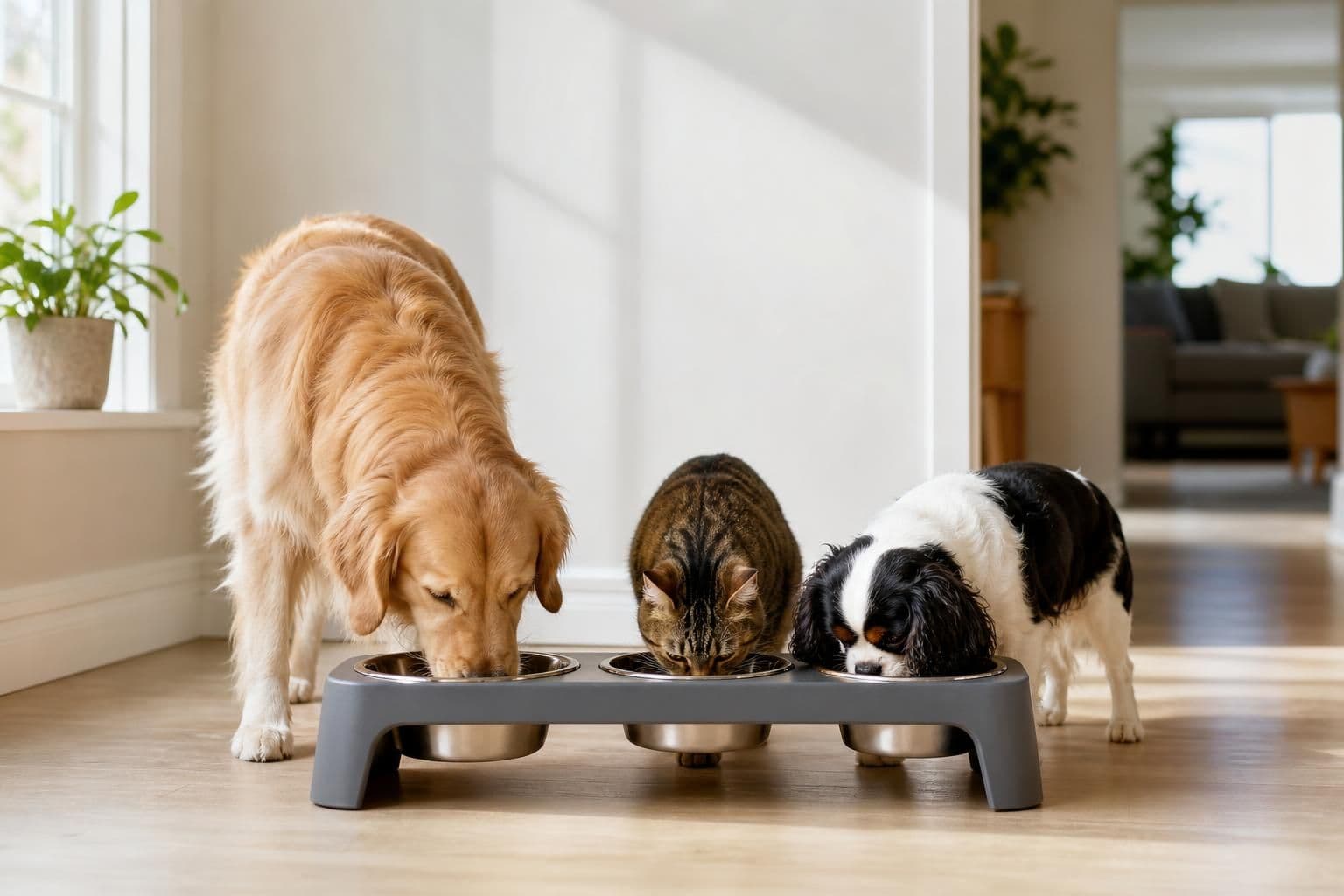
Key takeaway
The best pet feeding station for multiple pets separates each animal's bowls with enough physical distance or microchip/RFID recognition to stop food stealing, uses non-tip bases and slow-feed designs to control eating speed, and matches bowl height to each pet's size so no one has to compete at the same level. For most households with two or three pets of different sizes or appetites, a multi-bowl stand paired with a separate automatic feeder for the faster or food-motivated eater works better than one shared unit.
Key takeaways
- Give each pet at least 3 feet of separation, or a visual barrier, to reduce resource guarding during meals.
- Match bowl height and depth to each pet's size — a flat-faced cat or a senior dog needs a shallower, lower dish than a standard adult dog.
- Microchip or RFID-locking feeders solve food stealing in multi-cat homes; simple raised stands solve speed-eating and posture problems.
Why Multi-Pet Households Need a Different Setup
Feeding two or more animals from bowls placed side by side almost always creates competition, even between pets that otherwise get along. The Cornell Feline Health Center notes that cats are solitary hunters by instinct and often prefer to eat alone, away from the sightline of other cats — which is why many multi-cat homes see one cat guarding food or eating too fast out of anxiety. Dogs show a milder but similar pattern: faster eaters will often push a slower housemate away from a shared bowl.
A feeding station designed for multiple pets addresses this with physical separation, feeding order control, or both. The goal isn't just tidiness — it's reducing the stress-related gulping that leads to vomiting, bloat risk in deep-chested dogs, and under-eating in more timid pets.
Types of Multi-Pet Feeding Stations Compared
| Station type | Best for | How it separates pets | Typical drawback |
|---|---|---|---|
| Raised multi-bowl stand | 2 pets, similar eating speed | Side-by-side bowls at matched height | No control over who eats what |
| Microchip/RFID automatic feeder | Cats on different diets | Locks lid until the registered pet's chip is detected | Higher upfront cost, needs batteries or power |
| Timed-release dispenser | Dogs on a schedule, free-fed cats | Opens only at set times, not by pet | Doesn't stop a faster pet from muscling in |
| Slow feeder bowl + separate stations | Fast eaters, bloat-prone breeds | Physical maze slows intake; separate placement stops competition | Needs more counter or floor space |
| Elevated single-pet stands in different rooms | Pets who guard food or are senior/arthritic | Full room separation | Requires supervision to confirm each pet finishes |
What to Look for Before You Buy
Start with how your pets actually behave at mealtime, not just their number. A household with one food-motivated dog and one grazer needs a different solution than two cats on prescription diets.
- Bowl material and depth. Stainless steel resists bacteria buildup better than plastic, which can harbor scratches that trap residue — a point the FDA raises in general pet food handling guidance. Flat-faced cats do better with wide, shallow dishes that don't press on their whiskers.
- Non-slip, non-tip base. A station that slides during an eager meal increases spills and can startle a nervous eater into guarding behavior.
- Portion control. If one pet needs less food for weight management, a timed or chip-locking feeder prevents them from finishing a housemate's portion.
- Easy-clean parts. Look for dishwasher-safe inserts; feeding stations get dirty fast with two or more pets using them daily.
When Ai and Dudu, the two resident cats who test products for Ziva Paws, were switched from a shared bowl to separated stations, the faster eater stopped finishing her food in under a minute and started pacing herself — a change that's common once pets no longer feel they're racing for access. The feeding collection includes automatic dispensers and slow feeder bowls sized for exactly this kind of household adjustment.
Sizing and Placement for Each Pet
Sizing mistakes are one of the most common reasons a multi-pet feeding station gets abandoned within a few weeks. A bowl that's too deep for a short-muzzled cat or too shallow for a large dog leads to food pushed onto the floor, which then gets eaten by whichever pet gets there first — defeating the purpose of separation entirely.
Measure each pet's shoulder height to choose elevated stand height, and measure muzzle width to choose bowl diameter. As a general placement rule, keep stations at least 3 feet apart or around a visual corner, and give cats the option of a station on a different level (such as a counter or shelf) if there's any tension with a dog or another cat in the home. If sizing feels like guesswork, it helps to apply the same inch-based approach used for pet clothing — measuring the actual animal rather than relying on a generic small/medium/large label — since feeding equipment dimensions vary just as much between brands.
Preventing Food Stealing Without Constant Supervision
For households where one pet is persistently food-motivated, hardware does more than training alone. Options that work well together:
- Place the slower or more anxious eater's station in a separate room or on a raised surface the other pet can't reach.
- Use a microchip-locking feeder for the pet on a restricted diet so the lid only opens for them.
- Feed on a fixed schedule rather than free-feeding, so no food is left out to compete over between meals.
- Add a slow-feeder insert for the fast eater to slow consumption to match the other pet's pace.
Ongoing tension between cats at mealtime can also be a sign of broader resource guarding rather than just hunger — if hissing or swatting shows up near the feeding area specifically, it's worth reading about why cats hiss at other cats to rule out a deeper territorial issue before assuming it's only about food.
Keeping Water Access Separate Too
Multi-pet households often fix food competition but overlook water, which causes the same guarding behavior. The American Veterinary Medical Association recommends at least one water source per pet plus one extra, placed in different locations, as a general guideline for multi-pet homes — the same logic that applies to feeding stations applies to hydration. For dogs that travel between rooms or go on errands with their owner, a portable option like the kind covered in this guide to travel water bottles for dogs keeps water access consistent away from the shared household station.
Frequently Asked Questions
Q: What's the best feeding station for cats who steal each other's food?
A microchip or RFID-locking automatic feeder is the most reliable fix, since it only opens for the registered cat's chip. Pairing it with physical separation — different rooms or raised surfaces — reinforces the boundary further.
Q: How far apart should feeding stations be for multiple dogs?
Aim for at least 3 feet of separation or a visual barrier like a wall corner between stations. Dogs that already show tension around food may need full separation into different rooms during meals.
Q: Do slow feeder bowls work in a multi-pet household?
Yes — slow feeder bowls reduce gulping in fast eaters, which lowers competition-driven speed eating when another pet is nearby. They work best combined with separated placement rather than as a stand-alone fix for guarding.
Q: Is an automatic feeder worth it for just two pets?
It's most worth it when the two pets are on different diets, different schedules, or one needs portion control. For two pets with similar needs and no food tension, a simple multi-bowl stand is often enough.
Q: Can I use one large bowl for two pets to save space?
It's not recommended, even for pets that get along well, since shared bowls increase competitive eating and make portion control impossible. Two separate dishes, even placed close together, give each pet a clear sense of their own food.