Why Does My Cat Hiss at Other Cats?
Key takeaway
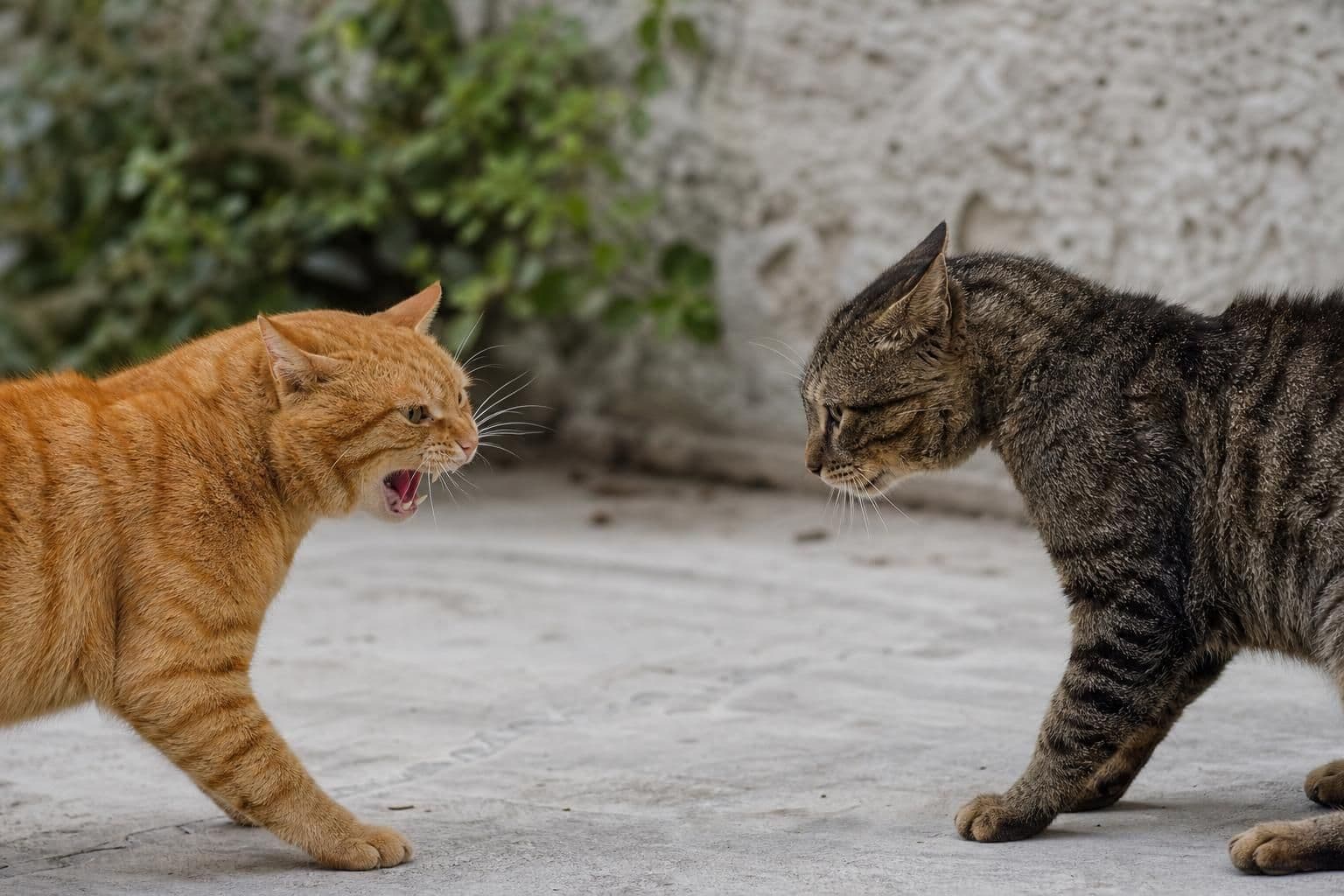
A cat hisses at other cats mainly as a defensive warning, not an act of aggression. It's an involuntary response triggered by fear, perceived territorial intrusion, unfamiliar scent, or sometimes pain, and it's meant to say "back off" before a fight becomes necessary. Hissing is a normal part of cat communication and doesn't automatically mean two cats can't eventually get along.
Key takeaways
- Hissing is defensive, not predatory — it signals fear or a need for space, not a desire to attack.
- New scents, sudden proximity, or a crowded resource (litter box, food, perch) are the most common triggers.
- Slow, scent-first reintroductions resolve most hissing between housemates within one to a few weeks.
What Hissing Actually Means
Hissing is a fixed action pattern — cats produce it reflexively when they feel cornered or threatened, regardless of whether the threat is real. The sound mimics a snake's hiss, which researchers believe evolved because it startles predators and rivals alike, buying the cat time to retreat. A hiss is almost always paired with other defensive body language: flattened ears, an arched back, piloerection (raised fur), and a low or tucked tail.
Unlike a growl or yowl that often escalates toward conflict, a hiss is frequently the cat's attempt to avoid one. According to the ASPCA, cats rely heavily on body posture and vocal signals to establish distance before physical confrontation, and hissing is one of the clearest "stay away" signals in their repertoire.
Common Triggers Between Cats
Unfamiliar Scent or New Introductions
Cats are highly scent-oriented, and a cat returning from the vet, groomer, or even another room can smell "wrong" to a housemate. This is a leading cause of sudden hissing between cats that previously got along, and it usually fades once the scent is reabsorbed into the group through mutual grooming and rubbing on shared objects.
Territory and Resource Guarding
Hissing often spikes when cats must share limited resources — one litter box for multiple cats, a single food bowl, or one favorite window perch. Veterinary behaviorists commonly recommend one litter box per cat plus one extra, a guideline cited by the Cornell Feline Health Center, because inadequate resources are a well-documented driver of inter-cat tension.
Fear or Past Negative Experience
A cat that was previously attacked, startled, or cornered by another cat may hiss preemptively at any cat that resembles the aggressor in size, color, or movement. This learned wariness can persist for months and doesn't always fade with simple reintroduction.
Pain or Illness
Sometimes the trigger isn't the other cat at all. A cat in pain — from arthritis, a dental problem, or an injury — may hiss when touched, approached quickly, or jostled, because contact increases discomfort. If hissing appears suddenly in a cat with no history of it, a vet check to rule out a medical cause is worth doing before assuming it's purely behavioral. If you're also noticing a drop in appetite alongside new irritability, it may help to read about reasons a cat stops eating to see whether the two are connected.
Redirected Aggression
A cat that's agitated by something it can't reach — a bird outside, a strange sound, another animal seen through a window — may hiss or even swat at the nearest cat simply because it's close by. This "redirected" hissing can look confusing because the real trigger has nothing to do with the cat on the receiving end.
How to Read the Body Language
Hissing rarely occurs alone. Watching the surrounding posture tells you how serious the warning is:
- Mild warning: ears slightly back, tail low but still, body relaxed otherwise.
- Escalating fear: flattened ears, arched back, puffed tail, stiff legs.
- High alert: crouched or sideways stance, dilated pupils, growling mixed with hissing.
- Pain-related: hissing paired with flinching, reluctance to be touched in a specific spot, or a hunched posture.
If body language escalates past a simple hiss into swatting or chasing, it's time to separate the cats rather than let them "work it out."
Helping Cats Coexist
Most inter-cat hissing in a household settles down with a slower, more structured introduction process rather than letting cats confront each other directly. A few practical steps:
- Separate the cats into different rooms initially, each with its own litter box, food, and water.
- Swap bedding or towels between the cats so they get used to each other's scent before meeting face to face.
- Allow supervised, brief visual contact (a cracked door or baby gate) before full access.
- Add enough resources — bowls, boxes, perches, and resting spots — so cats don't have to compete.
- Give each cat its own retreat space, such as a covered bed or elevated perch, so a hissing cat always has somewhere to de-escalate.
A cozy, enclosed resting spot matters more than people expect during this process — a nervous cat that can't find a safe place to retreat is far more likely to stay defensive. Ai and Dudu, the two cats who test products for Ziva Paws, tend to reach for an enclosed hideaway bed over an open cushion whenever a new scent or visitor puts them on edge, which is a useful cue for picking a bed shape if you're dealing with a skittish cat. Browsing the cat beds and hideaway furniture selection with that in mind can help you choose a shape that actually gets used, rather than ignored.
When Hissing Signals Something Else
Occasional hissing during a food dispute or startled moment is normal cat behavior and not a cause for concern. But persistent hissing that doesn't improve after several weeks of structured introduction, or hissing that's new and paired with other changes — hiding, reduced appetite, or vocalizing more at night — deserves a closer look. If nighttime vocalizing is also part of the picture, understanding why cats meow at night can help separate normal attention-seeking from something that needs a vet visit. Chronic stress between cats can also contribute to other issues, including litter box avoidance and overgrooming, so addressing the root tension sooner rather than later tends to pay off.
Frequently Asked Questions
Q: Is hissing a sign my cats will never get along?
No. Hissing is a normal part of cats negotiating space and is common even between cats that eventually become comfortable housemates. What matters more is whether the hissing decreases over time with proper introductions.
Q: Should I punish a cat for hissing?
No. Hissing is a warning, not misbehavior, and punishing it can make a cat feel it has no way to signal discomfort short of biting or scratching. It's better to remove the trigger and give the cat space.
Q: Why does my cat suddenly hiss at a cat it used to like?
This is often caused by a change in scent — for example, after a vet visit — or a new source of stress like a schedule change or new pet in the home. It usually resolves once the scent normalizes or the stressor is addressed.
Q: Can two cats share one litter box if they hiss at each other?
It's better to avoid it. Resource competition, including shared litter boxes, is a known trigger for inter-cat tension, so providing separate boxes often reduces hissing on its own.
Q: When should I take a hissing cat to the vet?
If hissing appears suddenly with no clear trigger, especially alongside flinching when touched, reduced appetite, or hiding, it's worth ruling out pain or illness as the underlying cause.