How to Organize Bathroom Drawers That Actually Stay Tidy
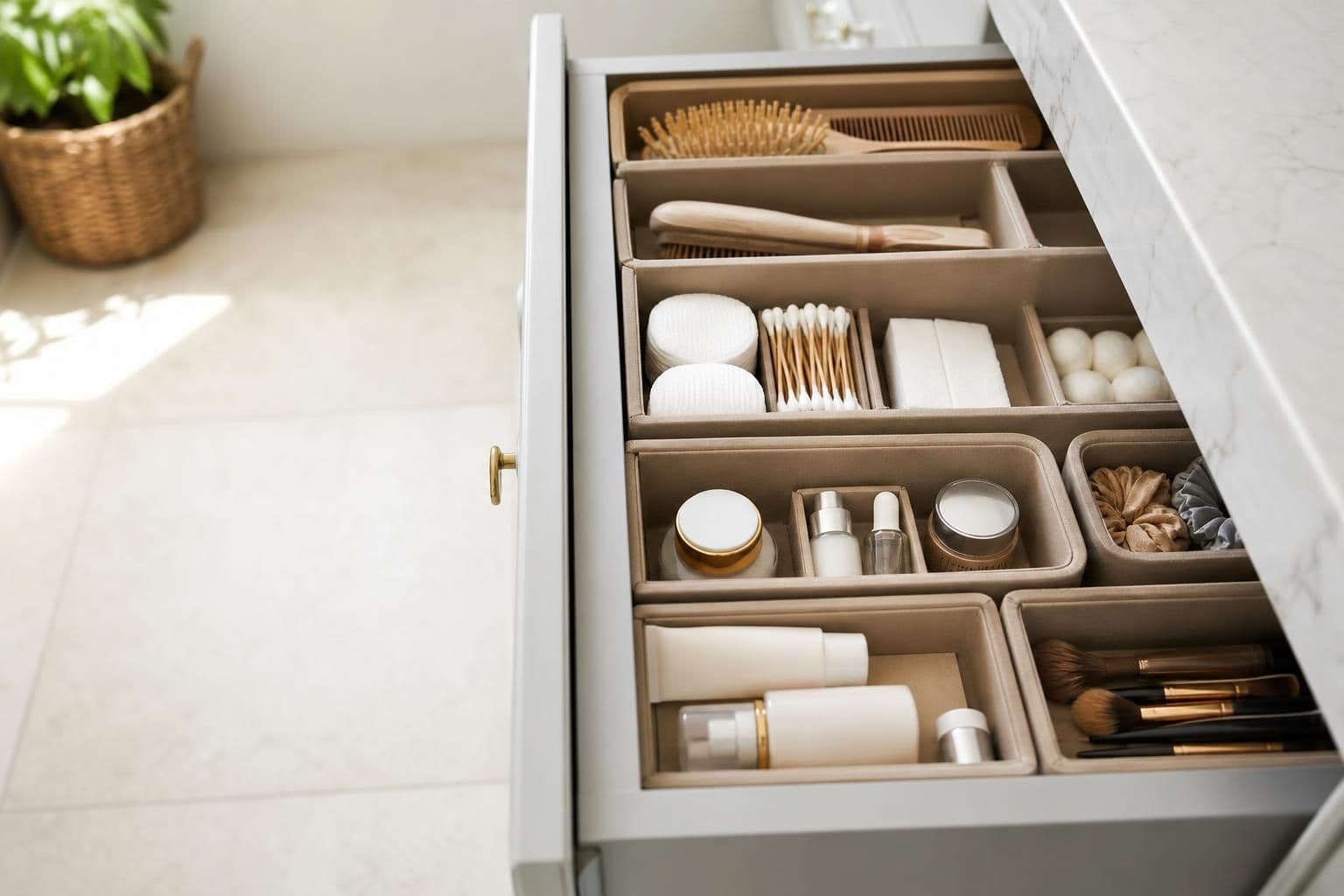
Key takeaway
To organize bathroom drawers, pull everything out, sort it into categories (skincare, hair tools, medicine, dental), toss expired or duplicate items, then return only what you use regularly using small dividers or bins to keep each category contained. The drawers that stay tidy are the ones where every item has one assigned spot, not just a general area.
Key takeaways
- Empty and sort before you buy any organizers — containers solve a sorting problem, they don't create one.
- Group by category and frequency of use, with daily items in the front of the drawer and occasional-use items toward the back.
- Check expiration dates on medications and sunscreen at least twice a year; the FDA notes that expired products can lose potency or become unsafe to use (FDA).
Start by Emptying the Drawer Completely
It's tempting to shuffle things around in place, but that just rearranges the clutter instead of solving it. Take everything out and lay it on a towel or counter where you can see it all at once. This step alone usually reveals duplicates — three half-used tubes of the same lotion, or four nail clippers — that have been quietly taking up space.
While the drawer is empty, wipe it down. Bathroom drawers collect dust, hair, and product residue faster than most people expect, especially drawers near the sink.
Sort Everything Into Categories
Once everything is out, group it into simple categories rather than trying to organize item by item. Common bathroom categories include:
- Skincare and daily grooming (moisturizer, razors, tweezers)
- Hair tools and accessories (brushes, ties, small styling tools)
- Oral care (floss, extra toothbrushes, whitening strips)
- Medicine and first aid (pain relievers, bandages, thermometers)
- Nail care (clippers, files, polish)
This sorting method mirrors the same logic used for organizing kitchen tools without a renovation — group by purpose first, then figure out containment second. Trying to buy bins before you know your categories almost always leads to mismatched sizes.
Contain Each Category So Items Stop Drifting
Loose items in a drawer migrate the moment the drawer opens and closes a few times. Small dividers, trays, or even repurposed boxes keep each category in its own lane. A few practical approaches:
- Use shallow trays for flat items like compacts, razors, and floss boxes.
- Use small upright bins for taller items like lotion bottles or spray cans.
- Reserve the front third of the drawer for items used daily, and the back for backups and occasional-use products.
If your bathroom also doubles as a charging spot for electric toothbrushes or styling tools, keeping cords from tangling in with everything else is its own small project — the same approach used in keeping cables neat at home works just as well for a hair dryer cord or a trimmer charger.
Store Medications and Sharp Items Safely
Bathroom drawers are a common place to store over-the-counter medication, but they're not always the safest one. Heat and humidity from showers can degrade some medications faster than storage in a cooler, dry cabinet. The Centers for Disease Control and Prevention recommends keeping all medications, especially those accessible to children, in a location that's both dry and out of easy reach (CDC). If a bathroom drawer is your only storage option, use a small lidded box inside the drawer to separate medicine from everyday grooming items, and keep anything sharp — razors, nail scissors, tweezers — capped or sheathed.
Maintain the System Weekly, Not Monthly
Organizing a drawer once is easy; keeping it organized is the part most people skip. A two-minute weekly reset — putting stray items back in their assigned spot and tossing empty containers — prevents the slow drift back into clutter. This is the same low-effort maintenance habit that works for keeping a small home office organized on a budget: small, frequent resets beat big occasional overhauls.
If you share a bathroom, it helps to assign each person a drawer or a clearly defined section rather than one shared catch-all. According to the National Association of Productivity and Organizing Professionals, shared storage spaces stay tidier longer when each person has ownership over a defined zone rather than a communal one (NAPO).
When a Drawer Isn't Enough
Sometimes the real issue isn't organization — it's volume. If you've sorted, grouped, and contained everything and the drawer still won't close, you likely have more products than the space can hold, and it may be worth moving overflow items (extra towels, backup toiletries) to a nearby cabinet or shelf instead of forcing them into the same drawer.
Frequently Asked Questions
Q: What's the best way to organize a small bathroom drawer with limited space?
Sort items into categories first, then use shallow trays or small dividers so each category stays in its own section. Keep only daily-use items in the drawer and move backups or bulk items to a separate cabinet.
Q: How often should I clean out my bathroom drawers?
A quick weekly reset keeps clutter from building up, while a full sort-and-purge every few months helps you catch expired products like sunscreen or medication before they build up unnoticed.
Q: Should medication be stored in a bathroom drawer?
It can be, but bathrooms tend to be more humid and warmer than ideal storage conditions. If you do store medication there, use a sealed container inside the drawer and keep it away from children's reach, per CDC storage guidance.
Q: What should I use to divide a bathroom drawer without buying expensive organizers?
Small boxes, repurposed jewelry trays, or even cut-down cereal boxes work fine as makeshift dividers. The goal is separation by category, not a particular material or brand.
Q: How do I stop a shared bathroom drawer from getting messy again?
Assign each household member their own drawer or clearly defined section rather than one shared space. People are far more likely to put things back when they know exactly where their items belong.