What Is Quartz Made Of? A Guide to Engineered Stone
Key takeaway
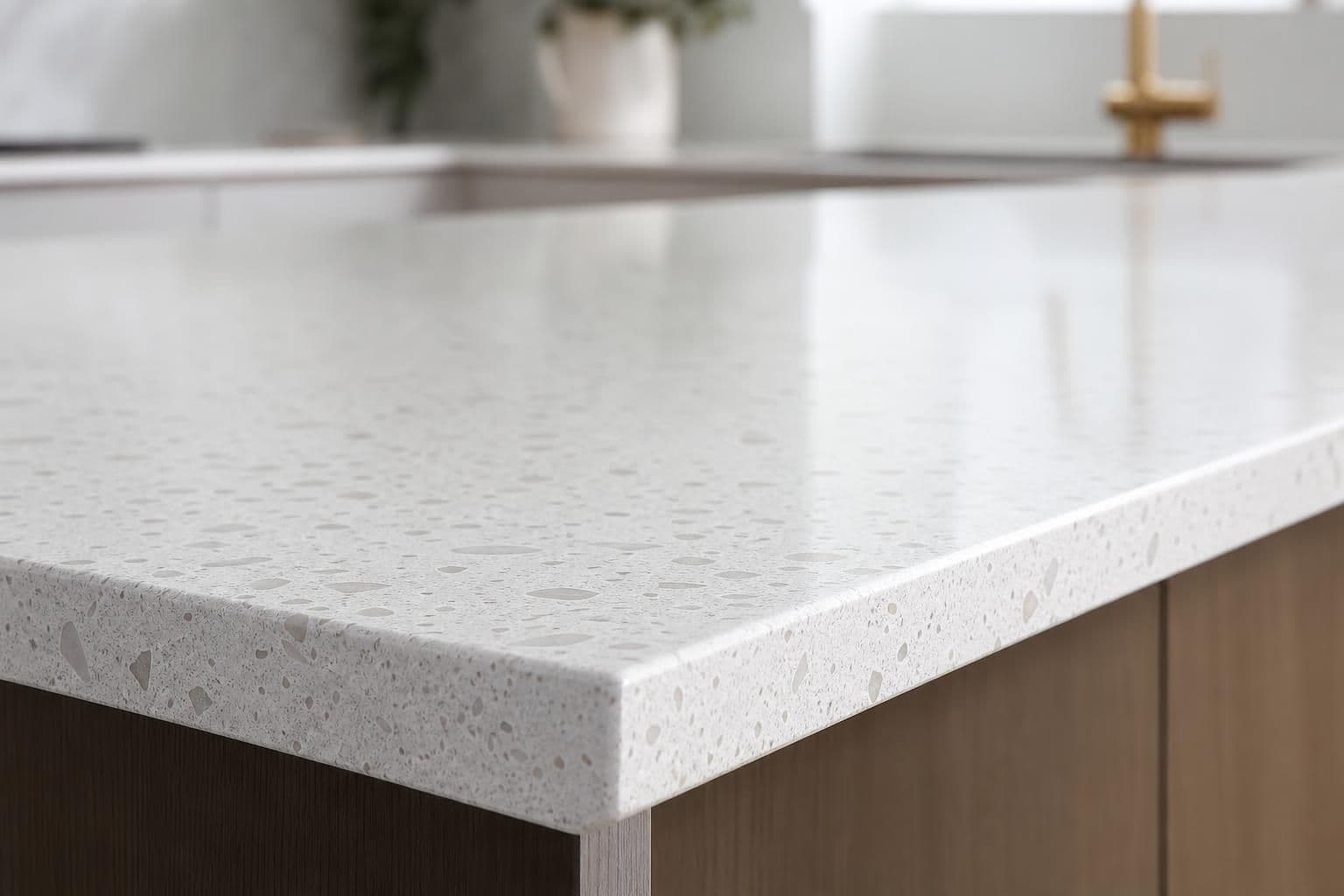
Quartz countertops are made from roughly 90-93% ground natural quartz mineral combined with 7-10% polyester resins, pigments, and sometimes recycled glass or mirror flecks, then compressed and cured into hard slabs. Unlike granite or marble, which are cut straight from stone quarried in one piece, quartz is an engineered product — a manufactured composite designed to mimic natural stone while offering more consistent color and less porosity. That blend of crushed mineral and resin is what makes quartz nonporous, stain-resistant, and a popular choice for kitchens and bathrooms in humid, salt-air climates like Oahu's.
Key takeaways
- Quartz countertops are roughly 90% crushed natural quartz mineral bound with about 7-10% polymer resin and pigment — not a solid slab of pure quartz stone.
- The resin binder is what makes quartz nonporous and low-maintenance, unlike granite, which needs periodic sealing to resist moisture.
- Because it's manufactured rather than quarried, quartz comes in far more consistent colors and patterns than natural stone, which matters for matching cabinets and lighting in island homes.
The raw materials that go into a quartz slab
Quartz countertops start with quartz mineral, one of the most abundant minerals on Earth's crust, according to the U.S. Geological Survey. Manufacturers crush and grade this quartz into fine particles, then mix it with:
- Polyester or polymer resin (roughly 7-10% of the mix), which acts as the binder holding everything together
- Pigments that create the base color, from bright whites to deep charcoals
- Reinforcing additives like recycled glass, mirror chips, or metallic flecks for texture and visual movement
- Trace fillers that help control density and finish
This mixture is poured into molds and compacted under intense vacuum pressure and vibration — a process most manufacturers call vibrocompaction — which removes air pockets and produces a dense, uniform slab. The slab is then cured in heat, cut to size, and polished or honed to the final finish.
Why the resin content matters for humidity and daily use
The polymer resin is the real difference-maker compared to natural stone. Because resin fills in the microscopic gaps between mineral particles, a finished quartz slab has almost no open pores for water, oil, or bacteria to soak into. That's a meaningful advantage in a climate where humidity sits high most of the year and countertops in kitchens and bathrooms deal with condensation, cooking spills, and salt air tracked in from the beach.
Granite, by contrast, is a natural stone with real pores that can absorb moisture and staining agents over time, which is why granite counters typically need resealing on a regular schedule — something covered in more detail in how to seal granite countertops in humid conditions. Quartz skips that maintenance step almost entirely because the resin already does the sealing job at the factory.
How manufacturing affects color, pattern, and durability
Because quartz is engineered rather than cut from a single quarried block, manufacturers can control color and veining with far more precision than nature allows. That's how you get large-format slabs with a uniform white background and consistent gray veining, or bold designs with metallic flecks that would never occur in a natural stone deposit. It also means two slabs from the same product line will look nearly identical, which matters when a condo owner wants matching countertops across a kitchen island and a wet bar, or when covering waterfall-edge quartz countertop islands that require perfectly matched panels wrapping around a single edge.
On the durability side, the resin binder gives quartz a Mohs hardness generally cited in the 6-7 range by fabricators and industry groups, close to natural granite, which is why quartz resists everyday scratching from knives and cookware. It isn't scratch-proof, though — heavy-duty tools or grit can still mark the surface, and homeowners dealing with a mark can find practical fixes in how to remove scratches from quartz countertops.
Quartz vs. other engineered and natural surfaces
It helps to see where quartz sits relative to the other materials homeowners compare it to:
- Granite — 100% natural stone, porous, needs periodic sealing, unique veining in every slab
- Marble — natural stone, softer and more porous than granite, prone to etching from acidic foods
- Solid surface (like Corian) — fully synthetic acrylic or polyester, no natural mineral content, can be more easily scratched or burned
- Quartz — engineered composite of natural mineral plus resin, nonporous, consistent patterning, resistant to most kitchen stains
This hybrid nature — mostly natural material, bound by a synthetic resin — is why quartz is often marketed as combining the best traits of stone and manufactured surfaces rather than being purely one or the other.
Fabrication and safety considerations
Cutting and polishing quartz slabs generates fine silica dust, and the Occupational Safety and Health Administration has published specific workplace standards for controlling crystalline silica exposure during stone fabrication, since prolonged inhalation of silica dust is a recognized respiratory hazard for workers who cut the material. This is one reason slab cutting, edge profiling, and sink cutouts are handled by professional fabricators with proper dust control and ventilation rather than as a DIY job — the health risk applies during cutting and polishing, not to a finished, sealed countertop sitting in a kitchen.
What this means for choosing quartz in a Hawaii home
Understanding the material composition explains why quartz performs the way it does on Oahu specifically. The nonporous resin-bound surface resists the mold and mildew growth that thrives in humid bathrooms, and it doesn't require the periodic sealing that natural stone does in a marine climate. For a closer look at how that durability holds up over the years in island conditions — including exposure to sun through lanai doors and daily humidity swings — see how long quartz countertops actually last in Hawaii homes. Day-to-day upkeep is also simpler than natural stone, since routine cleaning quartz countertops in Hawaii's humidity mostly comes down to mild soap and water rather than stone-specific sealers or cleaners.
Frequently Asked Questions
Q: Is quartz a natural or man-made material?
Quartz countertops are engineered, not natural. They're made from crushed natural quartz mineral combined with polyester resin, pigments, and sometimes glass or metallic flecks, then compressed and cured into slabs.
Q: What percentage of a quartz countertop is real quartz mineral?
Most manufacturers use roughly 90-93% ground natural quartz mineral, with the remaining 7-10% made up of polymer resin binder, pigments, and fillers.
Q: Does quartz contain any plastic or resin?
Yes. The polyester or polymer resin binder typically makes up about 7-10% of the slab and is what fuses the crushed quartz particles together into a solid, nonporous surface.
Q: Is quartz more durable than granite?
Quartz and granite have similar hardness, but quartz is nonporous thanks to its resin content, so it resists staining and doesn't require periodic sealing the way granite does. Granite can be more heat-tolerant in certain situations, but both are considered durable choices for kitchen and bathroom counters.
Q: Is cutting or polishing quartz dangerous?
Cutting and polishing quartz slabs releases fine crystalline silica dust, which workplace safety agencies recognize as a respiratory hazard for fabricators without proper ventilation and dust control. A finished, installed quartz countertop poses no such risk to homeowners.