Elevated Bowls for Cats: Pros and Cons Explained
Key takeaway
Elevated cat bowls can ease neck and joint strain, reduce whisker fatigue, and slow down fast eaters, but they aren't a universal fix — some cats do just as well at floor level, and a poorly chosen stand can wobble or trap food debris. The right choice depends on your cat's age, health, and how they naturally like to eat, not a blanket rule that "raised is always better."
Key takeaways
- Raised bowls mainly help cats with arthritis, mega esophagus, or a history of vomiting after meals — not every healthy cat needs one.
- Look for a stand height of roughly 3-5 inches for most adult cats, adjusted to shoulder height rather than a fixed number.
- Wide, shallow, non-tippy bowls reduce whisker stress more reliably than height alone.
What "elevated" actually means for a cat's posture
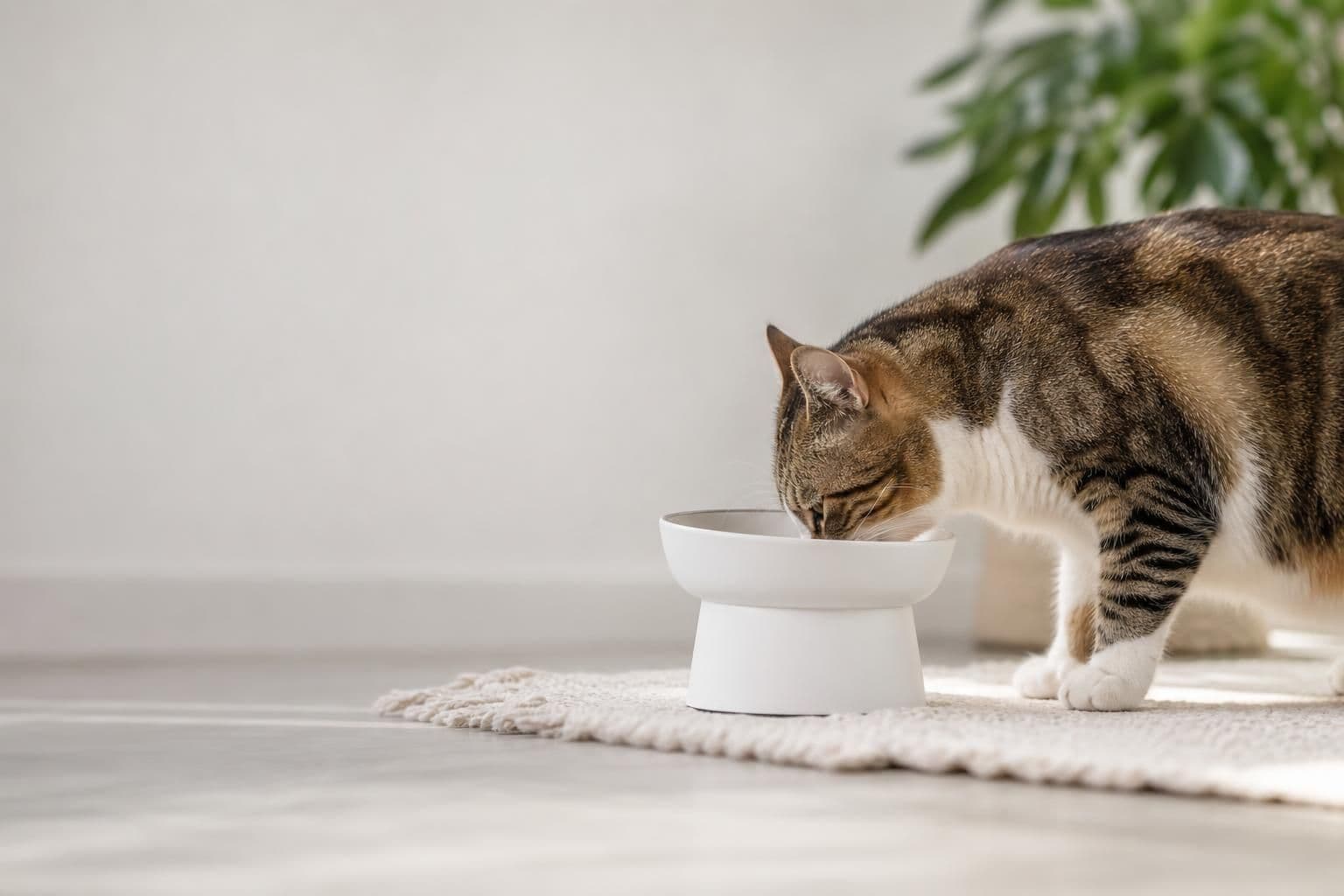
An elevated bowl raises the feeding surface off the floor so a cat doesn't have to lower its head and hunch its shoulders to eat. In a normal crouched position, a cat's neck bends downward and its front legs splay slightly to reach the floor; raising the bowl to roughly shoulder height lets the neck stay closer to a neutral line. This matters most for cats with spinal or joint conditions, since repeated neck flexion at every meal can aggravate existing discomfort over time.
The real benefits
- Less strain for older or arthritic cats. Cats with hip or spine arthritis often eat less because bending down is uncomfortable; a raised bowl can make mealtime less of a chore.
- Easier for cats recovering from injury or surgery. Vets sometimes recommend raised feeding temporarily after neck, jaw, or leg procedures to reduce awkward positioning.
- Potential help for megaesophagus. In cats with this specific swallowing disorder, gravity-assisted feeding at an elevated angle is sometimes advised by veterinarians as part of a broader management plan — but the angle and setup should come from a vet, not guesswork.
- Can reduce food and water spillage. A stable elevated bowl with a lip is less likely to slide across tile than a flat bowl a cat can nose around.
- May slow gulping in cats who eat too fast. Combined with a wider, shallower bowl shape, elevation can make it harder for a cat to shovel food quickly.
Our own cats, Ai and Dudu, are a good real-world contrast: Ai is an older, slightly stiffer cat who visibly settles into a raised bowl with less shifting and repositioning, while Dudu — younger and more flexible — eats just as comfortably from a bowl at floor height. That difference alone is a useful reminder that elevation solves a specific problem rather than being a universal upgrade.
The downsides worth knowing
- Wrong height can make things worse. A bowl set too high forces a cat to stretch its neck upward, which is just as unnatural as bending too far down.
- Not proven to prevent whisker fatigue on its own. Whisker stress comes mainly from bowl width, not height — a narrow, deep elevated bowl can still press on sensitive whiskers.
- Extra surfaces to clean. Stands and raised platforms add crevices where kibble dust and moisture collect, so they need more frequent wiping than a single flat bowl.
- Stability issues with lightweight stands. Cheap plastic stands can tip if a cat leans on the edge, which creates a mess and can scare a nervous cat off eating there again.
- Cost and counter space. A stand or platform is one more object to store, and in multi-cat homes you may need more than one.
Choosing the right height and shape
There's no single correct measurement, but a practical starting point is a stand that brings the bowl's rim to about the height of your cat's shoulder when standing normally — often in the 3 to 5 inch range for an average adult cat, less for kittens or very small breeds. Beyond height, prioritize:
- Wide, shallow bowls so whiskers don't touch the sides while eating.
- A non-slip base heavy or grippy enough that a determined cat can't tip it.
- Separate water placement away from food, since cats in the wild instinctively avoid drinking near a kill site — a behavior pattern still reflected in many cats' reluctance to drink next to their food bowl, as noted by feline behavior researchers at organizations like the ASPCA.
- Easy-clean materials like stainless steel or ceramic, which resist bacterial buildup better than scratched plastic, a point echoed in general pet hygiene guidance from the Centers for Disease Control and Prevention.
If your cat is young, flexible, and has no history of vomiting or joint pain, a standard low bowl is perfectly fine — elevation is a solution to a specific problem, not a default upgrade every cat needs.
When to just ask your vet first
Any cat that's vomiting regularly, eating less, or showing stiffness getting up and down should see a veterinarian before you experiment with feeding setups. Elevated bowls can be part of a management plan for conditions like megaesophagus or arthritis, but they're a supporting tool, not a substitute for diagnosis. The American Veterinary Medical Association recommends addressing sudden changes in eating posture or appetite with a vet visit rather than assuming it's purely a bowl issue.
For anyone setting up a full feeding station rather than a single bowl, it's worth looking at the same considerations that apply to bedding placement for anxious pets — a calm, low-traffic spot matters as much as the bowl itself, a theme covered in more depth in our guide to cozy bedding for anxious dogs, since food and rest areas both benefit from a quiet corner away from foot traffic. Ziva Paws' feeding collection includes both raised and standard bowl styles, so you can match the setup to your cat's actual needs rather than guessing.
Frequently Asked Questions
Q: Are elevated bowls better for all cats?
No. They mainly benefit cats with joint pain, certain swallowing disorders, or a tendency to spill food, while healthy, flexible cats often do fine with a standard low bowl.
Q: What height should a cat's elevated bowl be?
A common starting point is roughly 3 to 5 inches, aiming to bring the rim close to shoulder height rather than forcing the neck up or down; adjust based on your cat's size and comfort.
Q: Can an elevated bowl help with whisker fatigue?
Partly, but width matters more than height — a wide, shallow bowl reduces whisker contact regardless of whether it's raised.
Q: Do vets recommend raised bowls for megaesophagus?
Some do, as part of a broader gravity-assisted feeding plan, but the exact setup and angle should be confirmed with a veterinarian rather than chosen independently.
Q: How often should an elevated bowl stand be cleaned?
More often than a flat bowl, since the stand's crevices trap kibble dust and moisture; wiping it down every few days helps prevent bacterial buildup.