Raised Feeding Bowls for Large Breed Dogs: What to Know
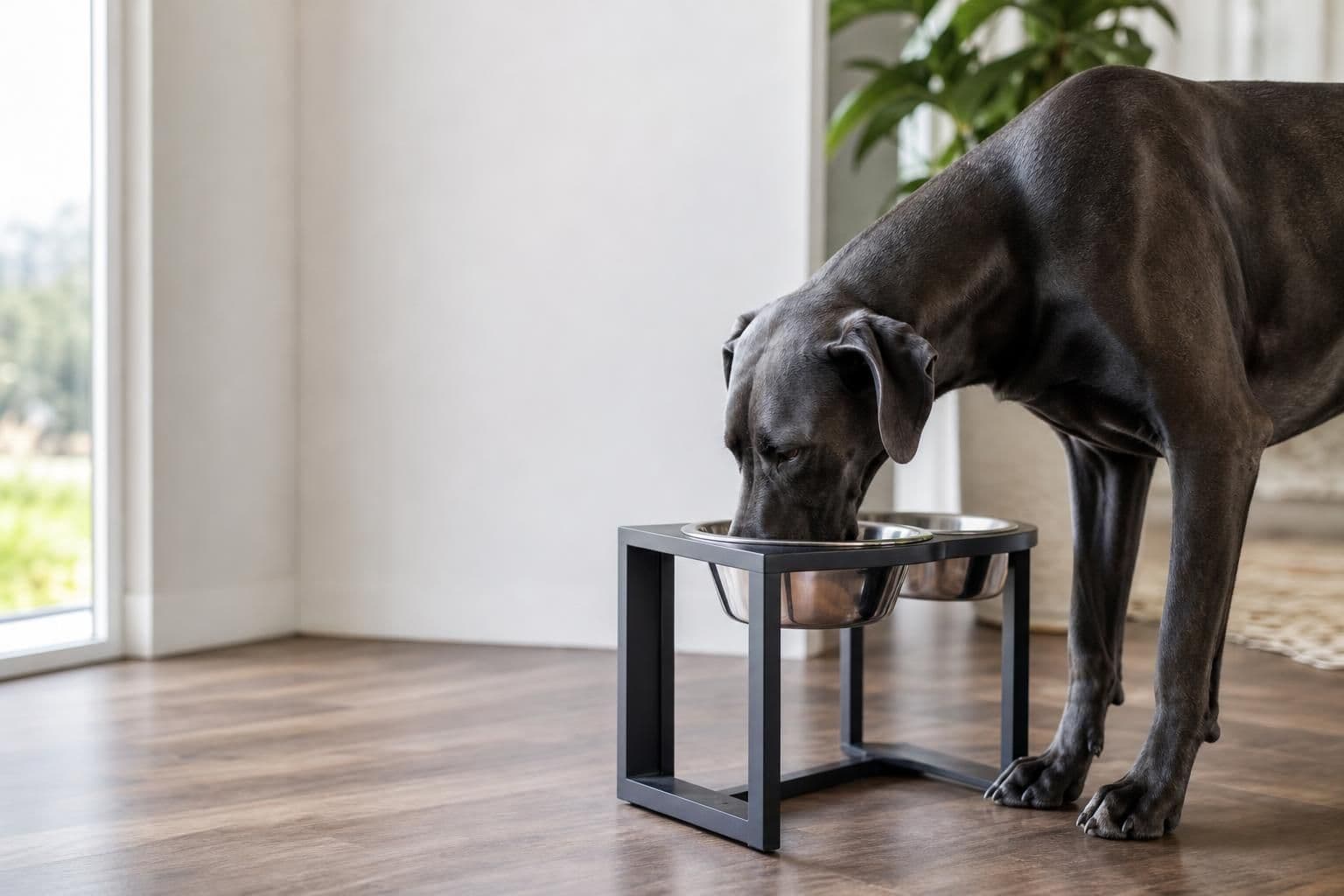
Key takeaway
Raised feeding bowls for large breed dogs should sit at a height where the dog's head and neck are roughly level or only slightly lowered while eating, not stretched downward or craned upward. For most large breeds this means a stand around 8 to 12 inches tall, though the right height depends on the dog's shoulder height and leg length rather than breed name alone. They're most useful for dogs with joint pain, neck or back issues, or megaesophagus, and less necessary for a healthy young dog who simply eats fast.
Key takeaways
- Measure your dog's elbow height while standing, not its breed average, to pick a bowl stand height.
- Raised bowls are a comfort and posture tool for arthritic or senior dogs — they are not a proven fix for bloat.
- Choose stainless steel or ceramic inserts over soft plastic to reduce chin acne and bacterial buildup.
What "raised" actually means for a large dog
A raised or elevated feeding bowl is simply a dish set into a stand so the dog doesn't have to lower its whole head to the floor. For large breeds — Labradors, German Shepherds, Great Danes, Mastiffs — that stand height typically ranges from about 4 inches for a dog with shorter legs relative to its body, up to 12-18 inches for giant breeds with very long legs and necks. The goal is a neutral neck position: imagine the dog standing normally and eating without hunching or reaching up.
The simplest way to find the right height is to measure from the floor to the top of your dog's shoulder (withers) while it's standing naturally, then subtract a few inches to account for the head dropping slightly during eating. A dog that's 24 inches at the shoulder generally does well with a stand in the 10-14 inch range, not a stand sized to its full height.
Who actually benefits from elevated bowls
Raised feeders aren't a universal upgrade — they solve specific problems:
- Arthritic or senior dogs: Bending to a floor bowl repeatedly stresses hips, shoulders, and the neck. A raised bowl reduces that repetitive strain during every meal.
- Dogs with megaesophagus or regurgitation issues: Gravity-assisted, more upright eating postures can help some dogs keep food down, though this should be guided by a veterinarian, not a product label.
- Large or giant breeds prone to neck and back strain: Dogs with long backs or heavy chests can feel awkward folding all the way to the ground for every bite.
- Dogs who eat near a resting area: Pairing a raised feeder with a dedicated feeding station setup keeps mealtime tidy in multi-pet households.
Healthy, young, structurally sound dogs generally don't need an elevated bowl — floor-level feeding is fine and in some cases preferred.
The bloat question, answered honestly
For years, raised bowls were recommended as a way to reduce gastric dilatation-volvulus (bloat, or GDV) in deep-chested large breeds. More recent veterinary research has actually pointed the other direction: some studies have found raised feeders associated with a higher risk of bloat in large and giant breeds, not a lower one, possibly because dogs swallow more air gulping from an elevated position. The American Kennel Club and veterinary sources now caution owners not to assume an elevated bowl is protective against bloat, especially in breeds already known to be at higher risk, such as Great Danes and Standard Poodles.
The practical takeaway: choose a raised bowl for comfort, posture, or a specific medical reason your vet has identified — not as a bloat-prevention strategy on its own. If your dog is a deep-chested breed and a fast eater, a slow feeder insert or puzzle-style feeding bowl addresses the gulping-air problem more directly than height does.
Materials and build quality that matter
Not all raised feeders are built the same, and the differences show up fast with a large, strong dog:
- Stand stability: A large dog pushing a bowl around the kitchen floor is annoying and can tip a lightweight stand. Look for a wide base or non-slip feet.
- Bowl material: Stainless steel and ceramic are easier to sanitize than soft plastic, which can develop micro-scratches that trap bacteria and sometimes trigger chin acne in short-haired dogs.
- Removable inserts: A stand with lift-out bowls is far easier to wash than a fixed, molded unit — food residue builds up fast with large-breed portion sizes.
- Adjustable height: Multi-level stands let you raise the bowl gradually as a dog ages or recovers from an injury, rather than buying a new stand every time its needs change.
Ai and Dudu, the two cats who test products before they're listed in Ziva Paws' feeding collection, are obviously not large dogs — but the same material logic applies across species: easy-to-clean inserts and a stable, non-tipping base matter regardless of who's eating.
Sizing bowls and stands correctly
Because "large breed" covers everything from a 50-pound Border Collie mix to a 150-pound Mastiff, a single height recommendation doesn't work. The most reliable approach:
- Measure shoulder height while the dog stands on a flat floor.
- Pick a stand roughly 2-4 inches shorter than that measurement as a starting point.
- Watch the dog eat for a few meals — if the neck is still angled sharply down or uncomfortably up, adjust.
- Reassess every year or two, since weight changes and joint stiffness shift what's comfortable over time.
This same inch-based thinking — measuring the actual animal instead of relying on a vague size label — is exactly why Ziva Paws lists its clothing collection in chest, neck, and back-length inches rather than generic S/M/L; fit problems with bowls and fit problems with coats come from the same root cause, a label that doesn't match the dog in front of you.
If you're also managing a multi-pet household where a big dog and a cat or small dog share a feeding area, a dedicated station with separate bowl heights avoids one pet crowding the other, as covered in this guide to multi-pet feeding setups.
A quick note on senior and recovering dogs
Dogs recovering from orthopedic surgery, managing arthritis, or wearing a protective collar often eat less comfortably from any bowl at the wrong height. If your dog is also dealing with the frustration of wearing a cone after surgery, a slightly raised, wide bowl can make it easier for the cone to clear the dish without knocking food everywhere — small adjustments like this reduce mealtime stress during recovery.
Frequently Asked Questions
Q: What height should a raised dog bowl be for a large breed?
Most large dogs do well with a stand around 8 to 12 inches tall, but the right height depends on the individual dog's shoulder height, not its breed category — measure the dog rather than guessing from breed averages.
Q: Do raised bowls prevent bloat in large dogs?
No. Some veterinary research has found raised feeders associated with a higher risk of bloat (GDV) in large and giant breeds, so they should not be used as a bloat-prevention measure without veterinary guidance.
Q: Are raised feeding bowls bad for puppies?
Raised bowls generally aren't necessary for growing puppies, since their joints are developing and floor-level eating is comfortable; elevated feeders are more often recommended for senior or arthritic dogs.
Q: What material is best for a large dog's raised bowl insert?
Stainless steel or ceramic inserts are easier to sanitize than soft plastic and are less likely to cause chin acne or trap bacteria, which matters more with the larger portion sizes big dogs eat.
Q: How often should I reassess my dog's bowl height?
Check in roughly once a year, or sooner if your dog gains or loses weight, develops joint stiffness, or recovers from surgery, since any of these can change what neck position is comfortable.