How to Transition a Puppy to Adult Food
Key takeaway
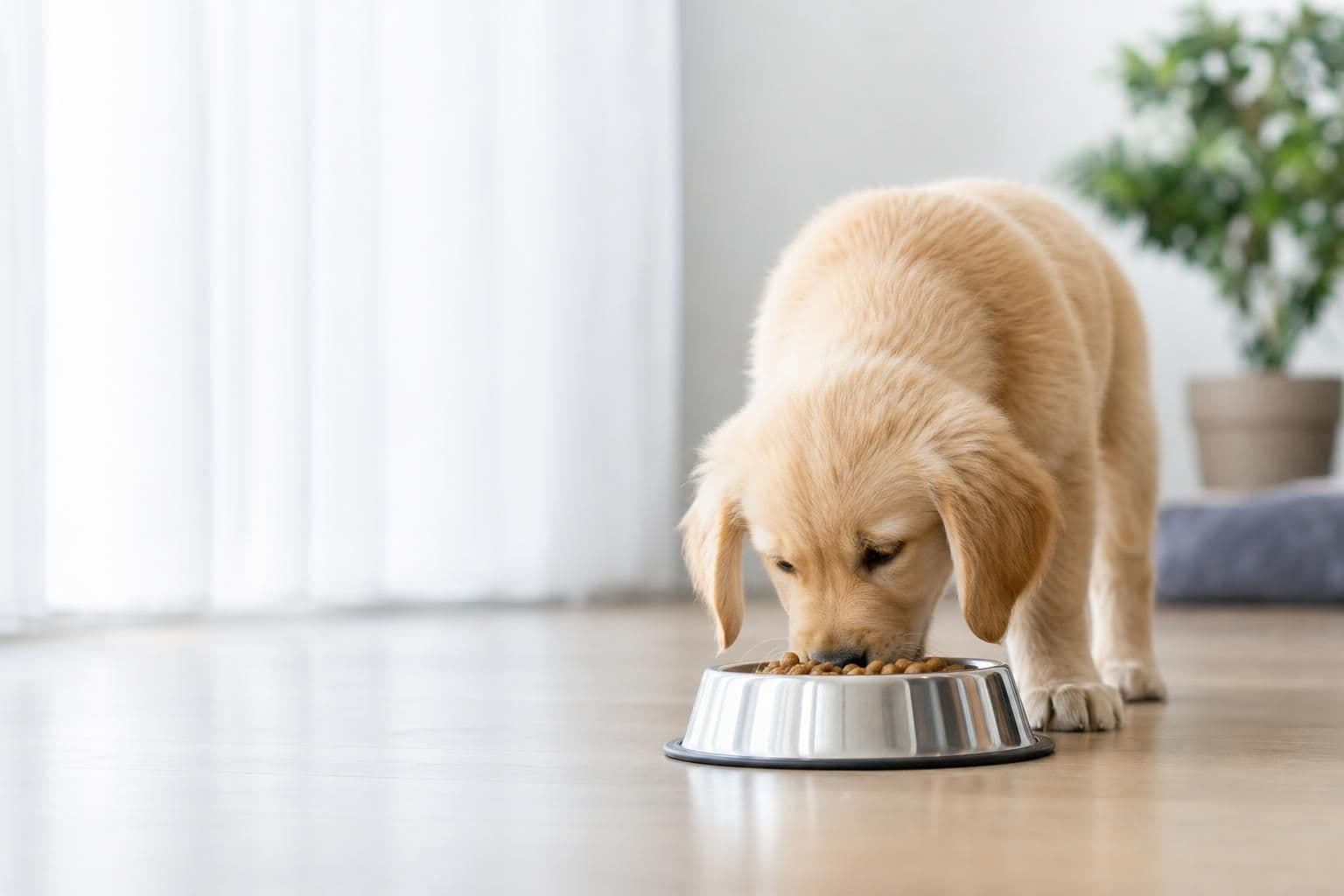
To transition a puppy to adult food, swap it in gradually over 7 to 10 days by mixing increasing amounts of the new food with decreasing amounts of the old food, rather than switching all at once. Start once your puppy has reached roughly 80-90% of its expected adult size — around 9-12 months for small breeds and 12-24 months for large and giant breeds. A slow swap gives the gut bacteria time to adjust, which lowers the odds of vomiting, diarrhea, or refused meals.
Key takeaways
- Mix adult food into puppy food gradually over 7-10 days instead of switching overnight.
- Timing depends on adult size, not a fixed birthday: small breeds mature faster than large ones.
- Watch stool consistency and appetite during the swap; slow down the transition if either changes.
When Your Puppy Is Actually Ready
Puppies need calorie- and nutrient-dense food while their skeleton and organs are still developing, so switching too early can shortchange that growth. The general rule vets use is size-based: small and toy breeds (under 20 lbs adult weight) are often close to full growth by 9-12 months, medium breeds around 12 months, and large or giant breeds (think retrievers, mastiffs, great danes) can keep growing until 18-24 months, according to guidance from the American Veterinary Medical Association. If you're unsure which bucket your dog falls into, ask your vet at the next wellness visit rather than guessing from breed stereotypes alone.
A puppy's calorie needs also drop noticeably once rapid growth slows, which is part of why adult formulas are calibrated differently — they're built for maintenance, not building new bone and muscle mass.
The 7-10 Day Mixing Schedule
A gradual swap is the single biggest factor in avoiding a messy transition. A commonly recommended ratio schedule looks like this:
- Days 1-2: 75% current puppy food / 25% new adult food
- Days 3-4: 50% / 50%
- Days 5-6: 25% puppy food / 75% adult food
- Days 7+: 100% adult food
If your puppy has a sensitive stomach, stretch this out to 10-14 days and hold each ratio an extra day or two before moving forward. Puppies who've had any recent GI upset, a recent dewormer, or a stressful event (new home, travel, grooming) do better with the slower version. If you're still working out portion sizes at any stage of this swap, a simple feeding guide for puppies can help you calculate how much total food — combined — your dog needs per meal based on current weight.
Signs the Transition Is Going Smoothly
A smooth switch usually looks almost boring: normal energy, consistent appetite, and stool that stays firm and well-formed throughout the week. Minor, temporary softening of stool on days 3-5 (the 50/50 point) isn't unusual and typically resolves on its own as the ratio shifts back toward the new food.
What you want to see by day 7-10:
- Stool holds its shape and color is consistent with what's normal for your dog
- No repeated vomiting or gagging after meals
- Puppy finishes meals in a normal time frame, not picking at food or refusing it
- No excessive gas or audible stomach noise beyond what's typical
Signs of a Rocky Transition — and What to Do
Diarrhea, vomiting, or a sudden refusal to eat during the swap usually means the pace is too fast for that individual dog, not that something is fundamentally wrong with the new food. The fix is almost always to pause progress — go back to the last ratio that worked, hold it for an extra 2-3 days, and then resume more slowly.
Contact your veterinarian if you see any of the following, since these go beyond a normal adjustment reaction:
- Diarrhea or vomiting lasting more than 24-48 hours
- Blood in stool or vomit
- Lethargy, fever, or refusal to drink water
- Any sign of dehydration (gums feel tacky, skin doesn't spring back when gently tented)
Because loose stool during a food swap can temporarily disrupt a routine you've worked hard to build, it's worth keeping your house-training schedule a little more flexible during this week — more frequent outdoor trips can offset the extra urgency that comes with softer stool.
Choosing the Right Adult Formula
Look for a bag labeled for "adult maintenance" or "all life stages" under AAFCO nutrient profiles — this is the feeding-trial and nutrient-standard body that most U.S. pet food labels reference. An all-life-stages formula is formulated to meet puppy-level minimums too, so it's a safe bridge food if you want one option that works through the transition and beyond, though it may run richer in calories than a dog at maintenance strictly needs.
Match protein source and kibble size to your dog's size and chewing style — a large-breed adult formula is generally lower in calcium and calorie density than a small-breed version, reflecting the different growth and joint-stress profiles of large versus small dogs.
Feeding Tools That Make the Switch Easier
A slow feeder bowl is genuinely useful during a food transition because it stretches out mealtime and reduces the gulping that can make a new food sit poorly. We've run slow feeders past our own cats, Ai and Dudu, before listing them, and the same slow-down effect applies across species — dogs just as easily inhale a bowl of kibble when they're excited about a new flavor. If portion consistency has been a struggle, an automatic feeder that doles out a fixed amount at set times removes the guesswork of eyeballing a shifting food ratio twice a day. Both fall under Ziva Paws' feeding category, alongside stainless and slow-feeder bowl styles sized for different breeds.
Frequently Asked Questions
Q: How long should I transition a puppy to adult food?
Most puppies do well with a 7-10 day gradual mix, moving from mostly puppy food to mostly adult food in steady increments. Dogs with sensitive stomachs or a history of GI issues often do better with 10-14 days.
Q: What age should a puppy switch to adult dog food?
It depends on expected adult size rather than a fixed age: small breeds are often ready around 9-12 months, medium breeds around 12 months, and large or giant breeds not until 18-24 months. Your vet can confirm timing based on your dog's growth curve.
Q: Can I switch my puppy to adult food all at once?
You can, but it raises the risk of vomiting or diarrhea because the gut hasn't had time to adjust to a new formula and ingredient ratio. A gradual 7-10 day mix is the lower-risk approach for most dogs.
Q: Is it okay to feed an all-life-stages formula instead of switching?
Yes — an "all life stages" formula under AAFCO nutrient profiles is formulated to meet puppy minimums, so it can serve as a bridge food through the transition. Keep an eye on weight gain, since these formulas can run calorie-dense for an adult dog at maintenance.
Q: Why did my puppy get diarrhea after switching food?
Diarrhea after a food switch is usually a sign the change happened too fast for the gut bacteria to adjust, not necessarily a sign the new food is wrong for your dog. Slowing the mixing schedule and holding at the last comfortable ratio for a few extra days typically resolves it.