Best Cabinets for a Garage or Laundry Room in Hawaii
Key takeaway
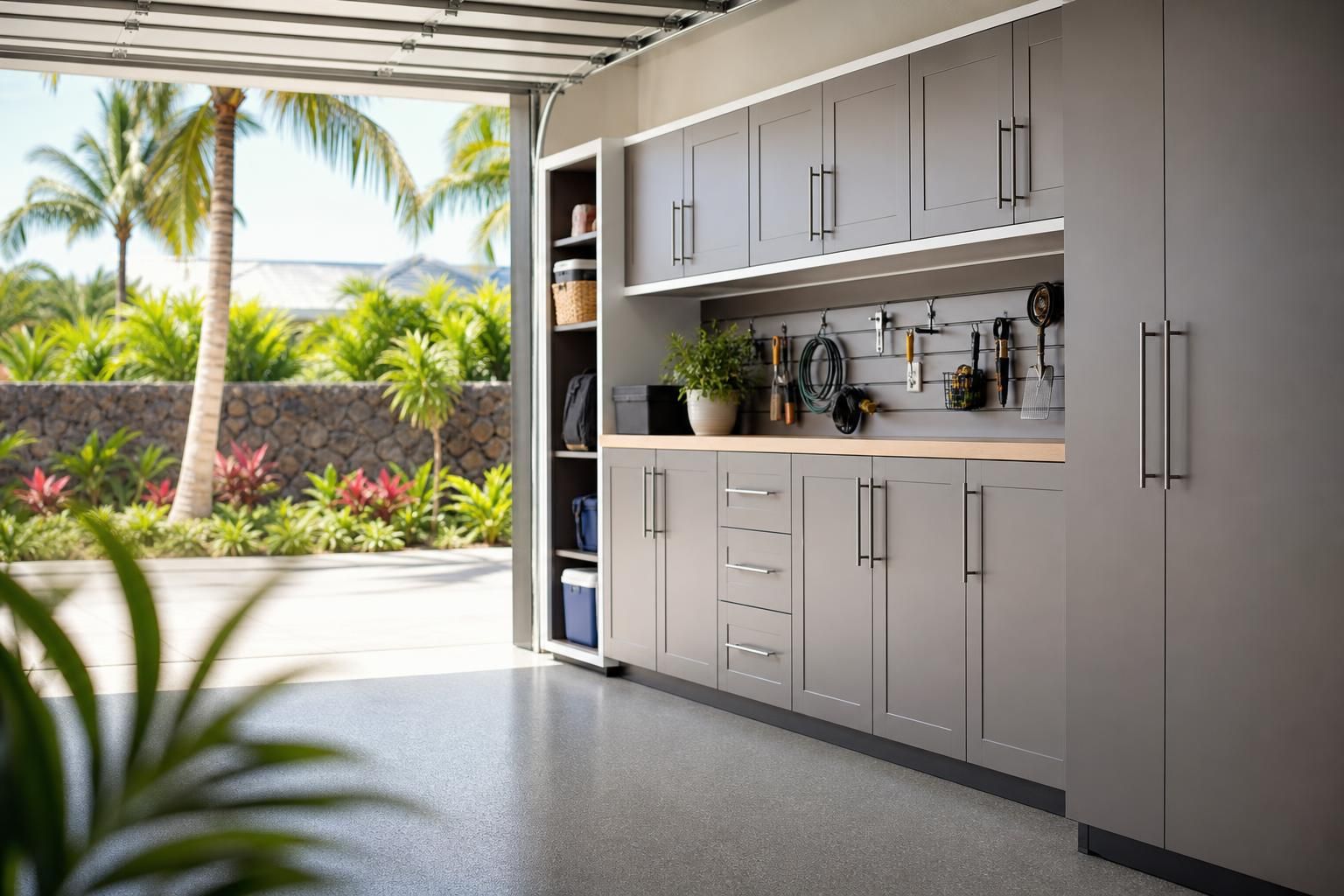
The best cabinets for a garage or laundry room in Hawaii are built from moisture-resistant materials like PVC, marine-grade polymer, or well-sealed plywood with metal or PVC hardware — not the particleboard boxes sold at big-box stores for mainland climates. On Oahu, cabinets near a washer, a water heater, or an open garage door face daily humidity swings, salt-laden air, and termite pressure that standard cabinet boxes aren't built to handle. Choosing the right core material and finish matters more here than style.
Key takeaways
- Skip particleboard and MDF cores in garages and laundry rooms; both swell and crumble when they absorb humidity or splashed water.
- PVC, marine-grade polymer, and well-sealed plywood resist moisture, salt air, and termites far better than standard cabinet materials.
- Stainless steel, PVC, or solid brass hardware won't corrode the way standard zinc-plated hardware does near washers and open garage doors.
Why Standard Cabinets Fail in Island Garages and Laundry Rooms
Most mainland-market cabinets are built around particleboard or medium-density fiberboard (MDF) cores wrapped in a thin veneer or laminate. Those materials are fine in a climate-controlled living room, but a garage with an open door or a laundry nook next to a water heater sees humidity levels and temperature swings that particleboard simply isn't engineered for. Once moisture gets into the edges or behind the laminate, the board swells, the laminate delaminates, and drawer bottoms sag within a year or two.
Hawaii adds two more stressors most cabinet lines never account for: salt air corroding hardware and fasteners, and termites, which the University of Hawaii's cooperative extension program has documented as a persistent structural pest issue across the islands, particularly for untreated wood products.
What to Look for in Garage and Laundry Cabinet Materials
A cabinet built for an Oahu garage or laundry room should check off a short list of practical requirements before style ever enters the conversation:
- A moisture-resistant core — PVC board, marine-grade polymer, or exterior-grade plywood instead of particleboard or raw MDF.
- A sealed or coated surface — thermofoil, melamine, or painted finishes that seal the edges, not just the face.
- Corrosion-resistant hardware — stainless steel, PVC, or solid brass hinges and slides instead of standard zinc-plated steel.
- No exposed raw wood — any cut edge or drilled hole should be sealed, since that's where moisture gets in first.
- A design that allows airflow — slightly raised toe kicks and vented panels help cabinets dry out after a humid spell instead of trapping moisture.
Comparing Common Cabinet Materials for Hawaii Garages and Laundry Rooms
| Material | Moisture Resistance | Termite Resistance | Best Use | Notes |
|---|---|---|---|---|
| Particleboard/MDF (standard) | Poor | Low | Not recommended for garage/laundry | Swells and crumbles with repeated moisture exposure |
| Plywood (sealed/exterior-grade) | Good | Moderate | Laundry rooms, covered garages | Needs fully sealed edges to perform well |
| PVC/polymer cabinetry | Excellent | High (non-wood) | Open garages, wet laundry areas | Won't rot or feed termites; wipes clean easily |
| Marine-grade polymer | Excellent | High (non-wood) | Garages, lanai-adjacent laundry | Built for boat interiors; handles direct splash well |
| Metal (powder-coated steel) | Excellent | High (non-wood) | Garage storage, workshop zones | Dents more easily than polymer but won't warp |
Garage Cabinets vs. Laundry Room Cabinets
Garage Cabinets
Garage cabinets typically deal with dust, tools, chemicals, and an open or frequently opened door that lets in humid outdoor air. Wall-mounted or raised base cabinets that keep contents a few inches off the slab help protect stored items if water ever pools during heavy rain. Metal and PVC options also hold up better against scuffs from bikes, tools, and sports gear than painted wood finishes.
Laundry Room Cabinets
Laundry cabinets live closer to a direct moisture source: the washer itself, plus steam from a dryer vent and detergent spills. A sealed polymer or well-finished plywood cabinet with a water-resistant countertop on top (many homeowners pair laundry cabinetry with quartz countertops for a durable folding surface) holds up better than a laminate-topped unit that can swell at the seams over time.
Hardware and Finish Details That Matter More in Hawaii
Standard zinc-plated hinges and drawer slides are the first thing to fail in a humid garage or laundry room — they start showing surface rust within a season or two in a coastal environment. Stainless steel hardware, which is built to resist oxidation, holds up significantly longer, and it's a standard upgrade offered on most custom cabinet lines rather than a specialty request. The U.S. EPA's guidance on indoor moisture and mold also notes that materials prone to trapping moisture create conditions where mold can take hold — another reason sealed, non-porous cabinet surfaces matter in laundry areas specifically.
How Custom Cabinets Compare to Big-Box Options for These Rooms
Big-box garage and laundry cabinet kits are typically mass-produced to a single set of specifications that assume a mainland, climate-controlled garage. Custom cabinetry, by contrast, can be built with the core material, hardware grade, and finish matched to the specific room and its moisture exposure — a garage with a frequently open door gets a different spec than an enclosed laundry closet. If you're curious about the build process itself, how custom cabinets are made walks through the material and construction choices that go into a finished box, and a related guide covers how long custom cabinets typically take to build once a design is finalized.
Working With a Local Cabinet Maker
Because garage and laundry cabinets in Hawaii need a different material spec than a mainland product line, it's worth working with a cabinet maker who builds locally and understands island conditions rather than ordering a generic kit online. A local shop can also walk through finish and hardware options in person, which matters when the room in question will be exposed to salt air, humidity, or direct water contact daily. For general guidance on vetting a cabinet maker on Oahu, see how to find the best cabinet maker in Honolulu.
Pricing for garage and laundry cabinetry on Oahu tends to run higher than mainland quotes you might see online, largely because materials are shipped in and local labor rates reflect the islands' cost of living. A local measurement and consultation is the most reliable way to get an accurate number for a specific room.
Frequently Asked Questions
Q: What is the most durable cabinet material for a Hawaii garage?
PVC and marine-grade polymer cabinets are the most durable choice for Hawaii garages because they don't absorb moisture, warp, or provide a food source for termites, unlike particleboard or untreated wood.
Q: Can I use regular kitchen cabinets in a laundry room?
Standard kitchen cabinets with particleboard cores aren't recommended for laundry rooms in Hawaii, since repeated exposure to washer moisture and humidity causes swelling and delamination faster than in a dry kitchen.
Q: Do garage cabinets need to be waterproof in Hawaii?
Fully waterproof isn't always necessary, but moisture-resistant materials are strongly recommended, especially for garages with an open door, a water heater, or any risk of water intrusion during heavy rain.
Q: Are metal cabinets better than wood for a garage in Hawaii?
Metal cabinets resist moisture and termites as well as PVC options do, though they can dent more easily; the better choice often comes down to whether durability against impact or against humidity is the bigger concern in that specific garage.
Q: What hardware should I choose for humid rooms?
Stainless steel, PVC, or solid brass hinges and drawer slides resist corrosion far better than standard zinc-plated hardware, which is the first component to show rust in a humid or coastal garage or laundry room.