Black Countertops: A Practical Guide for Hawaii Kitchens
Key takeaway
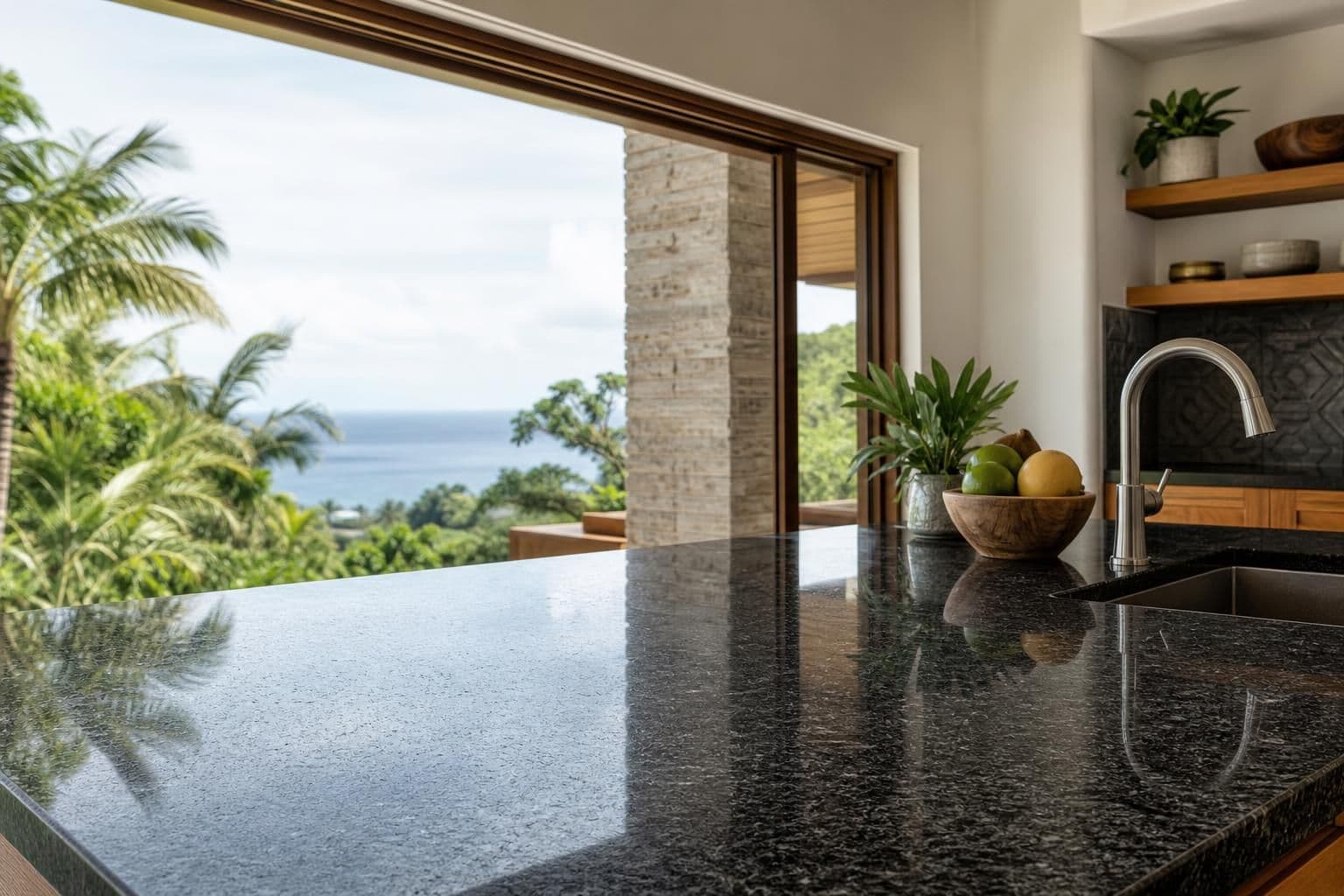
Black countertops work well in Hawaii kitchens because dark stone and quartz hide water spots and cooking grease better than light surfaces, and several black materials — notably quartz and granite — hold up reliably against the island's humidity and salt air. The best choice depends on whether you want a low-maintenance engineered surface or the natural variation of real stone, and on how much contrast you want against your cabinets and lighting. Polished black finishes show fingerprints and dust more readily, so matte or leathered options are worth considering for busy kitchens.
Key takeaways
- Black quartz needs no sealing and resists moisture better than any natural stone, making it a practical pick for Oahu's humid climate.
- Black granite and black soapstone each have natural movement (quartz flecks, veining, or soft matte tone) that engineered quartz cannot fully replicate.
- A honed or leathered finish on black stone hides fingerprints and water spots far better than a high-polish finish.
What "black countertops" actually means
"Black countertops" is really a catch-all for several different materials that happen to share a dark color family:
- Black granite – natural igneous stone with flecks of mica, feldspar, or quartz crystal that catch light even in a near-solid black slab.
- Black quartz – an engineered surface made from roughly 90–94% ground quartz mineral bound with resin, produced in a uniform color with little to no natural veining unless the manufacturer adds a pattern.
- Black soapstone – a softer natural stone that's naturally dark gray to black and often darkens further with mineral oil treatments over time.
- Black marble – true black marble (like Nero Marquina) is rarer and more porous, used more often as an accent than a full kitchen surface.
Each of these behaves differently once it's in a working kitchen, which matters more in Hawaii than almost anywhere on the mainland.
Why material choice matters more in a humid, salt-air climate
Honolulu's average relative humidity runs high year-round, and homes near the coast also deal with airborne salt that can accelerate wear on porous surfaces and metal fixtures. The National Weather Service tracks Oahu's humid, trade-wind-driven climate, which is a useful reference point for why materials rated for "average" U.S. conditions don't always perform the same way here.
Natural stone is porous to varying degrees, and the Natural Stone Institute notes that sealing reduces — but doesn't eliminate — a stone's ability to absorb liquids and moisture over time. In a Honolulu kitchen or a vacation-rental unit with heavy daily use, that means black granite and soapstone need periodic resealing to keep performing well, while quartz's resin binder makes it essentially non-porous without any sealing at all.
Comparing the main black countertop materials
Black granite Granite is quarried stone, formed from cooled magma rich in quartz, feldspar, and mica — the same minerals that give it its fleck pattern, as described by the U.S. Geological Survey in its background on igneous rock formation. It's extremely hard, resists heat well, and needs sealing roughly once a year in humid climates to stay stain-resistant. If you're deciding between finish types for a granite slab, it's worth reading up on honed versus polished granite finishes before you order — the finish changes both the look and the maintenance routine significantly.
Black quartz Quartz never needs sealing, resists scratches and most household acids, and keeps a consistent black tone from edge to edge. It's a strong fit for condo kitchens and rental units where low upkeep matters more than natural variation. If you're weighing quartz against other dark, low-maintenance surfaces, the comparison in quartz versus marble countertops covers how each handles daily wear.
Black soapstone Soapstone is softer and will scratch or dent more easily than granite or quartz, but it doesn't stain the way porous stones can, and scratches can often be sanded out at home. Many owners apply mineral oil periodically to deepen the black tone and even out the surface — a maintenance step some find charming and others find like one more chore. A side-by-side look at soapstone versus quartz countertops is a good next read if you're torn between the two.
Black marble True black marble is beautiful but among the most porous options here, and it etches when it contacts anything acidic — citrus, vinegar, even some cleaning products. It's a better fit for a powder room vanity or an accent island than a primary cooking surface in a humid kitchen.
Finish and fingerprint considerations
Polished black surfaces reflect light and look dramatic in photos, but they also show every water spot, dust streak, and fingerprint under kitchen lighting. A honed (matte) or leathered (lightly textured) finish diffuses light instead of reflecting it, which hides daily wear far better. Leathered finishes in particular add a subtle texture that catches fingerprints less than a smooth honed surface, making them popular for island kitchens that get heavy foot traffic from family or rental guests.
Pairing black countertops with cabinets and lighting
Black countertops create strong contrast against white or light wood cabinets, and a softer, more unified look against dark or charcoal cabinetry. Under-cabinet lighting becomes more important with black surfaces since they absorb rather than bounce light back into the room — a kitchen that felt bright with a light quartz counter can read noticeably darker with black installed. If you're planning cabinet colors alongside a dark countertop, the guidance in pairing quartz countertops with shaker cabinets applies just as well when the quartz in question is black rather than white.
A note on cost
Black granite, quartz, and soapstone each fall in different price tiers, and in Hawaii all of them run higher than mainland averages because slabs and engineered material are shipped in and installation labor costs more locally. Rather than estimate a number here, a local showroom visit or free design consultation is the most reliable way to get a current quote based on your actual kitchen layout and material selection.
Frequently Asked Questions
Q: Do black countertops show more scratches than lighter colors?
Scratches are usually more visible on dark, polished surfaces because light reflects differently off a scratched area than the surrounding gloss. A honed or leathered finish minimizes this visibility, and quartz resists scratching better than softer stones like soapstone or marble.
Q: Are black quartz countertops heat resistant?
Quartz resists moderate heat but can discolor or crack from direct, prolonged contact with very hot cookware, since the resin binder is more heat-sensitive than solid stone. Using a trivet or hot pad is the standard precaution recommended for any quartz surface, regardless of color.
Q: Do black granite countertops need to be sealed?
Yes — black granite is porous enough that most installers recommend sealing it annually, more often in a humid climate like Oahu's. A simple water-bead test (sprinkle water on the surface and see if it beads or soaks in) tells you when it's time to reseal.
Q: Will black countertops make a small kitchen feel darker?
They can, especially with limited natural light, but pairing black countertops with lighter cabinets, bright backsplash tile, and good under-cabinet lighting usually offsets the effect. A honed or leathered finish also reflects less glare than a high polish, which can soften the overall look.
Q: What's the most durable black countertop material for a rental unit?
Quartz is generally the lowest-maintenance option for vacation rentals since it needs no sealing and resists staining from everyday use by changing guests. Granite is a close second if it's sealed on schedule, while soapstone requires more hands-on care than most rental owners want to manage remotely.