Butcher Block vs Quartz Countertops for Hawaii Kitchens
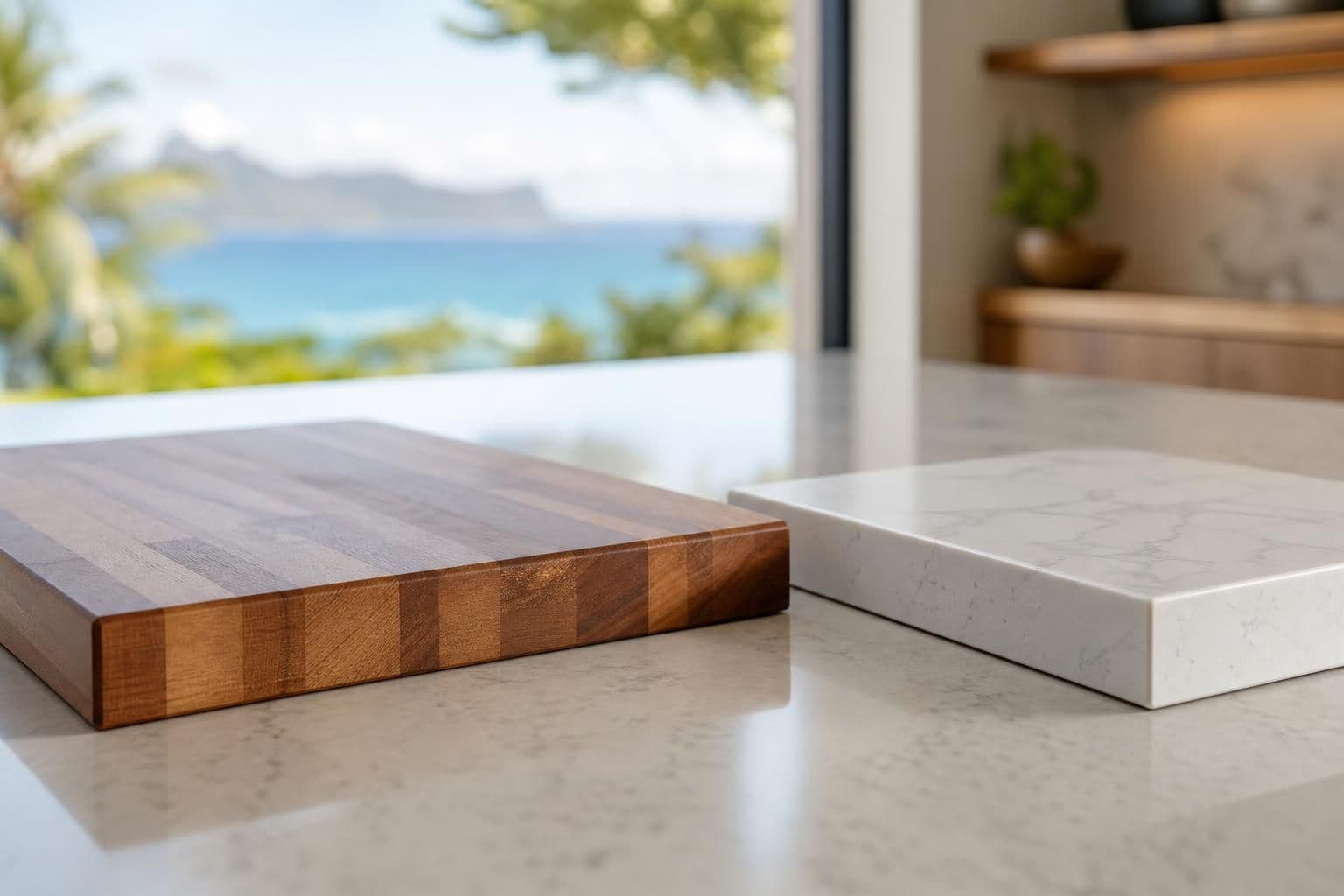
Key takeaway
Quartz countertops generally outperform butcher block in Hawaii's humid, salt-air climate because engineered quartz is non-porous and won't swell, crack, or harbor mold the way wood can when moisture levels stay high year-round. Butcher block offers warmth and a repairable surface that some homeowners prefer for island-style kitchens, but it needs more frequent sealing and careful moisture management near sinks and lanai-facing windows. The right choice depends on how much upkeep you're willing to do versus how much low-maintenance durability you want from day one.
Key takeaways
- Quartz resists humidity, salt air, and daily spills without sealing — ideal for condos and rentals left unattended between guests.
- Butcher block needs oiling every few weeks to months and should stay away from sink zones and direct sun exposure.
- In Oahu's climate, wood countertops face a higher risk of warping and mold than they would in a drier mainland kitchen.
How Each Material Handles Oahu's Climate
Hawaii's relative humidity regularly sits well above mainland averages, and wood is hygroscopic — it absorbs and releases moisture as conditions change. That constant swelling and shrinking is what causes butcher block to cup, crack at seams, or separate from glue joints over time, especially in homes without consistent air conditioning. The CDC's guidance on mold and moisture notes that mold needs moisture to grow, and a humid kitchen with a porous wood surface gives it exactly that.
Quartz is engineered from crushed stone bound with resin, making it essentially non-porous once cured. It doesn't absorb water vapor from the air, so it holds its dimensions and surface finish regardless of trade winds, rainy season, or a leaky lanai door left open. For buyers weighing material composition in more detail, this breakdown of what quartz is actually made of explains why the resin content matters for performance in wet climates.
Side-by-Side Comparison
| Factor | Butcher Block | Quartz |
|---|---|---|
| Moisture resistance | Absorbs humidity; needs regular sealing | Non-porous; unaffected by humidity |
| Maintenance | Oil every few weeks to months | Wipe clean; no sealing required |
| Heat tolerance | Can scorch or char from hot pans | Can discolor from prolonged direct heat |
| Repairability | Sandable and refinishable | Chips/cracks usually need professional repair |
| Typical lifespan in humid climates | Shorter without diligent care | Long-term, stable performance |
| Salt air exposure | Can dry out and crack near open windows | Unaffected by salt air |
Maintenance Realities for Condos and Vacation Rentals
Vacation-rental owners and condo investors on Oahu often go weeks between visits, which is where butcher block becomes a liability. A board that isn't oiled on schedule can dry out, crack, or take on water stains from a guest who leaves a wet glass overnight. Quartz holds up to that kind of unsupervised use because it doesn't need a maintenance routine beyond basic cleaning — a meaningful advantage for owners managing a unit remotely. If you're renovating a rental unit, these condo kitchen renovation ideas show how quartz surfaces hold up between guest turnovers without owner intervention.
Quartz isn't entirely maintenance-free, though — it can still discolor if a hot pan sits on it directly, so most manufacturers and fabricators recommend trivets as a precaution, a point covered in more depth in this guide to protecting quartz from heat damage.
Food Safety and Surface Hygiene
Butcher block's porous surface means bacteria can settle into knife scars and grain lines, which is why food-safety guidance treats wood cutting surfaces differently from sealed countertops. NSF International, the organization that sets standards for food-contact surfaces, certifies many quartz and solid-surface products specifically because their non-porous structure limits bacterial harborage compared to untreated wood. That doesn't make butcher block unsafe for countertop use, but it does mean a wood counter needs more frequent sanitizing, especially in a shared rental kitchen where cleaning consistency varies by guest.
Aesthetic and Design Trade-Offs
Butcher block brings natural warmth that fits a relaxed, island-casual kitchen, and it's genuinely repairable — sand out a scratch or stain and reseal. Quartz, by contrast, comes in a much wider range of colors and veining patterns manufactured to stay consistent slab to slab, which makes it easier to match an island to perimeter counters in a larger renovation. Homeowners drawn to tropical palettes often lean toward engineered stone for this reason; see these quartz color trends for tropical Hawaii homes for examples of veining and tone choices that read well against wood cabinetry and natural light.
Cost Considerations
Both materials carry higher installed costs in Hawaii than on the mainland, since slabs, hardwoods, and skilled labor all have to be shipped or trained locally, and that premium applies whether you choose butcher block or quartz. Rather than comparing national price averages that won't reflect island reality, it's more useful to request a local quote based on your kitchen's layout, square footage, and edge profile. A company like VC Flooring & Stone can walk through both material options during a free design consultation and give pricing specific to your project.
Which One Should You Choose?
If your kitchen sees heavy daily use, sits empty between rental stays, or is near an open lanai, quartz is the lower-risk choice because it doesn't depend on a maintenance schedule to stay sound. If you're an owner-occupant who enjoys the ritual of oiling a wood counter and likes the idea of sanding out scratches yourself, butcher block can still work — just keep it away from the sink and any west-facing window that gets strong afternoon sun. Many Oahu kitchens end up using both: quartz for the main run and a butcher block insert for a chopping zone, which isolates the wood's upkeep needs to one smaller section. For a broader look at how quartz performs across Hawaii kitchens specifically, this quartz countertops buyer's guide covers finish options and edge styles worth considering alongside a butcher block accent.
Frequently Asked Questions
Q: Does butcher block warp faster in Hawaii than on the mainland?
Yes, generally. Higher ambient humidity means wood absorbs more moisture from the air even without direct water contact, which accelerates swelling, cupping, and seam separation compared to drier mainland climates.
Q: Can you put butcher block next to a sink?
It's not recommended without very diligent sealing and drying, since standing water at the sink edge is the most common cause of butcher block cracking and mold growth. Many homeowners use a quartz or solid-surface strip around the sink and reserve butcher block for a separate island or prep zone.
Q: Is quartz heat resistant enough for hot pots and pans?
Quartz resists everyday heat better than wood, but direct contact with a very hot pan can still cause discoloration or thermal shock in some resin formulations. Trivets or hot pads are still recommended even on quartz.
Q: Which option is better for a vacation rental kitchen?
Quartz is typically the better fit for vacation rentals because it doesn't require a maintenance routine between guest stays and resists the humidity swings common in units that sit closed up for days at a time.
Q: Can butcher block and quartz be combined in one kitchen?
Yes, it's a common layout on Oahu — quartz for the main counters and sink area, with a butcher block insert on an island or secondary prep zone that's easier to keep maintained in isolation.