Hawaii Building Code Requirements for Flooring Moisture Barriers
Key takeaway
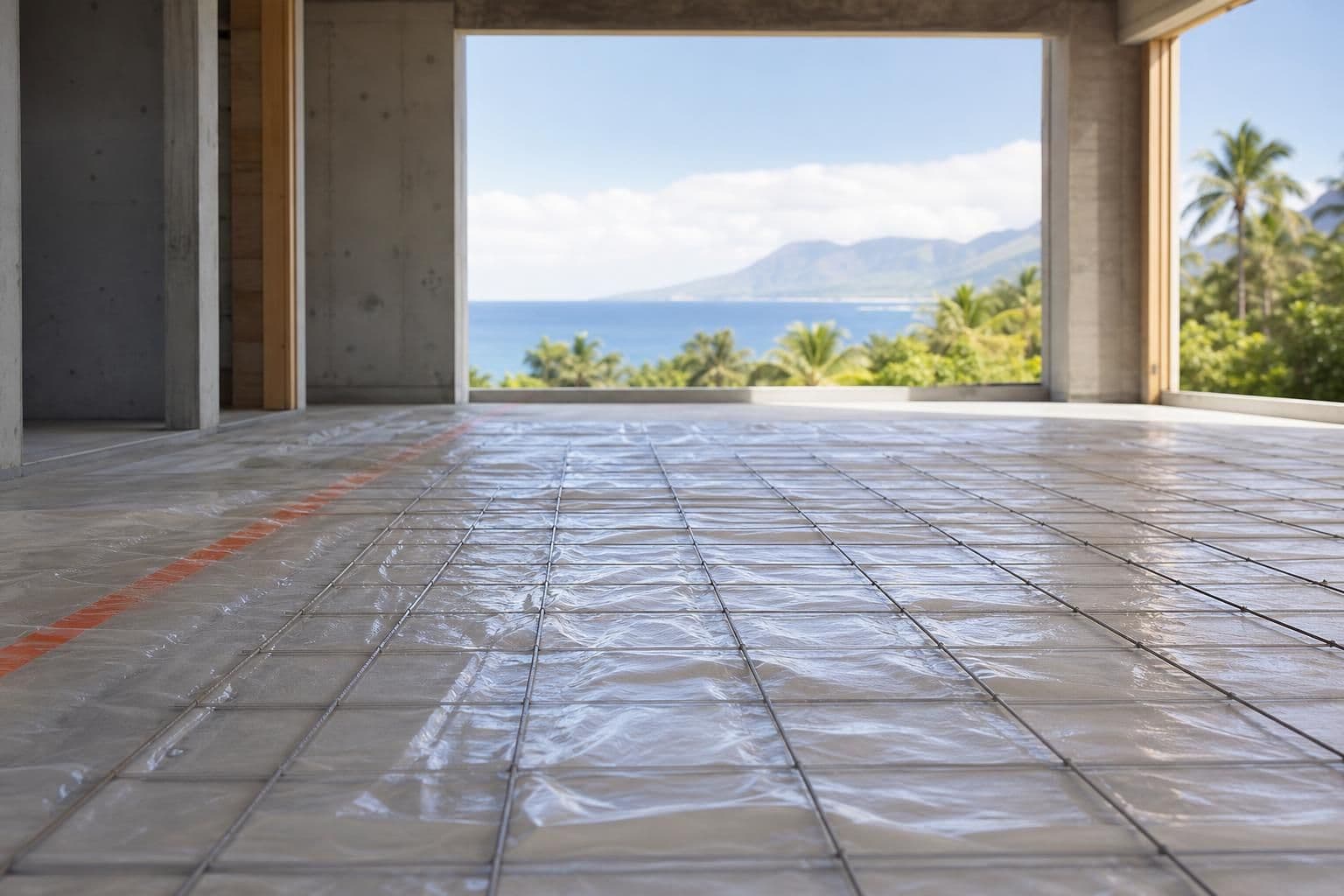
Hawaii follows the International Residential Code and International Building Code with state and county amendments, and both require a vapor retarder — typically a minimum 6-mil polyethylene sheet — under concrete slabs that will have flooring installed over them. Beyond that baseline, flooring manufacturers layer on their own moisture-testing requirements (calcium chloride or relative humidity probe tests) before they'll honor a warranty, which in practice matters more day-to-day than the code text itself. In Honolulu's humid, slab-heavy housing stock, meeting both the code minimum and the manufacturer's moisture threshold is what actually keeps a new floor from failing.
Key takeaways
- Hawaii's adopted building code requires a minimum 6-mil poly vapor retarder beneath concrete slabs before flooring goes down, per IRC Section R506.2.3.
- Code compliance alone doesn't guarantee a floor will perform — most manufacturers require a separate moisture test (ASTM F1869 or F2170) before installation, regardless of what the slab detail shows.
- Condos and older Oahu buildings on concrete slabs are the highest-risk case for moisture-related flooring failure, since slab age and prior sealers can throw off readings.
What the code actually requires at the slab
Hawaii's counties, including the City and County of Honolulu, administer building permits under versions of the International Building Code and International Residential Code, adapted with local amendments for wind, seismic, and termite conditions. For slab-on-grade construction — common across Oahu's single-family homes and virtually universal in condo towers — the IRC's slab provisions call for a vapor retarder placed between the slab and the base course, with 6-mil polyethylene as the commonly specified minimum. This requirement exists to slow the migration of ground moisture up through the concrete and into whatever flooring material sits on top of it.
That requirement is about new construction. It says little about what happens 20 or 40 years later when a condo owner wants to replace old carpet or tile with vinyl plank, which is where most renovation moisture problems actually start.
Why code compliance isn't the same as "moisture-safe"
A slab built to code in 1985 can still read high for moisture today. Concrete is porous and continues to release residual moisture from the original pour for years, and a vapor retarder only slows upward migration — it doesn't eliminate it, especially in a climate like Oahu's where humidity, rainfall, and high water tables keep ground moisture levels elevated most of the year. The EPA's guidance on moisture control in buildings notes that persistent dampness, not a single moisture event, is usually what drives mold growth and material failure.
That's why reputable flooring installers don't rely on the original vapor retarder detail alone. They test the slab directly before installation, using one of two recognized methods:
- ASTM F1869 (calcium chloride test): measures moisture vapor emission rate from the slab surface over a 60- to 72-hour period.
- ASTM F2170 (in-situ relative humidity probe): drills into the slab to measure relative humidity at a depth proportional to the slab thickness, generally considered the more reliable method for thicker slabs.
ASTM International publishes and maintains both standards, and most flooring manufacturers reference one or both in their written installation and warranty requirements.
How moisture barrier requirements differ by flooring type
Code and manufacturer requirements aren't one-size-fits-all — they shift depending on what's being installed over the slab.
- Waterproof SPC luxury vinyl plank: Generally the most forgiving option on concrete, but manufacturers still set maximum relative humidity and pH thresholds for the slab surface, and may require a thin moisture-mitigating underlayment on marginal readings.
- Solid or engineered hardwood: Far less tolerant of residual slab moisture; most manufacturers require a liquid-applied or sheet moisture barrier in addition to whatever vapor retarder is already in the slab.
- Tile and stone: Less sensitive to vapor transmission itself, but high moisture can still affect thin-set bond strength and lead to efflorescence through grout lines over time.
- Cabinetry sitting on or near affected slabs: Base cabinets installed directly over a chronically damp slab edge can swell or delaminate at the toe kick, which is one reason humidity-resistant cabinet construction matters as much as the flooring choice itself in an island kitchen remodel.
The condo and vacation-rental complication
A large share of Oahu's housing stock is concrete high-rise construction, and that changes the moisture conversation. In a condo, the slab is typically shared structural concrete rather than a ground-contact slab, so ground moisture isn't usually the issue — but curing time, prior adhesive residue, and years of sealed-over moisture from old flooring glue-downs can still produce high readings. Vacation-rental owners doing a fast turnover renovation are especially prone to skipping the testing step because of schedule pressure, which is exactly when a flooring failure shows up fastest — often within the first rainy season after installation.
What happens when a barrier is missing or inadequate
Skipping or under-specifying a moisture barrier doesn't usually cause an immediate problem — it shows up months later as cupping planks, lifting vinyl seams, adhesive failure, or a persistent musty smell at the floor line. Because these issues trace back to a construction or renovation decision, they're also the kind of defect that surfaces in real estate disclosures and can complicate a sale. The International Code Council, which develops the IRC and IBC that Hawaii's counties adopt, maintains that vapor retarder requirements exist specifically to prevent this slower, harder-to-diagnose category of moisture damage rather than acute flooding events.
Frequently Asked Questions
Q: Does Hawaii require a vapor barrier under all flooring, or just concrete slabs?
The code-mandated vapor retarder applies to concrete slab-on-grade construction, not to floors installed over raised wood framing, which relies on crawlspace ventilation and framing-level moisture control instead. Flooring manufacturers may still recommend an underlayment with built-in moisture resistance over wood subfloors in humid climates, but that's a manufacturer specification rather than a code requirement.
Q: Who tests slab moisture before a flooring installation in Honolulu?
A qualified flooring contractor or installer typically performs the calcium chloride or relative humidity probe test before installation begins, since the results determine whether additional moisture mitigation is needed. Homeowners generally aren't expected to test the slab themselves, but should ask for documented results, especially on older concrete.
Q: Can I install vinyl plank flooring over a damp concrete slab?
Not without addressing the moisture first — most SPC and LVP manufacturers set a maximum relative humidity or emission rate in their installation instructions, and installing over a slab that exceeds it can void the product warranty even if the flooring looks fine on day one. In marginal cases, a moisture-mitigating primer or membrane can bring the slab within an acceptable range.
Q: Is a moisture barrier required when renovating an existing condo unit?
Hawaii's building code requirements for moisture barriers are primarily written for new construction, so a renovation in an existing unit is usually governed more by the flooring manufacturer's installation standards than by a fresh code review. That said, permitting requirements can still apply depending on the scope of the renovation, so it's worth confirming with the building department before work begins.
Q: What's the difference between a vapor retarder and a vapor barrier?
The terms are often used interchangeably, but technically a vapor barrier has a very low permeance rating and blocks moisture almost entirely, while a vapor retarder slows moisture movement without fully stopping it. The 6-mil polyethylene sheeting referenced in the IRC's slab provisions functions as a vapor retarder in most real-world installations.