Quartz Countertops in Honolulu: A Buyer's Guide
Key takeaway
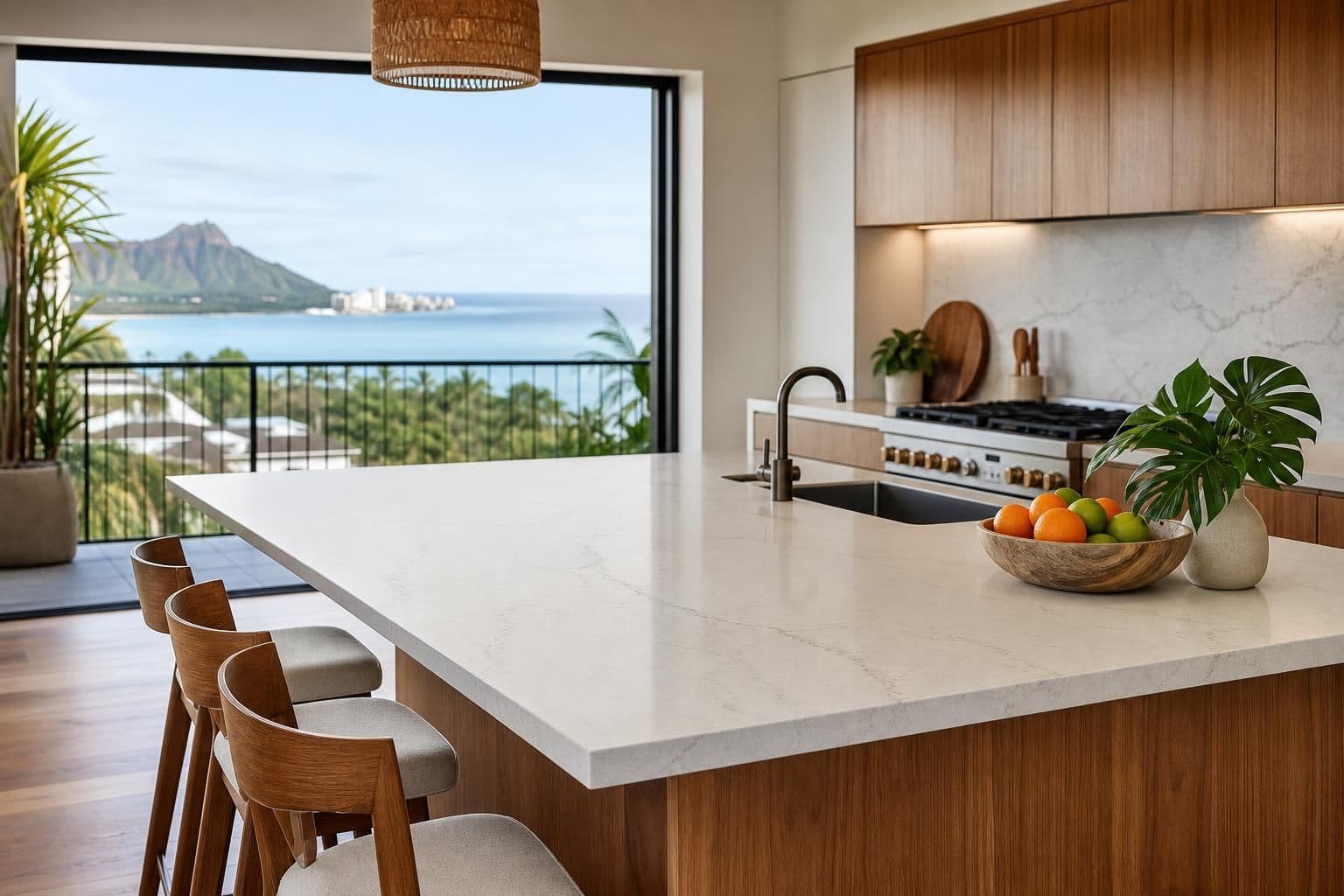
Quartz countertops in Honolulu are engineered stone slabs made from roughly 90–94% ground quartz crystal bound with polymer resin, and they're a strong choice for island homes because the resin seals the surface against the humidity, salt air, and daily wear common in Oahu kitchens and bathrooms. Unlike granite or marble, quartz never needs sealing and resists staining from acidic foods, coffee, and sunscreen residue. For most Honolulu buyers, the real decision isn't whether quartz works here — it's which color, edge style, and installer will hold up best over years of island living.
Key takeaways
- Quartz doesn't need sealing and resists moisture damage, making it a low-maintenance fit for Hawaii's humidity and salt air.
- Slab selection matters more than brand name — view the actual slab in person before ordering, since veining and color vary by batch.
- Get precise measurements after cabinets are set, not before, since even small gaps affect seam placement and overhang support.
Why Quartz Performs Well in Hawaii's Climate
Natural stone like granite is porous and needs periodic sealing to block moisture and bacteria, especially in humid environments. Quartz's resin binder closes off that porosity during manufacturing, so the surface stays non-porous without any maintenance step. This matters in Oahu kitchens where trade-wind humidity and occasional salt air exposure near coastal homes can accelerate wear on untreated materials. The U.S. Environmental Protection Agency notes that consistently high indoor humidity promotes mold and bacterial growth on porous surfaces, which is one reason non-porous countertop materials are popular in tropical and coastal regions.
For condo and vacation-rental owners cycling through renters, this durability translates into fewer callbacks for stains, cracks, or resealing. Homes that already invested in durable countertops for high-turnover vacation rentals often pair that surface with matching quartz in bathrooms for a consistent, low-upkeep finish throughout the unit.
What Affects Quartz Countertop Selection in Honolulu
Choosing quartz isn't just about color. A few practical factors shape the decision for local homes:
- Slab thickness — most quartz comes in 2cm or 3cm thickness; 3cm is common for kitchen islands and waterfall edges because it reads as a heavier, more substantial edge without needing a laminated build-up.
- Pattern consistency — quartz is manufactured, so veining patterns repeat more predictably than natural stone, which helps when matching a large island to perimeter counters.
- UV exposure — some quartz formulations can yellow slightly with prolonged direct sunlight, so lanai-adjacent kitchens or sunroom counters may warrant checking a manufacturer's outdoor-use rating before ordering.
- Edge profile — a waterfall edge, where the countertop wraps down the side of an island, has become a popular look in island kitchens; it's worth reviewing a few waterfall edge quartz countertop island design ideas before finalizing a layout.
Quartz vs. Granite for Oahu Kitchens
Both materials hold up in Hawaii's climate, but they behave differently day to day. Granite is a natural stone with unique veining in every slab, and it requires sealing on a regular schedule to stay stain-resistant, which is covered in detail in guidance on how to seal granite countertops in Hawaii's humidity. Quartz skips that maintenance step entirely because of its resin composition, which is why many condo owners and rental hosts prefer it for lower upkeep between tenants. Granite still appeals to buyers who want the one-of-a-kind pattern of natural stone and don't mind the periodic care; quartz appeals to buyers who want a consistent look and minimal ongoing maintenance, detailed further in tips on low-maintenance quartz countertops for Hawaii homes.
What the Installation Process Involves
A typical quartz countertop installation follows a predictable sequence:
- Template and measure — installers measure the cabinet layout in person, usually after cabinets are installed and leveled, to account for any wall irregularities.
- Slab selection — buyers view actual slabs (not just samples) to approve color, pattern, and any natural variation before fabrication.
- Fabrication — the slab is cut, edges profiled, and sink or cooktop cutouts made off-site using the template.
- Installation — the finished countertop is set on the cabinets, seams are joined and polished, and the surface is checked for level.
The Natural Stone Institute, an industry standards organization for stone and engineered surfaces, outlines similar templating and fabrication standards used across the countertop industry to ensure proper seam placement and structural support for overhangs.
Condo-Specific Considerations
Honolulu condo renovations often come with building rules that affect countertop projects — freight elevator scheduling, work-hour restrictions, and sometimes material or noise restrictions during fabrication cutouts. Buyers planning a kitchen update alongside new countertops should confirm building approval early, since many associations require documentation before work begins; the process is outlined in more detail in guidance on condo association approval for kitchen renovations in Honolulu. Building this step into the timeline upfront avoids delays once a slab has already been fabricated to fit a specific layout.
A Note on Cost
Quartz countertop pricing in Honolulu runs higher than mainland averages, largely because slabs are shipped in from out-of-state fabricators or manufacturers, and labor rates in Hawaii reflect the general cost of doing business on the islands. Rather than relying on a generic per-square-foot estimate, it's more useful to get a quote based on your actual layout, edge style, and slab selection, since those variables shift the total more than the base material cost.
Frequently Asked Questions
Q: Is quartz better than granite for Hawaii's humidity?
Quartz performs better with less effort because its resin binder makes it non-porous from the start, so it never needs sealing. Granite is also durable in humid climates but requires periodic sealing to maintain its stain resistance.
Q: Can quartz countertops be used outdoors on a lanai in Honolulu?
Some quartz formulations aren't rated for prolonged direct UV exposure and can yellow over time outdoors. Check the manufacturer's outdoor-use rating before installing quartz on an uncovered lanai or exterior kitchen.
Q: How long does a quartz countertop installation take?
After templating, fabrication typically takes one to two weeks depending on the fabricator's schedule, followed by a single-day installation once the slab is ready. Condo buildings may add time for elevator scheduling or work-hour approval.
Q: Do quartz countertops need to be sealed?
No. The resin binder in quartz makes the surface non-porous during manufacturing, so it doesn't require sealing the way natural stone does.
Q: What edge styles work well with quartz in a kitchen island?
Waterfall edges, where the slab wraps down the side of the island to the floor, are popular because quartz's consistent pattern lines up cleanly across the vertical and horizontal surfaces. Standard eased or bullnose edges also work well for perimeter counters.