Quartzite Countertops Honolulu: A Buyer's Guide
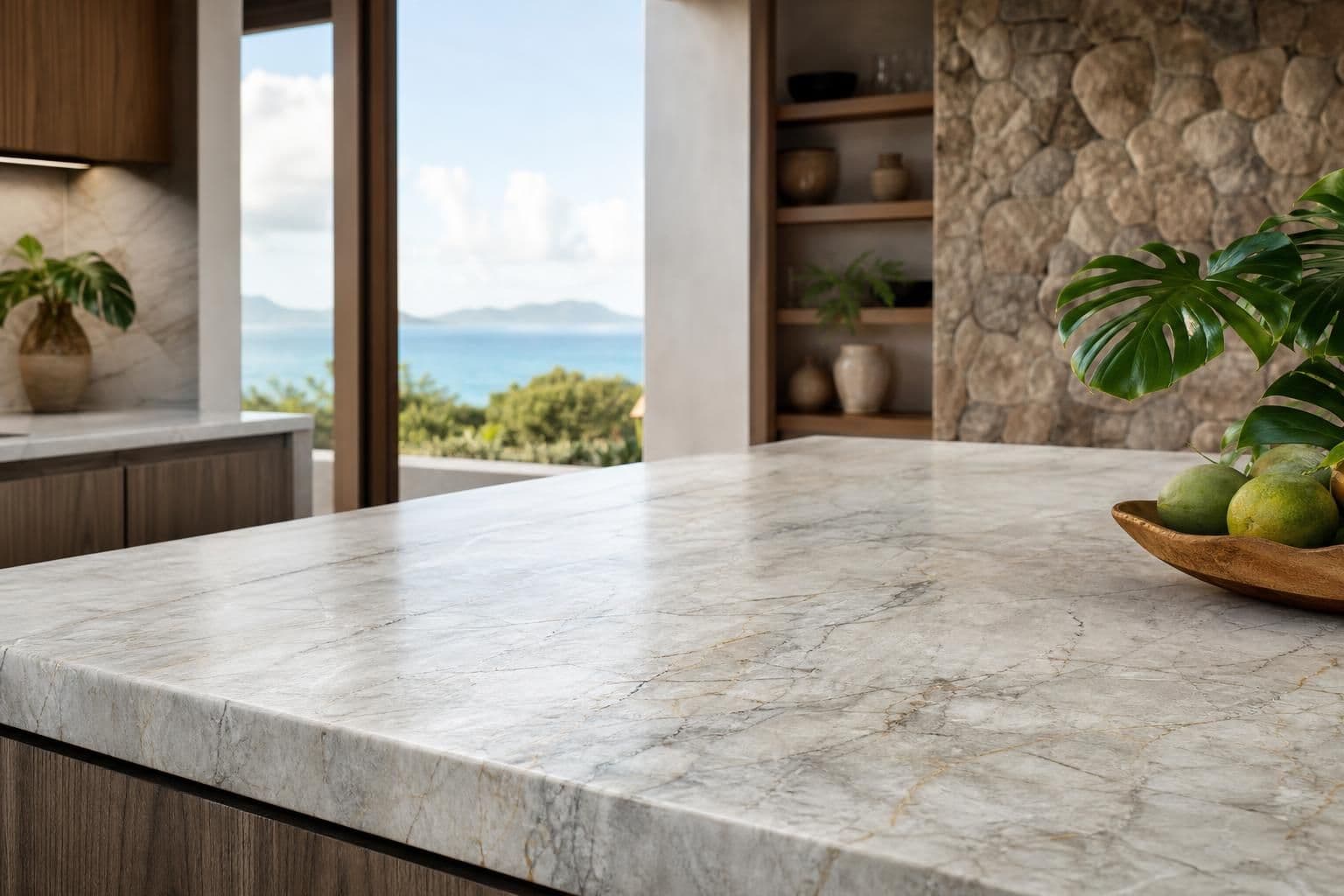
Key takeaway
Quartzite is a natural stone that performs well in Honolulu kitchens because it resists heat, scratching, and UV fading better than marble or soapstone, making it a strong pick for open lanai-adjacent kitchens and sunlit condo units. It does need periodic sealing to stay stain-resistant in Hawaii's humidity, and slab cost and availability depend on which quarry pattern you choose. For most island homeowners, the trade-off is worth it: a harder, more weather-tolerant stone with the organic veining buyers want in a marble look.
Key takeaways
- Quartzite ranks 7 on the Mohs scale, close to natural quartz crystal, so it resists scratches from knives, pans, and daily condo kitchen use better than marble or limestone.
- Plan to reseal quartzite roughly once a year in Oahu's humidity — more often near open lanai kitchens or salt-air windows than in fully air-conditioned units.
- Choose a dense, low-absorption quartzite slab (ask your fabricator to show you the slab's water-absorption rating) if the countertop will sit near a sink, wet bar, or outdoor-facing kitchen pass-through.
What Quartzite Actually Is
Quartzite is metamorphic rock formed when sandstone is subjected to heat and pressure underground, fusing quartz grains into a dense, crystalline structure. That process is what gives true quartzite its hardness — it's a geological cousin of quartz crystal, not the same material as engineered "quartz" countertops, which are manufactured from crushed stone and resin. The United States Geological Survey notes that quartzite's durability comes directly from this quartz-grain fusion, which is why fabricators prize it for heavy-use surfaces. Because the name overlaps with engineered quartz, it's common for showroom visitors to confuse the two — worth clarifying before you buy, since care routines differ.
Why It Suits Honolulu Homes Specifically
Oahu kitchens deal with conditions mainland buying guides don't account for: trade-wind humidity, salt-laden air near the coast, and UV exposure through large sliding doors or lanai-facing windows. Quartzite holds up well against all three:
- Heat tolerance — a hot pan set directly on sealed quartzite won't scorch or discolor it the way it can some engineered surfaces.
- UV stability — natural quartzite doesn't fade or yellow with direct sun, which matters in units with floor-to-ceiling glass facing the ocean.
- Scratch resistance — its hardness means everyday knife nicks and ring scrapes are far less likely than on marble or soapstone.
The trade-off is porosity. Unlike engineered quartz, natural quartzite is porous and needs a penetrating sealer to resist oil, wine, and acidic spills — a step condo and vacation-rental owners sometimes skip because they assume all "quartz-family" stone is maintenance-free.
Sealing, Staining, and Everyday Care
A quality penetrating sealer soaks into the stone's pores and repels liquids before they stain, rather than coating the surface like a topical sealer would. Most quartzite installations should be resealed on a schedule rather than waiting for visible staining, since by the time a stain shows, the liquid has already penetrated. In a humid Honolulu kitchen, that typically means checking the surface annually with a simple water-bead test: if water soaks in within a few minutes instead of beading up, it's time to reseal. If you're weighing this maintenance step against other natural stones, the comparison in quartzite vs. granite walks through how upkeep differs between the two.
For daily cleaning, a pH-neutral stone cleaner avoids breaking down the sealer the way vinegar, bleach, or citrus-based cleaners can. The Marble Institute of America recommends avoiding acidic or abrasive cleaners on all natural stone, quartzite included, since repeated acid contact etches the surface even on harder stones.
Choosing Quartzite vs. Other Stone and Quartz Options
Buyers shopping for quartzite in Honolulu usually land here after comparing it against marble, soapstone, or engineered quartz. A few distinctions worth knowing before you visit a showroom:
- Quartzite vs. marble — both offer dramatic veining, but quartzite is significantly harder and more scratch- and acid-resistant, making it the better pick for a primary kitchen island. The detailed breakdown in quartz vs. marble countertops is useful if you're still torn between the look of marble and the practicality of a harder stone.
- Quartzite vs. engineered quartz — engineered quartz is non-porous and needs no sealing, but it can't fully replicate the organic, one-of-a-kind movement of natural quartzite veining. If low maintenance matters more than natural variation, the engineered option covered in pairing quartz countertops with shaker cabinets may be the simpler path.
- Quartzite vs. soapstone — soapstone is softer and develops a patina over time, which some owners like and others don't; soapstone vs. quartz covers that trade-off in more depth.
What a Quartzite Installation Involves
Natural stone slabs are heavy and irregular, so installation isn't a DIY-friendly job the way some vinyl flooring projects are. A typical process includes an in-home or showroom template measurement, slab selection (since no two quartzite slabs look identical, most fabricators have you choose the actual slab rather than just a color name), precision cutting with diamond-tipped tools, edge profiling, sink and cooktop cutouts, and a final seal applied after the countertop is set. Because slabs ship to Hawaii rather than being locally quarried, lead times and overall project cost tend to run above mainland norms — a local showroom visit or free consultation is the most reliable way to get a real timeline and number for your kitchen rather than relying on a mainland price guide.
Frequently Asked Questions
Q: Is quartzite a good choice for a humid Honolulu kitchen?
Yes — quartzite's low porosity once properly sealed, combined with its resistance to heat and UV fading, makes it well-suited to humid, sun-exposed island kitchens. The main requirement is keeping up with an annual sealing check rather than treating it as maintenance-free.
Q: How is quartzite different from quartz countertops?
Quartzite is a natural metamorphic stone quarried from the ground, while "quartz" countertops are engineered from crushed stone and resin. Quartzite needs periodic sealing because it's porous; engineered quartz does not, because it's non-porous by design.
Q: Does quartzite scratch or stain easily?
Quartzite resists scratching very well due to its hardness, rating near 7 on the Mohs scale. It can stain if unsealed or overdue for resealing, since it's porous, so routine sealing is the key maintenance step.
Q: Can quartzite handle hot pans straight from the stove?
Sealed quartzite tolerates direct heat better than many other natural stones and most engineered surfaces, and brief contact with a hot pan typically won't scorch it. Using a trivet is still good practice to protect the sealer over time.
Q: Will quartzite fade from sun exposure near a lanai or floor-to-ceiling windows?
No — quartzite is UV-stable and doesn't yellow or fade with direct sunlight, which is one reason it holds up well in Oahu units with large glass doors facing the ocean or pool deck.