Best Bed for Large Cats: A Buyer's Sizing Guide
Key takeaway
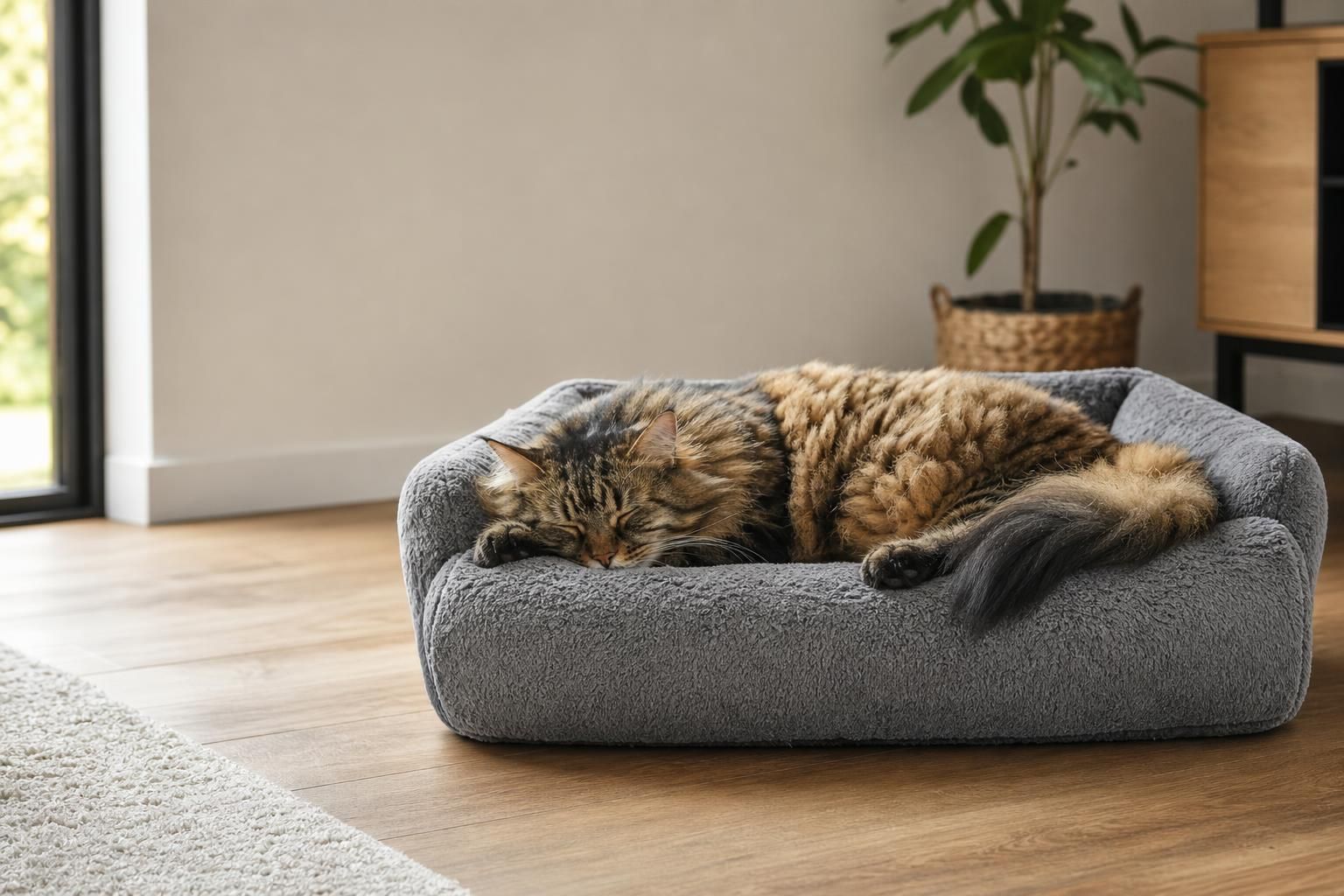
The best bed for large cats is one measured in inches rather than labeled "cat-sized," with at least 24–28 inches of interior diameter or length so the cat can stretch out or curl up fully without a paw hanging off the edge. Look for a base that holds shape under 15+ pounds, raised or bolstered sides for back support, and a cover that unzips for machine washing. Plush round beds, bolster beds, and open rectangular pads all work, but the right pick depends on whether your cat likes to sprawl or burrow.
Key takeaways
- Measure your cat nose-to-tail while stretched out, then add 4–6 inches — that's the minimum interior bed dimension to look for.
- Bolstered or enclosed beds suit cats who like to curl and feel hidden; flat, open pads suit sprawlers who sleep stretched out.
- Check the fill and base material: compressed, high-density foam or clustered fiberfill holds up better than loose stuffing under a heavier cat.
Why Standard Cat Beds Often Fail Large Cats
Most mass-market cat beds are built around an average 8–10 pound cat, so a 15-to-20-pound Maine Coon or large mixed-breed cat ends up with legs or a tail hanging over the rim all night. A bed that's too small also compresses faster, flattening the fill within weeks and losing the supportive dome shape that bolster beds rely on for perceived security. The fix isn't a vaguely labeled "XL" bed — it's a bed with a stated interior measurement you can compare directly to your cat's resting length.
How to Measure Your Cat Before You Shop
Skip generic size labels and measure your cat the way you'd measure for clothing. This is the same inch-based approach Ziva Paws uses for its clothing sizing charts, because garment and bed fit have the same failure point: eyeballing it instead of measuring it.
- Let your cat lie down fully stretched, then measure nose to base of tail.
- Measure your cat lying curled in their favorite spot for a curl-diameter number.
- Add 4–6 inches to the stretched length (or 2–3 inches to the curl diameter) to get your minimum bed size.
- Note your cat's weight — it tells you how dense the base foam or fiberfill needs to be to avoid bottoming out.
A cat around 16–20 pounds typically needs an interior bed footprint of at least 26–30 inches for a flat pad, or a 20–22 inch interior diameter for a round bolster bed that still leaves room to curl.
Bed Styles Compared for Larger Cats
| Bed style | Best for | Interior space to look for | Watch-out |
|---|---|---|---|
| Flat/open pad | Sprawlers, warm climates | 26–30 in. length | Less sense of enclosure, may feel exposed |
| Round bolster bed | Curlers who like back support | 20–22 in. interior diameter | Bolster height should still clear a stretched tail |
| Enclosed hood/nest bed | Anxious or senior cats | 18–20 in. interior height + width | Entrance needs to be wide enough for shoulders |
| Rattan or raised nest | Cats who like height and visibility | 24+ in. outer diameter | Check weight rating of the frame, not just the cushion |
| Heated or orthopedic pad | Older or arthritic large cats | Match to stretched length | Confirm low-voltage, chew-resistant cord if heated |
Material and Build Details That Actually Matter
A bed's listed size means little if the base collapses under a heavier cat within a season. A few concrete things to check before buying:
- Base density: a compressed foam base (not loose fiberfill alone) holds a dome or bolster shape longer under sustained weight.
- Seam construction: double-stitched seams at stress points (where the bolster meets the base) resist splitting from repeated kneading and scratching.
- Washability: a removable, machine-washable cover matters more for larger cats, who shed and track more litter simply by covering more surface area.
- Base grip: a non-slip bottom keeps a larger, heavier bed from sliding on hardwood or tile as the cat climbs in and out.
Our own cats, Ai and Dudu, test bedding fit and seam durability before anything goes on the Ziva Paws site, specifically checking whether a bolster holds its shape after repeated kneading — a habit most cats never outgrow.
Enclosed vs. Open: Which Shape Fits a Bigger Cat Best
Some large cats still prefer to hide rather than sprawl, and enclosed designs can work for them if the entrance and internal height are sized correctly — a hood that's roomy enough for a kitten will pinch a 20-pound cat's shoulders. If your cat consistently chooses closets, boxes, or under-bed spaces over open furniture, it's worth reading why cats gravitate toward enclosed beds before assuming a flat pad is the right fit. The instinct is about feeling protected from above and behind, not about the bed being too small — so an enclosed design in the correct interior size can solve that need without cramping a larger frame.
When Scratching Behavior Signals a Bed Problem
If a large cat is shredding the edges of a new bed within days, it's not necessarily destructive behavior — it can be a sizing or texture mismatch, or simple territorial scent-marking. The reasons cats scratch at their bedding range from nesting instinct to claw maintenance, and a bed that's genuinely the right size tends to get scratched less because the cat isn't trying to reshape it to fit.
A Note on Weight and Joint Support
Larger cats, especially those carrying extra weight or entering their senior years, benefit from firmer, higher-density support rather than soft loose fill that lets joints sink to the floor of the bed. The Cornell Feline Health Center notes that joint and mobility issues become more common as cats age, which makes supportive, properly sized bedding more than a comfort preference for an older large-breed cat. The ASPCA also recommends providing cats with a dedicated resting spot away from high-traffic areas, which matters more for larger cats since they often need more physical space to feel settled.
Quick Buying Checklist
- Confirm the listed dimension is interior space, not overall bed footprint including bolsters.
- Match bed style (flat, bolstered, enclosed) to how your cat actually sleeps, not how you'd like them to sleep.
- Prioritize a washable cover and a non-slip base over extra decorative trim.
- If your cat is still growing or a mixed-breed with unclear adult size, size slightly up rather than down.
Frequently Asked Questions
Q: How big should a bed be for a large cat?
For a cat stretched out nose to tail, add 4–6 inches to that measurement for the minimum interior length of a flat bed. For a round or bolster-style bed, aim for at least 20–22 inches of interior diameter so the cat can still curl comfortably.
Q: Do large cats prefer enclosed or open beds?
It depends on the individual cat's instincts more than its size — some large cats still prefer enclosed, hidden spaces, while others sprawl out on open pads. The key factor isn't preference for open versus closed, it's making sure the enclosed option is sized correctly so shoulders and hips aren't cramped.
Q: What bed material holds up best under a heavier cat?
A compressed, high-density foam base or tightly clustered fiberfill resists flattening better than loose stuffing, especially under cats over 15 pounds. Double-stitched seams at stress points also matter, since kneading and scratching concentrate wear there first.
Q: Can a bed that's too small cause behavior problems?
Yes — a cat may scratch, reshape, or avoid a bed that doesn't match its resting size, which can look like destructive behavior but is really a fit issue. Switching to a correctly measured bed often reduces that scratching on its own.
Q: Should senior large cats have a different bed than younger ones?
Senior cats, particularly larger ones, benefit from firmer support and lower entry heights since joint stiffness becomes more common with age. A supportive, properly sized base matters more at that stage than extra plush softness.