Best Cat Nest Bed for Winter: A Buyer's Guide
Key takeaway
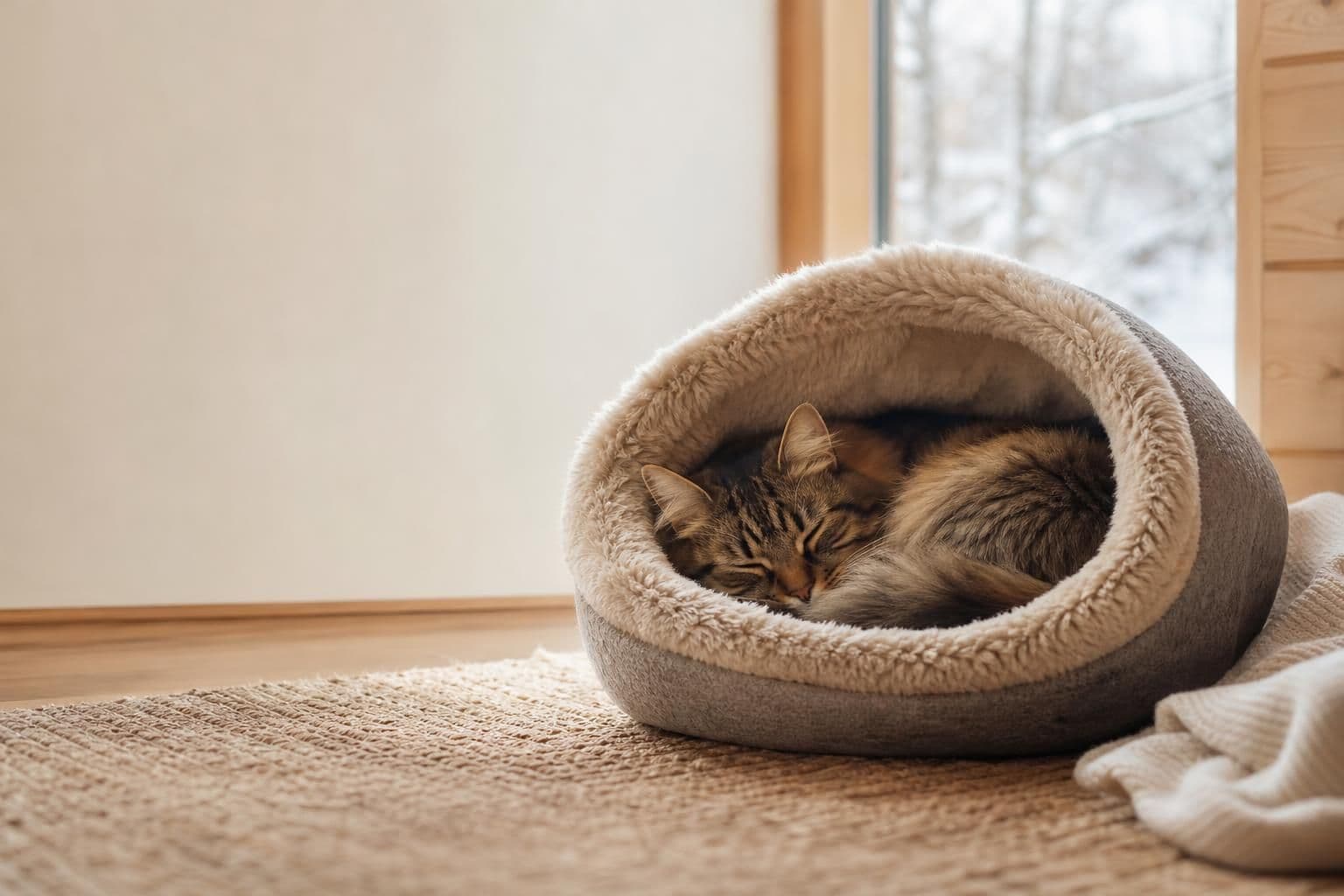
The best cat nest bed for winter has raised, enclosed walls that block drafts, a base thick enough to insulate against cold floors, and a machine-washable cover for shedding season. Look for plush or sherpa fabric with a fill like memory foam or high-loft polyester, sized so your cat can curl up with their chin resting on the rim. Covered or hooded nests trap body heat best, which matters most for senior cats, short-haired breeds, and homes with tile or hardwood floors.
Key takeaways
- Choose a nest with raised walls at least 4-6 inches tall to trap body heat and block drafts.
- Measure your cat curled up nose-to-tail and add 2-4 inches for a cozy-but-not-cramped fit.
- Prioritize machine-washable covers and a non-slip base over floors that get cold in winter.
What makes a nest bed warmer than a flat pad
A flat cushion lets heat escape in every direction, while a nest-style bed with raised sides creates a pocket of warm air around the cat's body. The taller the walls, the more heat stays trapped, which is why hooded or donut-shaped nests tend to feel noticeably warmer than open pads once temperatures drop. Fill material matters too: dense memory foam or high-loft polyester fiberfill holds warmth longer than thin, flat stuffing that compresses after a few weeks of use.
Floor temperature plays a bigger role than most owners expect. Cold spreads upward from tile, laminate, or concrete, so a bed without a thick, insulated base can feel chilly even in a heated room. A raised nest or one with a firm foam bottom layer helps separate your cat from that cold surface.
Sizing a nest bed correctly
Oversized beds don't trap heat as efficiently, and undersized ones leave your cat's legs or tail hanging over the edge into cold air. The most reliable way to size a nest is to measure your cat while they're curled up in their typical sleeping position, from nose to tail, then add roughly 2-4 inches of diameter so they can shift positions without spilling out.
This is the same inch-based approach Ziva Paws applies across its clothing line — real chest, neck, and back-length measurements instead of vague S/M/L labels — because cats and dogs vary so much in body shape that generic sizing often misses the mark. The same logic applies to bedding: a nest that's "medium" at one brand may run small or large compared to another.
Materials and fill types compared
| Nest bed feature | Best for | Trade-off |
|---|---|---|
| Sherpa or plush fleece cover | Warmth retention, soft feel | Sheds more, needs frequent washing |
| Memory foam base | Senior cats, joint support | Heavier, slower to dry if washed |
| High-loft polyester fill | Lightweight warmth, quick dry | Compresses faster than foam over time |
| Hooded or covered design | Anxious or draft-sensitive cats | Less airflow, can feel warm in mild weather |
| Raised rattan or wicker nest | Added insulation from cold floors | Bulkier, less portable between rooms |
Signs your cat needs a warmer bed this winter
Cats are good at hiding discomfort, but a few behaviors usually signal that their current bed isn't cutting it once the weather turns cold. According to the ASPCA, indoor cats can still be sensitive to temperature swings, and seeking out heat sources is a normal cold-weather response rather than a sign of illness on its own.
Watch for these patterns:
- Sleeping on top of heating vents, radiators, or laundry straight out of the dryer
- Curling into a tighter ball than usual, tail wrapped fully around the body
- Avoiding a previously favorite bed located near a window or exterior wall
- Shivering briefly after waking, especially in short-haired or senior cats
If you notice two or more of these, it's a reasonable signal to upgrade to a more insulated nest rather than layering extra blankets on an open pad.
Placement matters as much as the bed itself
Even the warmest nest underperforms if it sits in a drafty spot. Interior walls, away from exterior doors and single-pane windows, hold ambient room heat better than corners near glass. The U.S. Department of Energy notes that windows and doors are common sources of household heat loss in winter, which is worth remembering when choosing where any pet bed goes, not just where it looks nice.
Elevating the bed slightly off the floor — on a low platform or folded towel — also helps in rooms with hard flooring, since it reduces direct contact with the coldest surface in the space.
How Ai and Dudu test for winter comfort
Ziva Paws' two resident cats, Ai and Dudu, try out bedding before it's listed, and their habits are a useful real-world check: a nest only earns repeat naps if it holds warmth without trapping odor, and if the cover survives regular washing without the fill clumping. That everyday testing is part of why fill quality and washable covers get called out specifically rather than treated as minor details.
If your cat already struggles with cold paws or joints, pairing a warm nest with a soft grooming towel from the grooming lineup for quick post-walk dry-offs can help keep damp fur from making the cold feel worse. For cats who also scratch and knead before settling in, a nearby scratcher lounge can give them a ritual stop before bed.
Washing and maintaining a winter nest bed
Fur, dander, and moisture build up faster in colder months when cats spend more time indoors and in one spot. A removable, machine-washable cover is the single most practical feature to check before buying, since hand-washing a whole nest bed is impractical for most households. Wash covers every one to two weeks during peak shedding season, and check the inner fill or foam for flattening every few months — if it no longer springs back after a cat gets up, it has lost most of its insulating ability.
Frequently Asked Questions
Q: What size nest bed is best for an adult cat in winter?
Measure your cat curled up nose-to-tail and choose a nest with an interior diameter 2-4 inches larger than that measurement, so they can fully tuck in without spilling over the edge.
Q: Are covered or hooded cat beds warmer than open nests?
Yes, covered designs trap more body heat because they limit airflow around the cat, which makes them a better choice for drafty rooms or cats who seem to seek out small, enclosed warm spots.
Q: How often should I wash a winter cat bed cover?
Every one to two weeks during cold months is a reasonable baseline, since indoor cats spend more time in their beds and shed more in heated homes.
Q: Does bed placement really affect how warm a cat stays?
Yes — beds near exterior windows or doors lose heat faster than those placed against interior walls, since glass and door gaps are common points of household heat loss.
Q: Can a nest bed replace a heating pad for cold-sensitive cats?
A well-insulated nest reduces heat loss significantly, but cats with health conditions affecting circulation may still benefit from a vet-approved heating option in addition to a warm bed.