7 Dog Crate Alternative Options That Actually Work
Key takeaway
A dog crate alternative is any confinement or safe-zone setup — such as an exercise pen, a gated room, a dog-proofed area, or a sturdy open bed with boundaries — that keeps a dog contained and safe without using a traditional wire or plastic crate. The right choice depends on your dog's chewing habits, anxiety level, house-training status, and how much space you have. Most owners land on one of these options after a crate stops suiting their dog's age or temperament.
Key takeaways
- Exercise pens and baby-gated rooms give more room to move than a crate while still containing a dog safely.
- A crate alternative only works if it matches your dog's destructive or anxious behavior — test it while supervised before leaving them alone in it.
- Comfort matters as much as containment: a washable, properly sized bed inside the safe zone reduces pacing and chewing on furniture.
When People Start Looking for a Crate Alternative
Owners usually search for this after one of three things happens: their dog has outgrown puppyhood and no longer needs tight confinement, their dog shows anxiety or panic in a crate, or they simply want their living space to feel less like a kennel. The American Veterinary Medical Association notes that crates are a training tool, not a lifetime requirement — once a dog is reliably house-trained and past the destructive-chewing phase (commonly 6 months to 2 years depending on the dog), many families transition to looser containment.
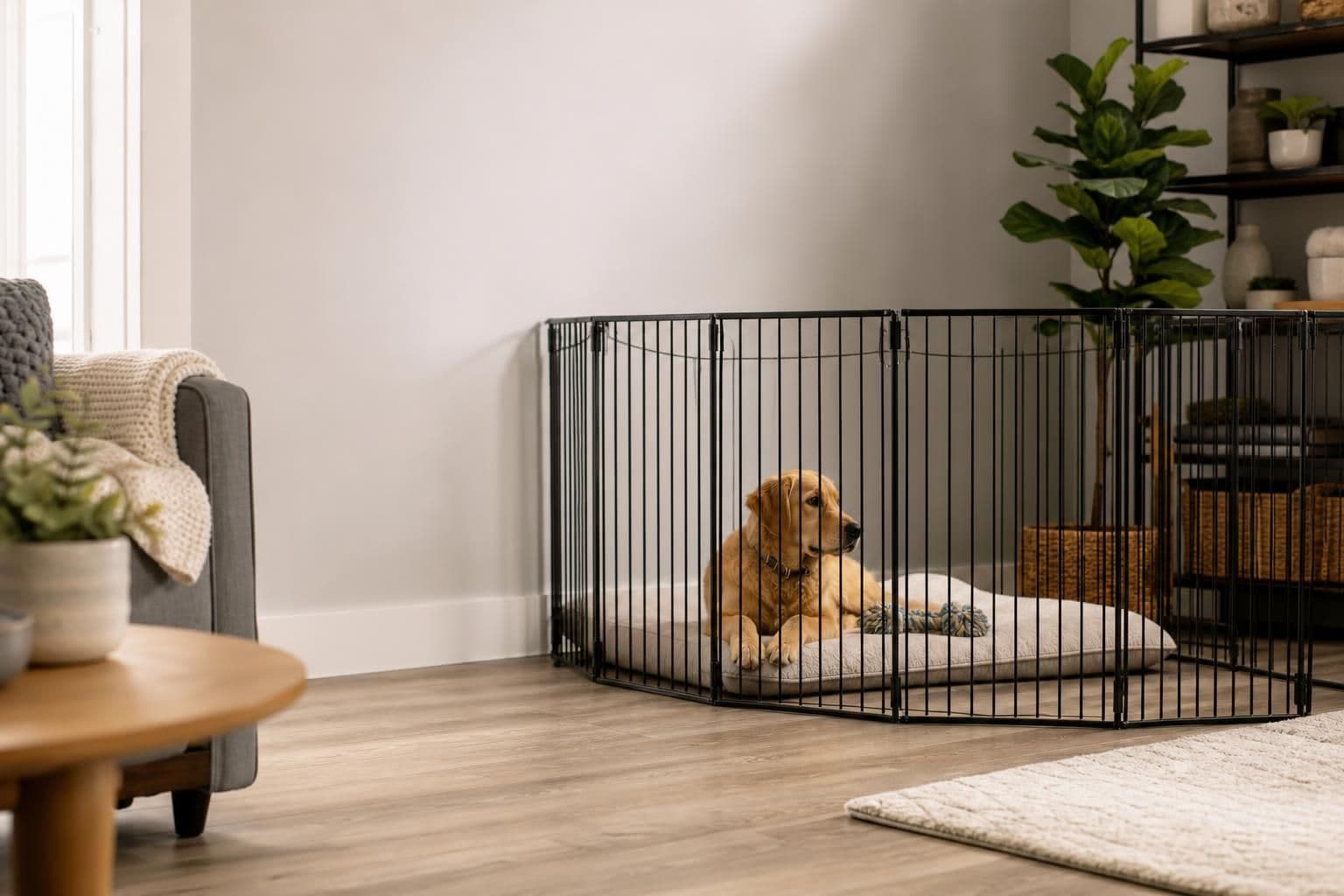
1. Exercise Pens (X-Pens)
An exercise pen is a freestanding, foldable barrier — usually metal panels — that creates a boundary without a top or sides pressing in. Pens typically range from 24 to 48 inches tall and can be configured into a square, rectangle, or L-shape to fit a room corner. They work well for dogs who need space to turn around, stretch out, or stand up fully, which a standard crate doesn't always allow for larger breeds.
2. Baby Gates and Room Dividers
Gating off a single room — a kitchen, laundry room, or hallway — turns an entire space into the containment area instead of a box. This suits dogs who do fine with freedom but need to be kept off carpets, away from stairs, or separated from a resident cat during the adjustment period. Pressure-mounted gates are easiest to move between rooms; hardware-mounted ones hold up better against a determined pusher.
3. A Fully Dog-Proofed Room
If you have a spare room, laundry room, or mudroom, dog-proofing it (cords up, trash secured, nothing chewable at nose height) can replace a crate entirely. This works best for house-trained adult dogs without severe separation anxiety, since an open room offers no physical reassurance the way a den-like crate does for dogs who find enclosed spaces calming.
4. Soft-Sided or Furniture-Style Crates
For dogs who are calm and non-destructive but whose owners simply dislike the look of a wire crate, furniture-style crates (styled as end tables or cabinets) and soft-sided mesh crates offer a middle ground — still a defined den, just less industrial. These aren't suitable for strong chewers or dogs who scratch at barriers, since soft mesh and thin panels won't hold up to that.
5. Open Beds With a Defined Boundary
Some dogs don't need a barrier at all — they need a spot that reliably means "stay here." A sturdy, bolstered bed placed in a low-traffic corner, paired with consistent training, can function as a release from constant confinement for dogs with excellent house manners. Sizing the bed correctly matters more than people expect: a bed too small gets abandoned, and one too large loses the "denning" effect that helps dogs settle. If you're also rethinking your dog's overnight settling routine, a well-placed bed is often part of that fix.
6. Cat-Style Tunnels, Nests, and Hammocks (Multi-Pet Households)
In homes with both dogs and cats, giving each animal their own defined resting spot reduces resource guarding and nighttime conflict, which indirectly reduces how much confinement either pet needs. Ziva Paws tests its bedding and hammock styles with its own cats, Ai and Dudu, before listing them, checking that fabric holds up to daily scratching and that the structure stays put once a pet settles in — the same durability questions worth asking about any crate alternative you buy, for either species. Browse the bedding and furniture collection for den-style options sized for both cats and dogs.
7. Enrichment-Based Confinement
A pen or gated room only stays calm if the dog has something to do inside it. Puzzle feeders, treat-dispensing toys, and chew-safe options reduce the boredom that turns a loose setup into a destroyed baseboard. The toys collection covers puzzle boxes and durable chew options worth rotating through a pen so the same toy doesn't go stale after a week.
Matching the Alternative to the Dog
| Dog's behavior | Better-suited alternative |
|---|---|
| Still teething or a heavy chewer | Metal exercise pen, not soft-sided |
| Mild separation anxiety | Gated single room with their bed and scent |
| Severe panic or self-injury when confined | Consult a vet before any unsupervised confinement |
| Reliably house-trained, calm | Open room or boundary-only bed setup |
| Shares space with a cat | Pen plus a separate elevated cat perch |
The ASPCA points out that true separation anxiety — pacing, drooling, destructive escape attempts at exits — needs a behavior plan, not just a different container; swapping a crate for a pen won't resolve panic-driven behavior on its own.
Transitioning From a Crate Without Setbacks
Dogs who were crate trained as puppies sometimes regress in house manners when confinement loosens too fast. A gradual approach works better than an abrupt switch:
- Leave the crate door open with the new pen or gate set up alongside it for a week.
- Supervise short absences (10–15 minutes) in the new setup before leaving for hours.
- Keep the dog's existing bedding and one familiar toy in the new space so the scent cues carry over.
- Only remove the crate once a week of unsupervised time has passed without accidents or destruction.
Frequently Asked Questions
Q: What is the best dog crate alternative for a dog with separation anxiety?
A gated single room with familiar bedding and background noise tends to work better than an open pen, since walls provide more security than bars. Dogs with moderate to severe anxiety symptoms, such as panic or self-injury, should be evaluated by a veterinarian before any unsupervised confinement change.
Q: Can an exercise pen replace a crate for a puppy?
It can once the puppy is past the heaviest teething and chewing phase, usually after the baby teeth are gone around 6 months of age, but very young puppies often still do better in a smaller, enclosed space for house-training purposes. A pen set up in a dog-proofed kitchen is a reasonable middle step.
Q: Is it safe to leave a dog loose in one room instead of a crate?
Yes, for a house-trained adult dog without destructive habits, as long as the room is gated and free of hazards like loose cords, trash, or toxic plants. Start with short supervised trials before leaving the dog alone for a full workday.
Q: Do dogs need a den-like space even without a crate?
Many dogs seek out an enclosed, low-traffic spot to settle, which is why bolstered beds, covered nests, or a pen placed in a quiet corner often work better than wide-open floor space. Observing where your dog naturally chooses to nap is a good guide for where to set up their alternative.
Q: How do I stop my dog from destroying furniture once the crate is gone?
Pair any crate alternative with enrichment — puzzle feeders, chew toys, and a regular exercise routine — since boredom and pent-up energy are common drivers of destructive behavior. Reviewing how much daily exercise your dog actually needs can also reduce restlessness during unsupervised time.