How Many Toys Should a Dog Have? A Practical Guide
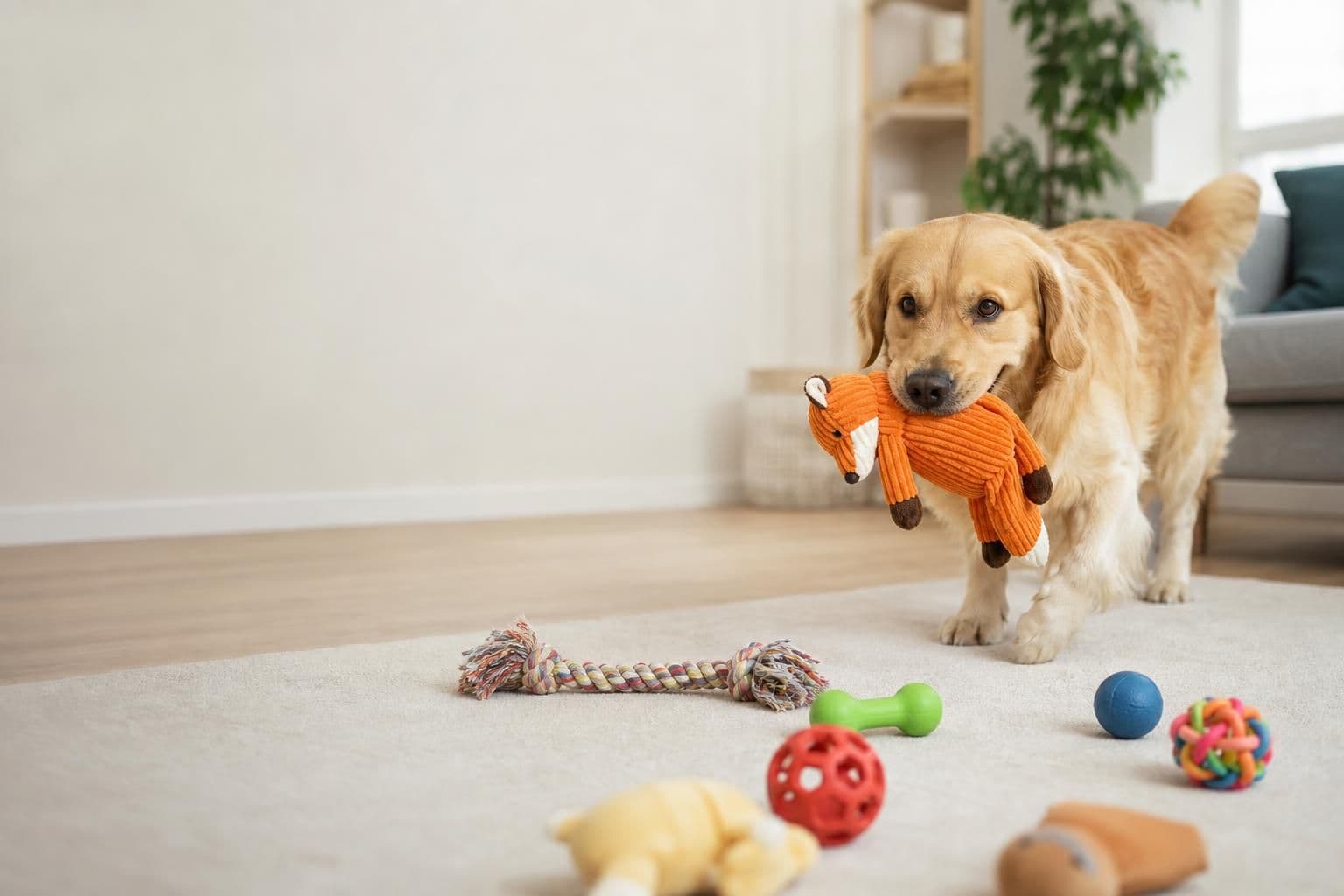
Key takeaway
Most dogs do well with 5 to 8 toys available at any given time, drawn from a larger rotating collection of 10 to 15. The exact number matters less than variety — a mix of chew, plush, puzzle, and fetch-style toys keeps a dog mentally engaged without cluttering the house or creating resource-guarding issues. Rotating toys every one to two weeks makes even a small collection feel new again.
Key takeaways
- Keep 5-8 toys accessible at once; store the rest and rotate every 1-2 weeks to renew interest.
- Cover at least three toy categories (chew, interactive/puzzle, and soft/comfort) rather than buying duplicates of one type.
- Watch for boredom (destructive chewing, pacing) or overload (toys ignored, guarding) and adjust the count accordingly.
Why a Set Number of Toys Isn't the Whole Story
There's no universal rule enforced by veterinary or behavior organizations about an exact toy count — the right number depends on the dog's age, energy level, and how much supervised playtime it gets. A high-energy young dog left alone for long stretches typically needs more mental stimulation than an older, low-drive dog with daily walks and training sessions. The American Veterinary Medical Association notes that environmental enrichment, which includes toys, is a core part of preventing boredom-driven behavior problems in dogs, not a fixed checklist item.
What a Well-Rounded Toy Collection Looks Like
Rather than counting toys individually, think in categories. A balanced rotation usually includes:
- Chew toys for dogs that need to gnaw — rubber or nylon designs sized to the dog's jaw strength.
- Plush or squeaky toys for comfort and low-key play, often a dog's "security object."
- Puzzle or treat-dispensing toys that slow down eating or reward problem-solving.
- Fetch or tug toys for structured physical exercise.
- One or two novelty toys kept in reserve specifically for rotation.
Having one of each category on hand, rather than five identical squeaky balls, does more for a dog's engagement than sheer quantity.
Signs Your Dog Has Too Few or Too Many Toys
Too few toys often shows up as redirected chewing — on furniture, shoes, or baseboards — because the dog is seeking texture and stimulation it isn't getting elsewhere. Too many toys, on the other hand, can lead to a dog ignoring all of them, or in multi-dog households, guarding a pile it can't actually use. A practical middle ground: if a dog hasn't touched a toy in over two weeks, it's a candidate for rotation storage rather than permanent access.
Building a Simple Toy Rotation System
- Lay out your full toy collection and sort by category (chew, plush, puzzle, tug).
- Pick 5-8 that represent at least three categories and leave them out.
- Store the rest in a closed bin, out of sight.
- Swap in 2-3 stored toys every 1-2 weeks, removing an equal number from circulation.
- Retire any toy showing frayed seams, exposed stuffing, or cracked plastic immediately.
This keeps the toy box small and manageable while making every toy feel novel again when it reappears.
Matching Toy Size and Durability to Your Dog
Toy safety depends more on fit than on toy count. A toy too small for a dog's mouth is a choking risk; one that's too soft for a heavy chewer will be destroyed and potentially swallowed in pieces. The ASPCA recommends supervising new toys the first few times a dog interacts with them, especially anything with squeakers, stuffing, or small removable parts. At Ziva Paws, resident cats Ai and Dudu test product durability before anything goes up for sale, and while they're cats rather than dogs, the same "does it hold up to real chewing and batting" standard applies across the toys collection.
Toys Are One Piece of a Bigger Enrichment Picture
Toy count matters less when a dog also gets physical exercise, training time, and a calm place to decompress. Dogs prone to anxiety often do better with fewer, familiar comfort toys kept near their resting spot rather than a rotating novelty pile — something worth considering alongside choosing a cozy bed for an anxious dog, since a stable sleeping area reduces the pressure on toys to do all the emotional-comfort work. Puzzle feeders can also double as enrichment tools if regular toys aren't holding a dog's interest; the feeding collection includes slow feeders that serve a similar mental-stimulation purpose at mealtime.
When to Add or Remove Toys From the Mix
Puppies teething, dogs recovering from surgery, or seniors with reduced jaw strength all need toy collections adjusted for that life stage rather than a fixed number. A young, destructive chewer may go through toys faster and need more frequent restocking, while a senior dog might do fine with two or three soft, familiar favorites. Reassessing the collection every few months — checking for wear, interest level, and appropriateness for current age or health — is more useful than sticking to a static count indefinitely.
Frequently Asked Questions
Q: How many toys should a dog have at once?
Most dogs do well with 5 to 8 toys accessible at a time, ideally spanning chew, plush, puzzle, and fetch categories, with additional toys stored for rotation.
Q: Can a dog have too many toys?
Yes — an overwhelming pile can lead to toys being ignored altogether or, in multi-dog homes, to guarding behavior. Keeping a smaller active set and rotating the rest usually works better.
Q: How often should I rotate my dog's toys?
Every one to two weeks is a reasonable interval for most dogs; swapping a few toys out and a few back in keeps the collection feeling new without constant repurchasing.
Q: Do puppies need more toys than adult dogs?
Puppies often go through a teething phase where they need durable, appropriately sized chew toys more frequently, but the overall count principle — a small rotating set rather than a large static pile — still applies.
Q: What toy categories should every dog have?
At minimum, a chew toy, a soft/plush comfort toy, and one interactive or puzzle-style toy cover the main behavioral needs most dogs have.