How Much Should I Feed My Cat? A Practical Guide
Key takeaway
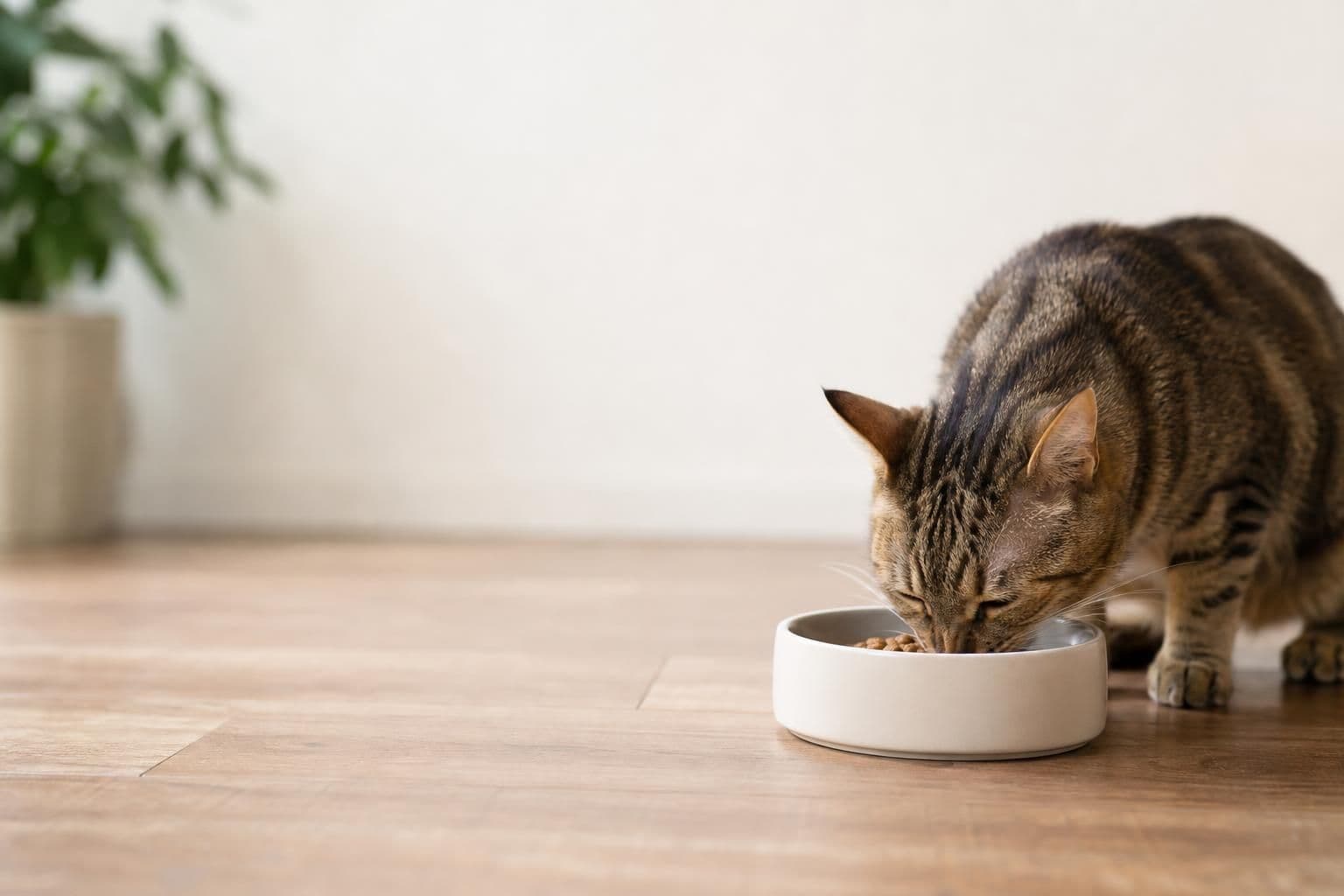
Most healthy adult indoor cats need roughly 24 to 35 calories per pound of body weight each day, which works out to about 200–275 calories daily for an average 8–10 pound cat. The exact number depends on age, activity level, whether the cat is spayed or neutered, and the calorie density of the specific food, so the feeding chart on the bag or can is a starting point, not a rule. The best way to fine-tune the amount is to track your cat's weight and body condition every few weeks and adjust the portion up or down in small steps.
Key takeaways
- Start with 24–35 calories per pound of body weight per day for an average adult cat, then adjust based on results.
- Use a kitchen scale or measuring cup consistently — "eyeballing" food is the most common cause of overfeeding.
- Check body condition (not just the scale) every 2–4 weeks and adjust portions by 10% at a time.
Why the Bag's Feeding Chart Isn't the Final Answer
Pet food packaging lists feeding amounts based on average cats at average activity levels, which rarely matches any specific cat. A neutered indoor cat that sleeps most of the day often needs less than the chart suggests, while a younger, more active cat may need more. The ASPCA recommends treating package guidelines as a starting range and adjusting based on your cat's actual weight trend rather than following the number exactly.
Calorie density also varies a lot between products. A cup of one dry food might contain 300 calories, while another brand's cup holds 400. Switching foods without recalculating the portion is one of the easiest ways for a cat's weight to drift up or down without an owner noticing.
A Simple Way to Calculate Portions
- Find your cat's current weight in pounds (a home scale works: weigh yourself holding the cat, then subtract your own weight).
- Multiply by 24–35 calories, depending on activity level (use the lower end for a sedentary indoor cat, the higher end for an active or younger cat).
- Check the calorie content per cup or can on the food's label — it's usually listed as "kcal/kg" or "kcal per cup" in the guaranteed analysis section.
- Divide your target daily calories by the food's calorie count to get the daily amount, then split it across 2–3 meals.
Using a slow feeder bowl or a portioned feeding routine can also help prevent cats from eating an entire day's ration in one sitting, which some cats will do if food is left out freely. If you're setting up a feeding routine for the first time, a set of measuring tools and slow feeders makes it easier to keep portions consistent day to day.
Adjusting for Life Stage
- Kittens need considerably more calories per pound than adults because they're growing — typically fed 3–4 small meals a day rather than 2.
- Adult cats (roughly 1–7 years) generally do well on 2 measured meals a day, split to match their calculated daily total.
- Senior cats (7+ years) sometimes need fewer calories if activity drops, but some seniors lose muscle and need slightly more — this is a case where a vet check helps rule out thyroid or kidney issues before assuming it's just aging.
Reading Your Cat's Body, Not Just the Scale
Weight alone doesn't tell the whole story, since a cat's ideal weight varies by frame size. The American Animal Hospital Association recommends using a 9-point body condition score, where a cat at an ideal weight has ribs you can feel easily under a thin layer of fat and a visible waist when viewed from above. If ribs are hard to feel at all, or there's no waist, the cat is likely overweight; if ribs, spine, and hip bones are visible with no fat cover, the cat is likely underweight.
Doing a quick hands-on check during regular brushing sessions is an easy way to catch changes early, since you're already handling the cat's body. Pairing feeding checks with a regular grooming schedule means you're less likely to miss slow weight changes that build up over months.
Why Overfeeding Is the More Common Problem
Weight gain in indoor cats tends to happen gradually, a few grams at a time, which makes it easy to miss until a vet visit reveals a jump. The Association for Pet Obesity Prevention has tracked overweight and obese body condition in a majority of cats seen at U.S. veterinary clinics in past surveys, making it one of the more common preventable health issues in pet cats. Free-feeding (leaving dry food out all day) is one of the biggest contributors, since it removes any natural portion control.
Wet food, because it's more filling per calorie and higher in water content, can help some cats feel satisfied on fewer calories than an equivalent amount of dry kibble — worth discussing with a vet if weight management is a goal.
Signs Your Portions Need Adjusting
- Your cat is constantly meowing for food shortly after meals, or emptying the bowl and looking for more.
- Ribs are hard to feel, or the waist has disappeared when viewed from above.
- Weight has changed by more than a pound or two over a couple of months without an intentional diet change.
- Your cat seems less interested in play or is sleeping noticeably more than usual.
If any of these show up, adjust the daily total by about 10% and recheck body condition again in two to three weeks rather than making a large change all at once.
Frequently Asked Questions
Q: How many times a day should I feed my adult cat?
Two measured meals a day works well for most adult cats, though splitting the same daily total into 3 smaller meals can help cats that tend to overeat in one sitting or that beg frequently.
Q: Is free-feeding (leaving food out all day) a good idea?
Free-feeding removes portion control and is linked to higher rates of overweight body condition in cats, so measured meals are generally the safer default unless a vet has recommended otherwise for a specific health reason.
Q: How do I know if my cat is at a healthy weight?
Feel along the ribs — you should be able to feel them easily under a thin layer of fat — and look for a visible waist from above; if ribs are hard to find or there's no waist, the cat is likely carrying extra weight.
Q: Do kittens need more food than adult cats?
Yes, kittens need more calories per pound of body weight than adults because they're growing, and they typically do better on 3–4 smaller meals a day instead of 2.
Q: Should wet food or dry food portions be measured differently?
Yes — check the calorie count per can or per cup on the label rather than assuming one type equals the other, since calorie density varies significantly between wet and dry formulas and between brands.