Is a Whack-a-Mole Cat Toy Worth It?
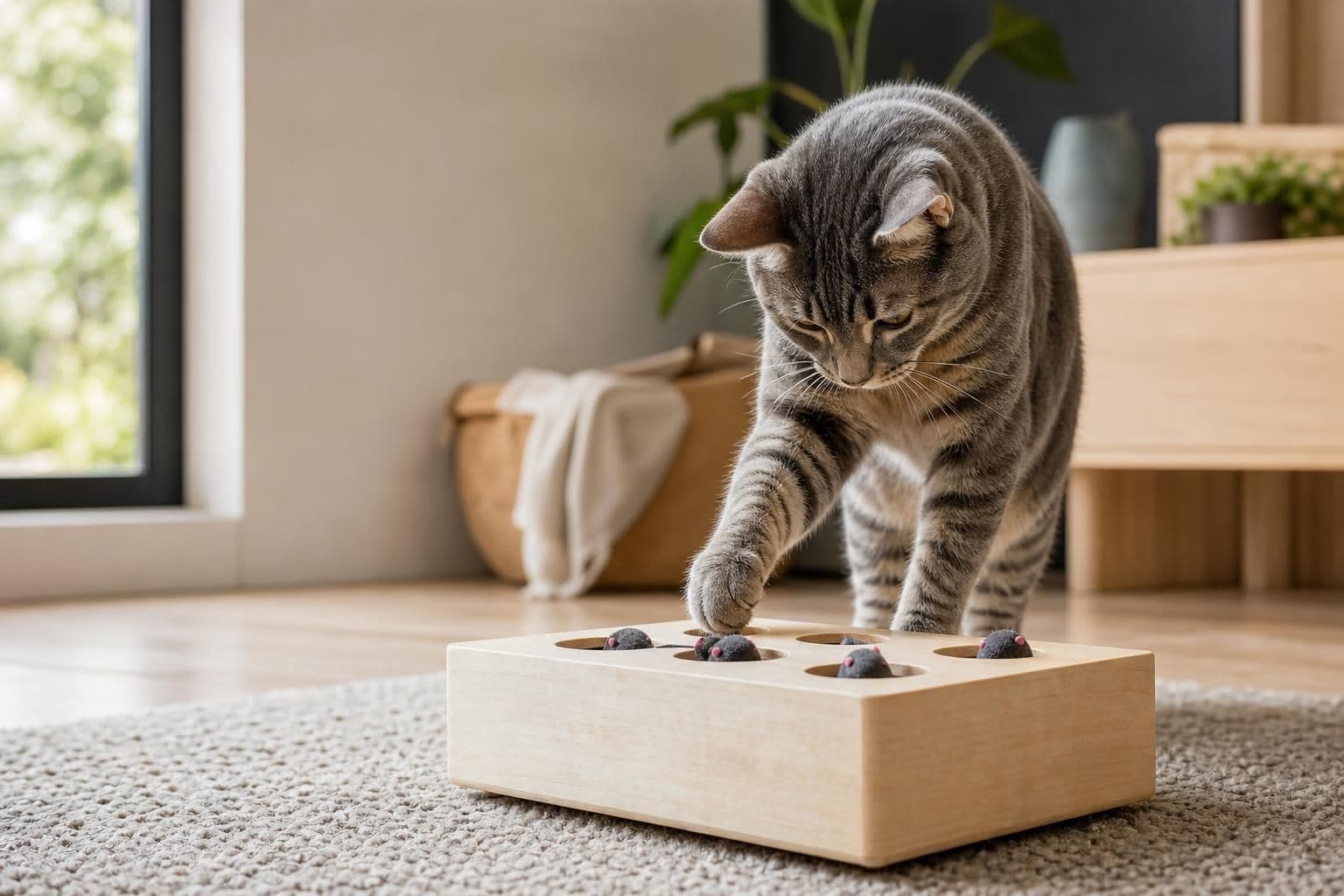
Key takeaway
A whack-a-mole cat toy is worth it for cats with a strong prey drive who need solo enrichment, especially in homes where the human can't always initiate playtime. It's less worth it for cats who are noise-sensitive or who only respond to toys a person is actively holding. The deciding factor isn't the gimmick — it's whether your specific cat chases movement without supervision.
Key takeaways
- Whack-a-mole toys work best for cats that already stalk or pounce on moving objects, not cats that ignore toss toys.
- Battery-powered pop-up versions can be loud; test volume near a sleeping cat before assuming it's fine.
- Pair it with a feeding puzzle or interactive teaser toy so the cat gets both solo and human-led play, since neither alone covers all enrichment needs.
What a Whack-a-Mole Cat Toy Actually Does
The toy mimics rodent movement by popping fabric "moles" or plush pieces up through holes in a base, either randomly (motorized) or manually (a hand pushes them up from underneath). The point is to trigger a cat's predatory sequence — stalk, chase, pounce, bite — in short bursts. This matters because indoor cats often show fewer outlets for that sequence than outdoor cats, and unspent predatory energy is a commonly cited factor in problem behaviors like nighttime zoomies or furniture scratching, according to the American Association of Feline Practitioners.
When It's Genuinely Worth the Money
A whack-a-mole toy earns its keep in a few specific situations:
- You work long hours and need something that runs without you present. Motorized versions with randomized timing keep a cat guessing better than a toy that pops in a fixed pattern.
- Your cat is food-motivated. Some models double as treat dispensers, rewarding a successful "catch" — this combines physical play with a small feeding puzzle element.
- You have multiple cats. A shared toy can reduce single-toy squabbles better than one wand toy that only one cat can use at a time.
- Your cat already chases laser dots or bugs on the wall. That's a strong predictor they'll engage with popping fabric too.
Our own test cats, Ai and Dudu, responded differently to the same unit — one pounced within the first minute, the other walked away and didn't return. That split is common enough that it's worth treating any whack-a-mole toy as a "try and observe" purchase rather than a guaranteed hit.
When It's Probably Not Worth It
Skip it, or deprioritize it, if any of these describe your cat:
- Noise-sensitive cats. Motorized units have a motor hum plus a mechanical pop; a cat startled by vacuum cleaners often reacts the same way here.
- Senior cats with reduced mobility. Batting at a hole-level toy requires some crouching and quick paw extension that arthritic cats may avoid.
- Cats that only play with humans present. If your cat has never engaged with an unattended toy — including simple balls left on the floor — a whack-a-mole toy is unlikely to change that pattern on its own.
- Kittens who might chew fabric edges. Supervise early sessions until you know your kitten won't gnaw at the moles themselves.
Durability and Safety Basics to Check Before Buying
Look at three things before adding a whack-a-mole toy to your cart:
- Battery compartment security. It should be screwed shut, not just snapped, so a determined cat can't pry it open.
- Mole fabric attachment. Stitched or securely glued fabric holds up better than moles that are just tucked into a slot, which can be pulled loose and become a swallowing hazard.
- Base material. A weighted or rubber-footed base stays put on hard floors; a light plastic base will skate across the room mid-play, which frustrates cats and ends the session early.
The ASPCA recommends inspecting any interactive pet toy periodically for loose parts, torn seams, or exposed wiring, and retiring it once damage appears — advice that applies directly to motorized cat toys with small moving parts.
How It Compares to Other Enrichment Toys
No single toy replaces variety. A whack-a-mole toy covers solo, high-energy pounce play, but it doesn't replicate the scent-and-forage behavior of a puzzle feeder, or the social bonding of a wand toy you control. If your cat's play routine is limited to one toy type, expect boredom to creep back in within a few weeks regardless of which toy you picked. Rotating between a whack-a-mole toy, a puzzle box, and a teaser ball tends to hold interest longer than any one toy used daily. Ziva Paws' toy collection is organized by play style — pounce, chase, forage — which makes it easier to build that rotation instead of guessing.
Setting It Up for the Best Odds of Success
Placement affects engagement more than most buyers expect. Put the toy somewhere the cat already spends time — near a favorite window perch or a well-used cozy bed rather than a hallway they rarely walk through. Run the first session at a low speed setting if the toy has one, and let the cat investigate with sniffing before the motor starts. Cats that are startled on the first encounter often generalize that fear to the whole object and avoid it afterward, so a slow, quiet introduction matters more than the toy's features.
Frequently Asked Questions
Q: Are whack-a-mole cat toys safe for kittens?
They can be, but supervise early sessions since kittens are more likely to chew on fabric moles or paw at the battery compartment. Once you've confirmed the kitten plays without trying to pull pieces loose, unsupervised use is generally fine.
Q: Do all cats respond to whack-a-mole toys?
No. Cats with a strong prey drive who already chase moving objects tend to engage quickly, while cats that only play with a human holding the toy often ignore it. Testing with a low-cost version first can save you from buying a pricier motorized model your cat won't use.
Q: How loud are motorized whack-a-mole toys?
Volume varies by model, but most have an audible motor hum plus a mechanical popping sound each time a mole rises. If your cat startles at vacuum cleaners or doorbells, test the toy in a quiet room before leaving it running unattended.
Q: What's a good alternative if my cat doesn't like it?
A wand-style teaser toy or a puzzle feeder often works better for cats that need a human to initiate play or that are more food-driven than movement-driven. Rotating toy types, rather than replacing one toy with another of the same style, usually solves the boredom problem.
Q: How long do these toys typically last before wearing out?
Lifespan depends heavily on fabric quality and how roughly the cat plays, but the first failure point is usually the mole fabric tearing at the seams or the battery door loosening. Checking those two spots every few weeks extends usable life significantly.