Why Does My Cat Bring Me Toys?
Key takeaway
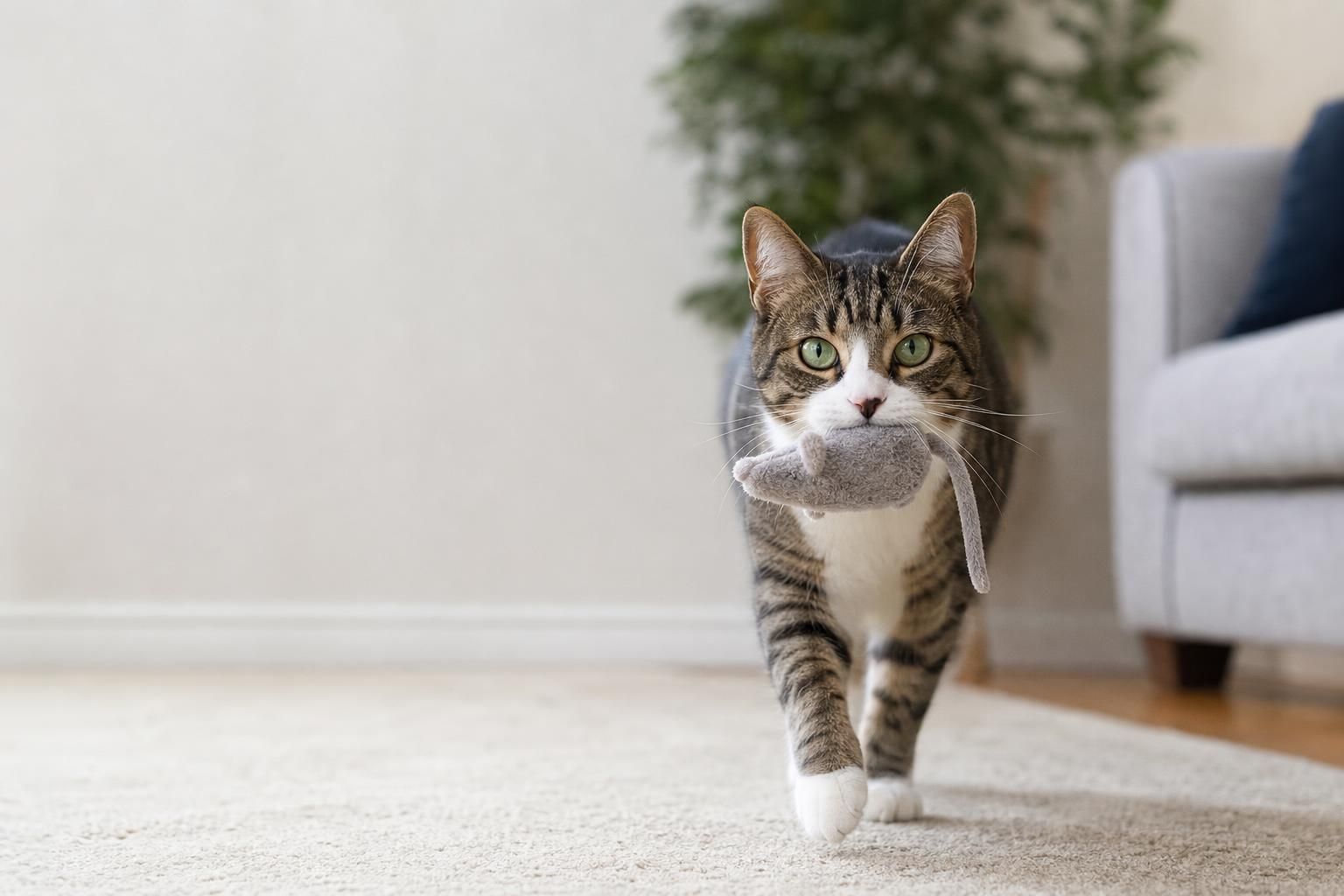
Cats bring toys to their owners mainly because it mimics the instinctive act of delivering prey back to the group, a behavior rooted in their wild ancestors' hunting and provisioning habits. For many cats, it's also a bid for attention, play, or praise, since owners often react with delight, which reinforces the behavior. In rarer cases, a cat may be "gifting" an item it associates with comfort, such as a toy that smells like you or its favorite resting spot.
Key takeaways
- Toy-delivering usually stems from predatory instinct, not guilt or confusion — it's a completion of the hunt sequence.
- Cats repeat the behavior when it earns a reaction, so praise (even laughing) can reinforce it.
- Frequent, deliberate toy deposits are generally a sign of a secure, confident cat, not a problem to fix.
The hunting instinct behind the behavior
Domestic cats retain the same predatory sequence as their wild relatives: stalk, chase, pounce, kill, and carry. According to the American Veterinary Medical Association, play in cats closely parallels hunting behavior, with toys standing in for prey. When a cat brings you a toy, it's often completing that last step of the sequence — carrying the "prey" back to a safe spot, which in a multi-cat or mother-kitten context would be the den.
This is why the behavior appears more in cats that were raised by a mother who taught hunting skills, or in cats that have strong play drives toward feather wands and plush toys. The carrying instinct doesn't disappear just because the toy isn't real prey; the motor pattern still runs its course.
It's often a social or attention-seeking signal
Cats are keen observers of cause and effect. If dropping a toy at your feet gets you to look up, talk to the cat, or start a play session, the behavior gets reinforced through simple operant learning — no different from a dog learning that sitting earns a treat. Over time, some cats learn that toy delivery is a reliable way to initiate interaction, especially if they live in a household where play happens on a predictable schedule.
This is especially common in cats that are under-stimulated during the day. A cat left alone for long stretches may stockpile energy and then present a toy the moment someone walks in the door, essentially asking, "Can we do the fun thing now?" If you've noticed more toy-related behaviors lately, it might be worth reading about why dogs get so fixated on squeaky toys for a comparison of how different pets use play to communicate.
Could it be a "gift"?
The idea that cats bring prey or toys as gifts is a popular theory, and while it isn't fully proven, it lines up with known feline social behavior. Mother cats bring live or dead prey to kittens to teach hunting skills, and some researchers believe adult cats may generalize this instinct toward their human "kittens" — i.e., their owners. Whether or not the cat consciously intends it as a gift, the outcome is the same: a toy appears on your pillow, in your shoe, or next to your laptop.
A few patterns can help you tell gifting apart from general play-seeking:
- Timing: Gift-like deliveries often happen at night or early morning, echoing natural crepuscular hunting hours.
- Object choice: Cats sometimes pick a specific toy repeatedly, suggesting attachment to that item rather than random selection.
- Vocalization: A loud, insistent meow while carrying the toy (sometimes called a "prey call") is more associated with excitement or announcement than simple play.
Ai, one of the two resident cats who test products at Ziva Paws, regularly carries a specific plush toy to the same spot by the food bowls before mealtime — a pattern that looks less like hunting and more like a learned routine tied to anticipation.
When toy-bringing signals something else
Most toy-carrying is harmless and even endearing, but a few related behaviors are worth paying attention to:
- Excessive meowing while carrying objects can indicate anxiety, especially in older cats experiencing cognitive changes, according to guidance from the Cornell Feline Health Center.
- Sudden onset in a cat that never did this before is usually not concerning on its own, but combined with other changes in appetite or litter box habits, it's worth mentioning at a routine vet visit.
- Compulsive repetition of fetching the same object dozens of times in a row can sometimes be a self-soothing behavior in cats with limited enrichment, similar in function to other repetitive habits covered in why some cats lose hair from stress or overgrooming.
None of these are reasons to worry by default — they're just signs to watch if the behavior changes in intensity or starts alongside other symptoms.
How toy type affects the behavior
Not all toys trigger retrieval instincts equally. Lightweight, prey-sized items — small plush mice, felt balls, soft catnip toys — are the easiest for a cat to carry in its mouth and are far more likely to be "delivered" than large or awkwardly shaped toys. Toys with a slight texture or fabric a cat can grip also get carried more often than smooth plastic ones.
If your cat already brings you specific toys, rotating in a few new textures (crinkle fabric, faux fur, or a small catnip-stuffed shape) can keep the instinct engaged rather than letting the cat fixate on one item until it falls apart. The toys collection includes several plush and catnip options sized for easy carrying, which can be a simple way to give a toy-obsessed cat more variety without changing the behavior itself.
Should you encourage or discourage it?
In most cases, there's no reason to discourage toy-bringing — it's a sign of a confident, engaged cat expressing a natural behavior in a safe, indoor-appropriate way. Responding with brief praise, a quick play session, or simply acknowledging the cat reinforces a positive interaction loop without requiring extra effort.
The only time it's worth adjusting your response is if the behavior escalates into demanding or disruptive patterns, such as repeated nighttime deliveries that interrupt sleep. In that case, a short, scheduled play session before bed — using a wand toy to let the cat complete a full hunt-catch-carry cycle — often reduces nighttime toy-dropping because the predatory drive gets satisfied earlier in the evening.
Frequently Asked Questions
Q: Why does my cat bring me dead bugs or bones instead of toys?
This is the same instinctive behavior extended to real prey. Cats that go outdoors or encounter insects indoors may bring these items for the same reasons they bring toys — completing the hunting sequence and sometimes sharing the catch with their household.
Q: Why does my cat meow loudly while carrying a toy?
Loud meowing during toy delivery, sometimes called a "prey call," is thought to announce the catch or seek attention. It's generally not a sign of distress unless paired with other behavior changes.
Q: Is it normal for a cat to bring the same toy over and over?
Yes, many cats develop a preference for one specific toy, often due to its texture, size, or scent. This repetition usually reflects comfort or habit rather than a problem.
Q: Should I always play with my cat when it brings a toy?
Responding, even briefly, reinforces the bond and satisfies the cat's instinct to complete the hunt cycle. You don't need a long session every time — a short toss-and-retrieve or a few seconds of praise is usually enough.
Q: Can toy-bringing be a sign of stress?
Occasionally, yes — if it's paired with excessive vocalization, pacing, or changes in appetite, it may reflect anxiety rather than simple play. On its own, toy-carrying is typically a normal, healthy behavior.