Wooden Cat Hammock: What to Look for Before You Buy
Key takeaway
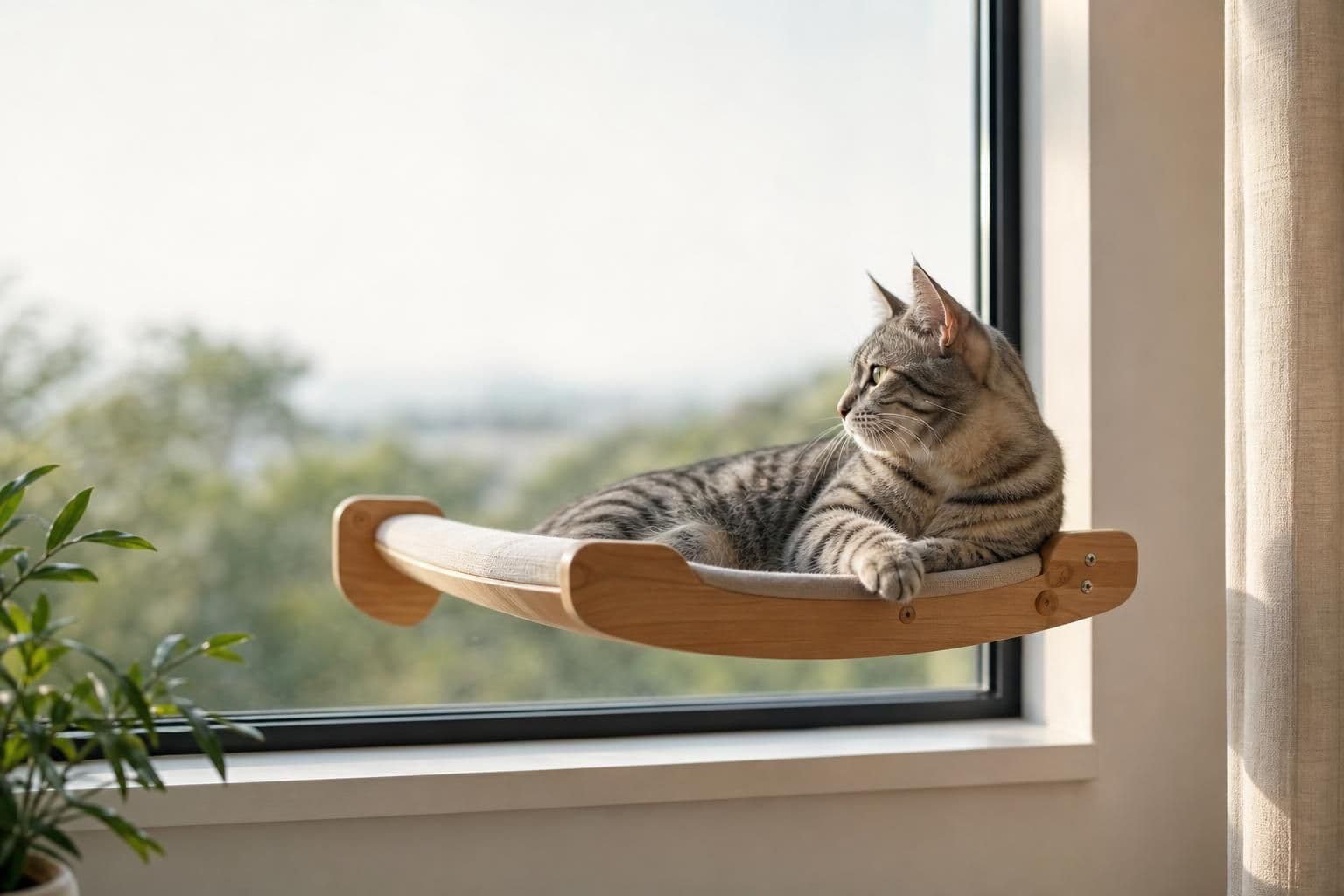
A good wooden cat hammock has a solid, kiln-dried wood frame rated to hold at least 15-20 lbs, a taut but padded fabric sling mounted with rounded (not sharp) hardware, and either suction-cup or screw-in wall mounts rated for indoor use. Look for finishes labeled non-toxic or unfinished natural wood, since cats often chew or lick the frame edges. The best placement is next to a window at a height where your cat can see outside without jumping more than a body-length to reach it.
Key takeaways
- Choose a frame with a stated weight capacity of 15-20 lbs or more, even for a single average-sized cat, to allow for jumping and shifting weight.
- Check that the wood finish is non-toxic and free of sharp edges, since cats groom and chew near contact points.
- Mount the hammock at a height cats can reach in one or two jumps — most cats prefer perches 2-4 feet off the floor near a window.
Why Cats Gravitate Toward Elevated Perches
Cats are natural climbers, and vertical space gives them a sense of security and a vantage point to monitor their territory. The Cornell Feline Health Center notes that environmental enrichment, including elevated resting spots, reduces stress-related behaviors in indoor cats by giving them choices about where to observe and rest. A wooden hammock mounted at window height taps directly into this instinct, which is why cats often adopt one faster than a floor bed.
Wood Type and Frame Safety
Most wooden cat hammocks use pine, beech, or bamboo frames, chosen because they're lightweight relative to their strength and easy to sand smooth. A few things matter more than the species itself:
- Finish: Water-based, non-toxic sealants are safer than varnishes with strong solvent odors, since cats rub their faces and bodies against the frame.
- Joinery: Dowel or screw joints reinforced with wood glue hold up better under repeated jumping than staples or nails alone.
- Edge treatment: Rounded or beveled edges prevent snagging fur or scratching skin during quick entries and exits.
The ASPCA advises checking any new pet furniture for loose fasteners, splinters, or protruding hardware before letting a cat use it unsupervised — a two-minute check that catches most manufacturing defects.
Sizing and Weight Capacity
Unlike clothing, hammocks aren't sized S/M/L — but capacity claims still vary widely between listings, and the actual usable sling area (length x width) matters more than the box dimensions. A hammock built for a single 10-lb cat may sag uncomfortably under a 15-lb cat stretched out fully. As a rule of thumb, look for a sling rated for at least 1.5 times your cat's weight, and a frame footprint at least as long as your cat from nose to base of tail.
If you're also shopping for clothing or a crate mat and keep running into vague sizing, it helps to know that some retailers now list garments by actual chest, neck, and back-length measurements in inches instead of generic labels — the same "measure first" logic applies to picking a hammock that actually fits your cat's resting posture.
Mounting and Wall Safety
Wooden hammocks typically mount one of three ways: suction cups to a window, screw brackets into a wall stud, or a freestanding frame that doesn't require mounting at all. Suction-cup models are the easiest to install but should be checked weekly, since suction strength can weaken with temperature swings near a sunny window. Screw-mounted frames are more permanent and generally handle more weight, but they require locating a stud rather than just drywall.
For renters or anyone unsure about drilling into a wall, a freestanding wooden cat tree with a built-in hammock platform avoids the mounting question entirely.
Comfort Add-Ons Cats Actually Use
A bare wood-and-canvas sling works, but most cats settle in faster with a removable cushion or fleece liner added on top. This also protects the fabric sling from claws and makes cleaning easier, since the cover can be tossed in the wash separately from the frame. If your cat is more anxious than most and tends to avoid open perches altogether, the same nesting instinct that makes enclosed cozy bedding for anxious pets work well applies here — a hammock with raised side walls or a partial canopy can feel safer than a flat, exposed platform.
Ziva Paws' own cats, Ai and Dudu, test bedding and perch products before they're listed, and one thing that consistently shows up in that process is that cats spend more time in a hammock once a familiar-smelling blanket or worn t-shirt is added during the first week — the scent seems to matter as much as the shape.
Placement and Cleaning
Position the hammock near a window with a view of a yard, street, or bird feeder rather than a blank wall — cats use these spots for visual stimulation as much as rest. Keep it a few inches clear of blinds cords or curtain pulls, and avoid direct heater vents, which can make the wood frame uncomfortably warm in winter.
Routine grooming also affects how clean a hammock stays. Cats shed on fabric slings just as they do on furniture, and keeping up with a regular grooming schedule cuts down on the loose fur that collects in hammock seams between washes.
Frequently Asked Questions
Q: How much weight can a wooden cat hammock hold?
Most quality wooden cat hammocks are rated for 15-20 lbs, though capacity depends on frame joinery and sling fabric strength. Always check the manufacturer's stated weight limit rather than assuming based on size alone.
Q: Is a wooden frame safer than a metal one for cat hammocks?
Wood and metal can both be safe if edges are smooth and hardware is secure; wood tends to feel warmer to the touch and is less likely to have sharp seams, while metal frames often support more weight. The bigger safety factor is finish quality and joint construction, not the material itself.
Q: How high should a cat hammock be mounted?
Most cats settle in fastest when a hammock is mounted 2-4 feet off the floor, low enough to reach in one or two jumps but high enough to feel elevated. Kittens and senior cats may need a lower height or an added step.
Q: Can two cats share one wooden hammock?
It depends on the frame's rated capacity and the cats' relationship — some hammocks list a combined weight limit that accounts for two cats, but many single-cat models will sag or feel unstable under double weight. Check the product's stated capacity before assuming it can hold more than one cat comfortably.