Best Countertop Edge Profiles for Hawaii Kitchens
Key takeaway
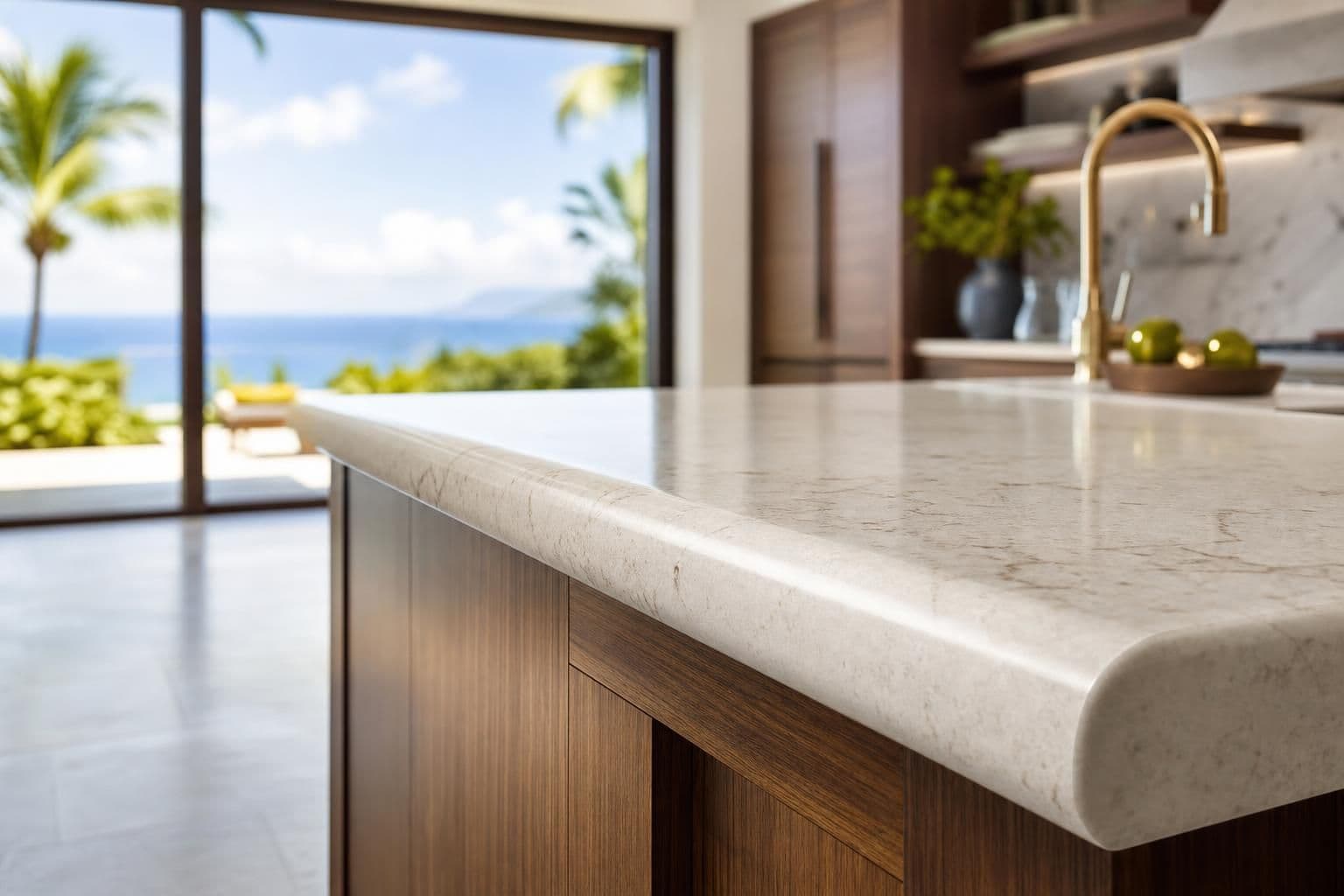
For most Hawaii kitchens, an eased or bullnose edge on quartz is the best all-around choice — it resists chipping in humid, high-traffic households, has no sharp corners for small kids or visiting guests, and wipes clean without catching moisture in grooves. Ogee and other detailed profiles look elegant but trap more dust and are harder to reseal if paired with natural stone. The right profile depends on your material, your household traffic, and whether the space is a full-time home or a vacation rental.
Key takeaways
- Eased and bullnose edges hold up best in humid, high-traffic Hawaii kitchens and clean the fastest.
- Detailed profiles like ogee or bevel work better on quartz than on porous stone, since quartz needs no resealing in the grooves.
- Vacation rentals and condos benefit from simple, rounded edges that are safer and easier to maintain between guest turnovers.
Why edge profile matters more in island kitchens
The edge profile isn't just a style choice — it affects how much moisture, grime, and salt-air residue collects along the counter's perimeter, and how the edge holds up to daily bumps from cookware, keiki, and beach gear. Oahu's humidity regularly sits well above mainland averages for much of the year, according to NOAA climate data, which means any crevice in an edge detail becomes a spot where moisture and mildew can linger if it's not wiped down regularly. A simpler profile with fewer grooves is just easier to keep dry and clean in a kitchen that's often running with windows open and trade winds blowing through.
Edge profile also affects durability under daily knocks. A squared or sharply beveled edge is more prone to chipping than a rounded one, especially on an island or peninsula counter where people lean, bump, and pull out stools constantly.
Common edge profiles and how they perform
| Edge Profile | Look | Best Material Match | Maintenance | Best For |
|---|---|---|---|---|
| Eased (slightly rounded square) | Clean, modern | Quartz, granite | Very low — flat surface, no grooves | Everyday family kitchens |
| Bullnose (fully rounded) | Soft, traditional | Quartz, granite, marble | Low — no sharp corners to catch dust | Homes with kids, rentals |
| Bevel | Angled, tailored | Quartz, granite | Low to moderate | Contemporary kitchens |
| Ogee | Decorative S-curve | Quartz, dense granite | Higher — grooves collect dust/grime | Formal or statement islands |
| Waterfall (edge wraps down to floor) | Dramatic, seamless | Quartz, quartzite | Moderate — large exposed surface | Islands as design focal points |
Eased and bullnose profiles are the two most commonly requested in Hawaii kitchen remodels because they pair cleaning ease with a look that works in both older plantation-style homes and newer condo builds.
Matching the edge to your material
Edge choice isn't independent of slab material. Natural stone edges like ogee or deep bevels show more of the stone's veining and depth, which is part of why they're popular on marble and granite. But natural stone is also porous and needs periodic resealing — a decision explored in more detail in this comparison of quartzite and granite for Oahu kitchens — and a highly detailed edge multiplies the surface area that needs sealant to reach evenly.
Quartz, by contrast, is engineered and non-porous, so edge detail doesn't affect sealing needs at all. That's one reason homeowners choosing from today's quartz slab color trends often pair bolder veining patterns with a simple eased edge — it lets the slab's pattern be the visual statement instead of competing with an ornate edge.
Edge profiles for condos and vacation rentals
Vacation-rental and condo kitchens see more turnover and more unfamiliar hands than a full-time residence, so simplicity and safety tend to win out. A rounded bullnose edge reduces the chance of a guest catching a hip or elbow on a sharp corner, and it has no groove for cleaning crews to scrub out between stays. Property managers juggling frequent turnovers also appreciate that eased and bullnose edges don't need any special cleaning products — a quick wipe with a standard kitchen cleaner is enough.
For owners comparing surface options for a rental unit, it's worth reading through this breakdown of quartz countertop color choices alongside edge profile, since light, busy patterns tend to hide water spots and small scratches better than solid dark colors — useful when a unit turns over every few days.
What the fabrication process looks like
Edge profiles are shaped after the slab is cut to size, using diamond router bits on a water-cooled saw to avoid cracking the stone or generating dust. A detailed profile like an ogee requires multiple passes with different bit shapes, which is part of why it typically adds more fabrication time than a single-pass eased or bullnose edge. According to the Natural Stone Institute, proper edge fabrication also includes polishing the cut surface to match the sheen of the slab's face, so the edge doesn't look duller or rougher than the countertop top — a detail worth asking about when you're choosing a countertop fabricator for an Oahu project.
Fabricators also account for overhang support at this stage. An eased or bullnose edge on an island with a long overhang may still need corbels or steel bracing underneath, regardless of how simple the edge profile itself is — the structural need comes from the overhang length, not the edge shape.
Frequently Asked Questions
Q: What is the most popular countertop edge profile in Hawaii kitchens?
Eased and bullnose edges are the most requested in Hawaii remodels because they resist chipping, have no grooves to trap moisture, and suit both older and newer home styles.
Q: Is a decorative edge like ogee a bad choice for a humid climate?
Not a bad choice, but it requires more regular wiping since its grooves can collect dust and moisture; it performs best on dense, non-porous quartz rather than softer natural stone.
Q: Do waterfall edges cost more to fabricate?
They generally take more slab material and fabrication time since the edge wraps down to the floor as a full panel, so expect it to run above a standard straight edge — your fabricator can quote the exact difference for your layout.
Q: Which edge profile is safest for homes with small children?
A fully rounded bullnose edge has no sharp corners or angles, making it the safer pick for households with young kids or frequent foot traffic near the counter.
Q: Does edge profile affect how often I need to reseal natural stone?
Yes indirectly — a more detailed profile like ogee has more surface area and grooves, so sealant needs to be worked in more carefully and checked more often than on a simple eased edge.