Why Does My Dog's Coat Ride Up When Walking?
Key takeaway
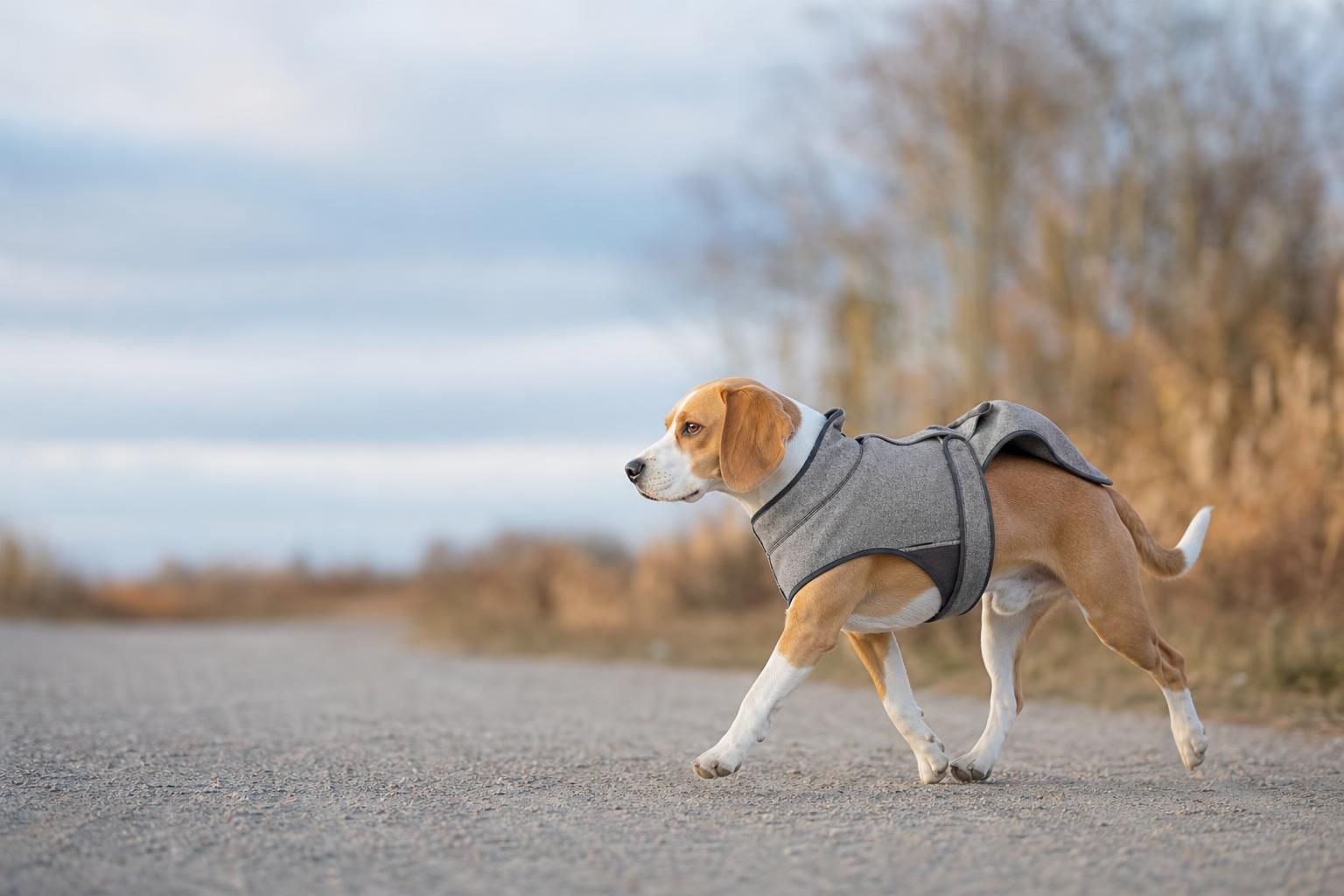
A dog's coat rides up when walking mainly because the chest girth is too loose relative to the neck opening, letting the garment slide backward with each stride, or because the back length is too short to stay anchored along the spine. Leg and shoulder movement also pushes fabric that isn't shaped to follow the dog's natural gait. The fix is almost always a sizing or design issue, not a behavior problem.
Key takeaways
- Riding up is usually a fit problem: chest too loose, neck too tight, or back length too short.
- Measure chest girth, neck, and back length in inches rather than relying on S/M/L labels.
- Leg openings and underbelly straps keep a coat anchored during walking far better than a simple pullover shape.
The Mechanics of Why a Coat Slides Backward
When a dog walks, the front legs reach forward and the shoulder blades rotate, which pulls fabric across the chest with every step. If the coat's chest band is loose, there's nothing to resist that forward-backward motion, so the garment gradually creeps toward the tail. A coat that fits snugly at the chest but not so tight it restricts breathing acts like an anchor point, keeping the rest of the garment in place as the legs move.
Back length matters just as much. A coat that stops too short before the base of the tail has less surface area gripping the torso, so it has more room to shift with each stride. A coat cut to reach closer to the tail (without covering it) distributes movement across a longer stretch of the back, which reduces slippage.
Sizing Mistakes That Make Riding Up Worse
Generic S/M/L labels are one of the biggest causes of poor-fitting dog coats, because a "medium" from one brand might fit a 14-inch chest and a "medium" from another might fit an 18-inch chest. Dogs with long backs and narrow chests (like dachshunds or greyhounds) or dogs with broad chests and short backs (like French bulldogs) are especially prone to riding-up problems because standard sizing assumes an average proportion that doesn't exist for every breed.
Measuring in inches avoids this guesswork. Three measurements matter most:
- Neck circumference — where a collar would sit, measured snugly but not tight.
- Chest girth — the widest part of the ribcage, usually just behind the front legs.
- Back length — from the base of the neck to the base of the tail, following the spine.
Ziva Paws lists all its clothing in these three inch-based measurements instead of S/M/L, specifically because chest-to-back proportion is what determines whether a coat stays put or rides up during a walk.
Design Features That Prevent Riding Up
Beyond correct sizing, certain construction choices reduce movement:
- Leg openings or underbelly straps — these loop under the front legs or belly and stop the coat from rotating around the torso.
- A higher neck-to-chest taper — coats cut closer at the neck and wider at the chest follow the natural shape of the dog instead of hanging like a straight tube.
- Stretch panels at the shoulder — a small amount of give where the shoulder blades move allows the coat to flex with the stride instead of bunching and then sliding.
- Velcro or snap closures at two points — a single neck closure lets a coat twist; a second closure at the chest or belly holds it in two anchor points instead of one.
A coat without any of these features, even if sized correctly, will move more than one designed with a dog's gait in mind.
Behavior and Comfort Factors
Sometimes a coat rides up because the dog is uncomfortable and shifting their gait to compensate — shortening their stride, hunching, or scratching at it mid-walk, which pulls fabric out of place. This is common with dogs trying a coat for the first time. If your dog also freezes, walks stiffly, or tries to shake it off, the discomfort itself may be dragging the coat out of position rather than the fit alone. For a deeper look at this reaction, see why some dogs shake after putting on a coat.
A coat that's too tight at the shoulders can also ride up as the dog tries to extend their front legs fully — the restriction forces an awkward stride that tugs at the garment. This is different from a loose coat riding up; it's a tight coat being pulled by compensatory movement. Watching how your dog walks for the first few minutes in a new coat tells you which problem you're dealing with.
How to Check and Fix the Fit at Home
- Measure neck, chest, and back length in inches with your dog standing naturally.
- Put the coat on and check you can fit two flat fingers under the chest band — snug, not tight.
- Walk your dog 10–15 steps and watch the chest band and back seam. If the chest band visibly slides backward, the chest measurement is too loose for that size.
- Check the back length again after walking — if more than an inch of bare back shows near the tail that wasn't showing before, the coat is too short for your dog's torso.
If your dog outright resists wearing anything regardless of fit, that's a separate issue worth troubleshooting on its own — see this guide on dogs refusing to wear a coat for ways to build tolerance gradually.
When Riding Up Signals a Deeper Fit Problem
Occasionally a coat rides up no matter how it's adjusted because the garment's overall shape doesn't match your dog's body type at all — for example, a coat designed for a barrel-chested breed put on a long, narrow-bodied dog. In these cases, no amount of tightening fixes it; a different cut is needed. Breed-specific proportions are well documented by veterinary and canine organizations, and the American Kennel Club is a useful reference for understanding typical body proportions by breed when choosing a garment style.
Cold-weather walks also add a layer of complexity, since wind and precipitation can cause a loose coat to flap and shift even more than it would on a still day. For guidance on weather-specific apparel choices, see this overview on dogs wearing scarves in winter, which touches on how outer layers interact with movement in cold conditions. Our own cats, Ai and Dudu, aren't exactly runway walkers, but testing garments on moving, wriggling bodies before anything goes up for sale has made the inch-based sizing approach a non-negotiable part of how every coat and sweater is measured.
Frequently Asked Questions
Q: Why does my dog's coat ride up only when walking fast or running?
Faster movement increases the forward pull on the chest band and shoulder area, so a coat that fits acceptably at a slow walk can still slide at a trot or run. A snugger chest fit and a secondary belly strap usually solve this.
Q: Does a tighter coat always stop riding up?
Not necessarily — if a coat is too tight at the shoulders, your dog may alter their stride to compensate, which can pull the coat out of place in a different way. The goal is a snug chest fit with full shoulder mobility, not maximum tightness.
Q: How do I know if my dog's coat is the wrong size versus the wrong design?
If the coat rides up even after confirming chest, neck, and back length match your dog's inch measurements, the issue is likely the garment's shape or lack of leg/belly anchoring rather than the size itself.
Q: Can a coat that's too short in the back cause riding up?
Yes. A shorter back panel has less surface area gripping the torso, so it shifts more easily with each stride compared to a coat that extends closer to the base of the tail.
Q: Is riding up more common in certain dog breeds?
Breeds with narrow chests relative to a long back, such as dachshunds or whippets, or breeds with a deep chest and short back, such as French bulldogs, are more prone to riding up because generic sizing doesn't account for their proportions.