Custom Marble Countertops in Honolulu: A Buyer's Guide
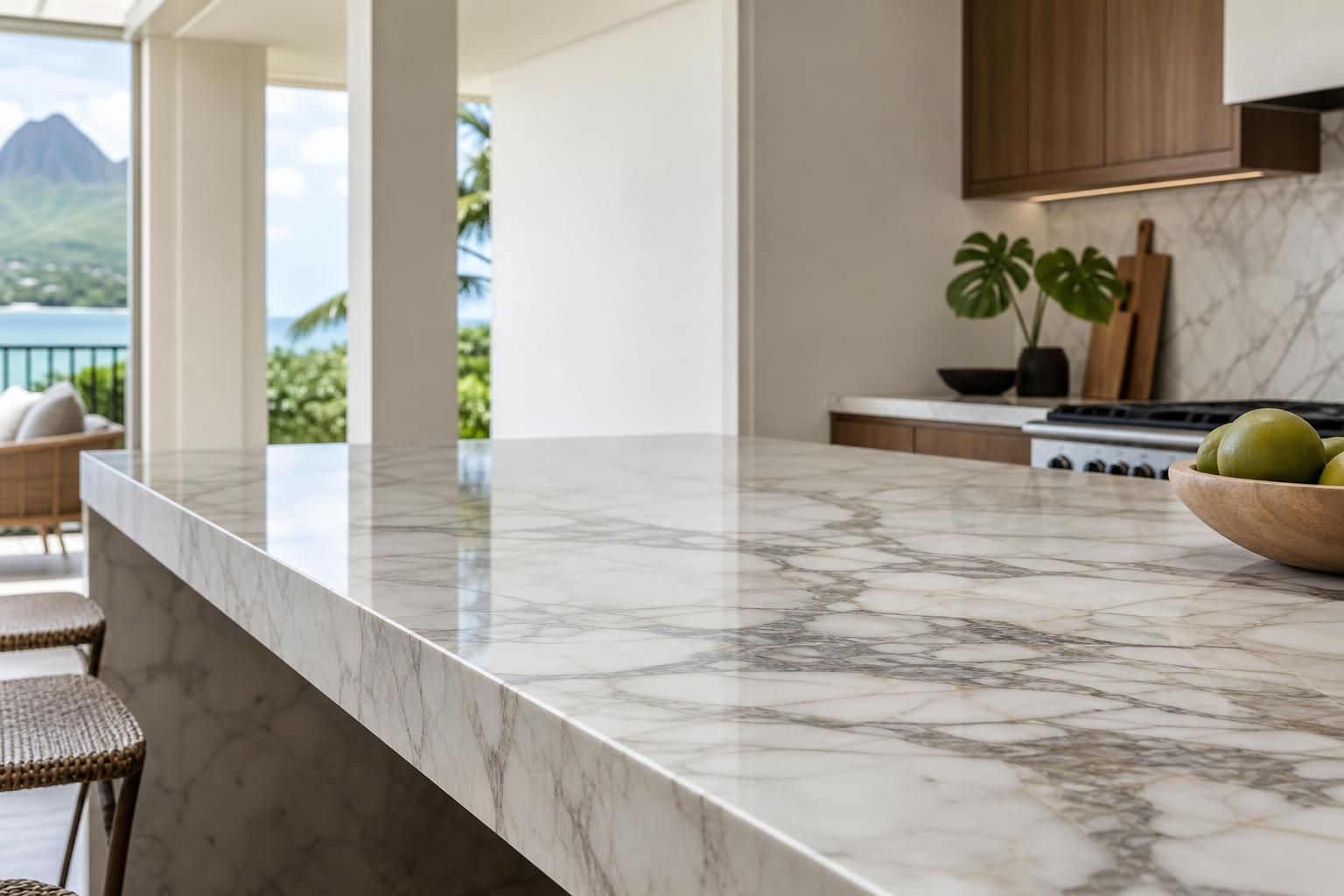
Key takeaway
Custom marble countertops in Honolulu are a realistic option for kitchen islands, bathroom vanities, and accent surfaces, but the material needs sealing, careful finish selection, and daily habits that respect its softness and porosity. Marble performs best in lower-traffic zones or paired with a protective finish, since Oahu's humidity and acidic foods (citrus, vinegar, poke sauces) can etch unsealed stone faster than in drier mainland climates. Homeowners who want the marble look with less maintenance often pair it with quartz in high-use areas, a trade-off worth discussing during a design consultation.
Key takeaways
- Seal custom marble countertops every 6-12 months in Honolulu's humidity; unsealed marble absorbs moisture and stains faster than in drier climates.
- Choose a honed or leathered finish for kitchen islands to hide etching from citrus and vinegar, and reserve high-polish marble for bathroom vanities or accent walls.
- Marble ranks around 3-4 on the Mohs hardness scale, softer than granite or quartz, so it scratches and etches more easily and needs gentler daily cleaning.
What Makes Marble Different From Quartz or Granite
Marble is a metamorphic rock formed from recrystallized limestone, composed mainly of calcium carbonate, which is why it reacts to acids the way chalk does. On the Mohs hardness scale, marble typically measures 3 to 4, compared with 6 to 7 for quartzite and roughly 7 for engineered quartz surfaces. That hardness gap explains why marble etches and scratches more readily, and why fabricators often recommend it for lower-contact surfaces rather than a daily prep station.
For buyers comparing options, our breakdown of quartz countertop pros and cons covers how engineered stone handles heat, scratching, and humidity differently than natural marble.
Where Marble Works Best in Oahu Homes
Custom marble countertops tend to perform best where they're seen more than they're scrubbed:
- Bathroom vanities – lower exposure to acidic spills, high visual payoff
- Kitchen islands used for serving, not prep – display surface, occasional light use
- Bar tops and accent counters – statement piece without daily cutting or citrus contact
- Fireplace surrounds and backsplashes – vertical surfaces rarely touched
Marble is also a popular choice for shower walls and tub surrounds in island bathrooms, where the veining reads as a design feature rather than a maintenance liability. If you're weighing marble against engineered alternatives for a bath remodel, see our guide to natural stone shower walls in Oahu for how different stones hold up to constant water exposure.
Finish Choice Changes How Much Maintenance You'll Do
The finish applied to a marble slab has almost as much impact on day-to-day livability as the stone itself:
- Polished – glossy, classic look, but shows etching and water spots most visibly
- Honed – matte surface that hides light etching and fingerprints better
- Leathered – textured finish that masks both etching and minor scratches, at the cost of a slightly less formal look
Because the same finish question comes up with quartzite, our comparison of leathered versus polished quartzite finishes is useful background even if you ultimately choose marble, since the trade-offs (hiding wear versus showing off shine) are nearly identical.
Sealing and Daily Care in a Humid Climate
Marble is porous, and Honolulu's year-round humidity means moisture and oils migrate into the stone faster than in arid regions. A penetrating sealer fills the pores without changing the surface look, and most fabricators recommend reapplying it on a schedule rather than waiting for visible staining, since by the time a stain shows, the sealer has often already broken down. Wipe spills — especially citrus juice, coffee, wine, and vinegar-based sauces — immediately, and use a pH-neutral stone cleaner rather than generic kitchen sprays, many of which contain acids or abrasives that dull the finish. The Natural Stone Institute publishes care guidance that applies directly to marble maintained in high-humidity environments like Oahu.
Cutting boards and trivets are non-negotiable on marble counters: a dropped knife edge or a hot pan can chip or scorch the surface in ways polishing can't fully reverse.
Custom Fabrication: What to Expect
"Custom" marble countertops means the slab is templated to your exact cabinet layout, including sink cutouts, edge profiles, and seam placement, rather than cut from stock sizes. A typical process includes an in-home or showroom measurement, slab selection (since veining varies significantly piece to piece), CNC or hand fabrication, and a final install with sealing done on site. If you're coordinating countertops with new cabinetry, working through choosing a custom kitchen cabinet designer in Oahu first can help the cabinet layout and countertop template line up without costly change orders mid-project.
Because marble slabs are imported and shipping to Hawaii adds freight cost on top of mainland rates, and skilled fabrication labor runs higher locally than on the mainland, custom marble projects in Honolulu typically cost more than the same job would elsewhere. A local showroom can walk through current slab availability and give a real quote based on your layout and finish choice.
Marble vs. Quartz for Vacation Rentals and Condos
Short-term rental owners and condo renovators often ask whether marble is worth the upkeep in a unit that isn't monitored daily. In practice, many owners choose marble for a bathroom vanity or accent piece and quartz for the kitchen prep surface, since quartz doesn't require sealing and resists staining from guest use far better. VC Flooring & Stone works with condo and vacation-rental owners across Oahu on exactly this kind of mixed-material approach, balancing the look buyers want with a maintenance load that fits a property without an on-site caretaker.
Frequently Asked Questions
Q: Is marble a good choice for Honolulu kitchens?
Marble can work well in Honolulu kitchens for islands, bars, and display surfaces, but it needs regular sealing and careful handling around acidic foods because of the humid climate. Many homeowners pair marble accents with a more durable surface like quartz on primary prep counters.
Q: How often does marble need to be sealed in Hawaii's climate?
Most fabricators recommend sealing custom marble countertops every 6 to 12 months in Honolulu, more often than in drier climates, because ambient humidity accelerates moisture absorption into the stone's pores.
Q: What's the difference between marble and quartz for custom countertops?
Marble is a natural, porous stone around 3-4 on the Mohs hardness scale that etches with acids and needs sealing, while quartz is an engineered surface, roughly 7 on the Mohs scale, that resists staining and etching without sealing. Marble offers unique natural veining; quartz offers more consistent patterns and lower maintenance.
Q: Can marble handle Hawaii's humidity and salt air?
Indoor marble countertops are shielded from direct salt air exposure, but ambient humidity still affects how quickly the stone absorbs moisture and how often it needs resealing. Marble used outdoors or in unconditioned spaces is more vulnerable and generally not recommended.
Q: How long does a custom marble countertop installation take?
After slab selection, templating typically happens on site, followed by fabrication and a separate installation visit once the stone is cut and finished. Scheduling depends on slab availability and project size, so it's worth confirming a timeline during the initial consultation.