Leathered vs Polished Quartzite Finish: Which Wins?
Key takeaway
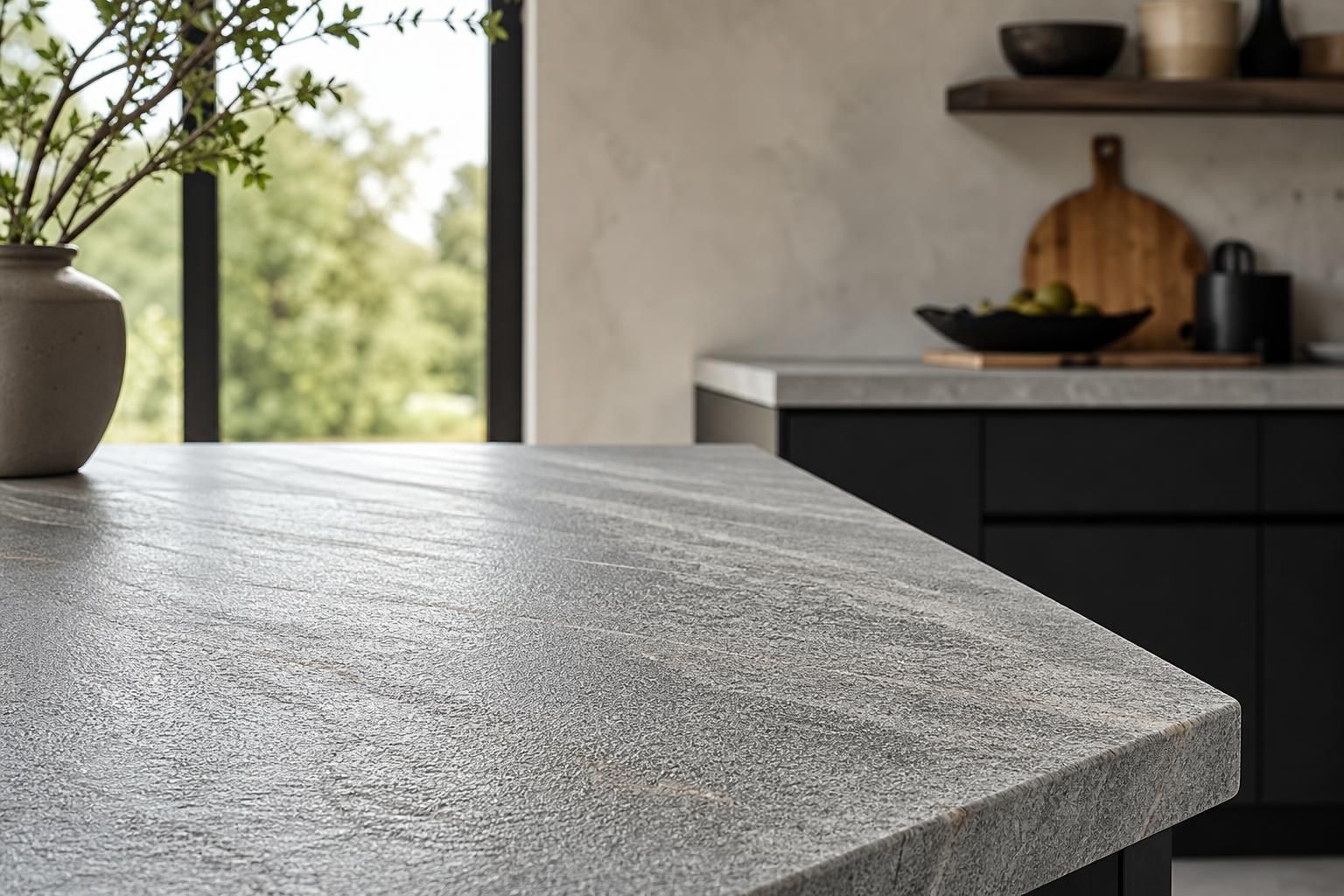
Leathered quartzite has a matte, slightly textured surface that hides fingerprints, water spots, and salt-air haze, while polished quartzite has a glossy, mirror-like finish that shows more color depth but reveals smudges and etching more readily. For most Oahu kitchens, leathered quartzite is the lower-maintenance, more forgiving choice; polished quartzite suits homeowners who want maximum shine and are willing to wipe down counters more often.
Key takeaways
- Leathered finishes mask water spots, fingerprints, and light scratches better, making them practical for busy kitchens and rental turnovers.
- Polished finishes show off quartzite's natural veining and color saturation but need more frequent wiping to stay streak-free.
- Both finishes need the same sealing schedule — the texture changes maintenance visibility, not the stone's actual porosity.
What Each Finish Actually Does to the Stone
Polishing uses progressively finer abrasives to flatten and smooth the surface until it reflects light like glass. Leathering uses diamond-tipped brushes instead of polishing pads, which creates a subtle texture — somewhere between matte and lightly rippled — without the sharp peaks and valleys of a true honed finish. The texture is shallow enough that it doesn't trap grime the way a deeply textured tile grout line would, but it's enough to scatter light instead of mirroring it.
Because quartzite is a natural metamorphic stone (formed when sandstone is compressed and heated over geologic time, according to the U.S. Geological Survey), its hardness is largely unaffected by which finish is applied. The finish changes the surface topography, not the mineral structure underneath, so neither option is inherently "stronger."
How the Two Finishes Behave in a Humid Climate
Hawaii's year-round humidity and salt air create a specific maintenance challenge: water spots and mineral deposits from tap water or sea spray that dry on a countertop and leave a visible film. On a polished surface, that film shows up as a dull haze against the glossy background. On a leathered surface, the texture diffuses light so the same residue is far less noticeable between cleanings.
This matters most in kitchens that double as entertaining spaces or in vacation rentals where cleaning happens on a changeover schedule rather than daily. If you're weighing finishes for a rental unit, it's worth reading through broader guidance on keeping a small condo kitchen looking bigger, since finish choice and layout both affect how "clean" a space photographs between guests.
Side-by-Side Comparison
| Factor | Leathered Quartzite | Polished Quartzite |
|---|---|---|
| Surface look | Matte, subtly textured, softer light reflection | Glossy, high-shine, strong color/vein contrast |
| Visibility of water spots & fingerprints | Low — texture breaks up glare | Higher — smudges show against the shine |
| Cleaning frequency | Standard wipe-down | More frequent polishing wipes to avoid streaking |
| Sealing needs | Same as polished — depends on the specific stone's porosity | Same as leathered |
| Scratch/etch visibility | Less noticeable due to texture | More noticeable, especially under kitchen lighting |
| Best suited for | High-traffic kitchens, rentals, busy households | Formal kitchens, bathroom vanities, lower-traffic surfaces |
Sealing and Everyday Care Are Nearly Identical
Regardless of finish, quartzite is still a natural stone with some porosity, and most fabricators recommend a penetrating sealer applied at installation and reapplied periodically — how often depends on the specific quarry block and how much daily use the surface gets. Neither finish eliminates the need to wipe up citrus juice, vinegar, or wine promptly; quartzite resists etching better than marble, but it isn't etch-proof, a distinction the Natural Stone Institute draws out clearly when comparing stone families.
Daily care is simple either way: a pH-neutral stone cleaner, a soft cloth, and avoiding abrasive pads. If you're also comparing quartzite against engineered quartz for the same project, the tradeoffs around maintenance and heat resistance are covered in more depth in a guide to quartz countertop pros and cons.
Which Finish Fits Which Room
Kitchens that see heavy use — cooking, kids, frequent guests — tend to look better longer with a leathered finish, since it forgives the small imperfections that accumulate between deep cleanings. Bathroom vanities and wet bars, where water contact is lighter and more controlled, are a better showcase for a polished finish's full color and shine. If you're outfitting a wet bar specifically, the finish decision pairs naturally with broader material choices covered in choosing a countertop for a wet bar.
Cabinet and countertop pairing also affects how much a finish's sheen reads in a room. A high-gloss polished slab next to matte shaker cabinetry creates more visual contrast than leathered stone does, which is worth considering alongside two-tone kitchen cabinet choices if you're planning the whole kitchen at once.
A Note on Cost
Leathered finishing is a slower fabrication process than polishing, and in Hawaii, where slabs are shipped in and skilled fabrication labor runs higher than mainland averages, that extra step typically shows up as a modest premium on the finishing line item rather than the material cost itself. The most reliable way to know what a specific slab and finish combination will run for your kitchen is a local in-home measurement and quote rather than a national price guide, since freight and installation conditions vary by project.
Frequently Asked Questions
Q: Is leathered quartzite harder to keep clean than polished?
No — it's generally easier day-to-day because its texture hides water spots, fingerprints, and light residue that show up clearly on a glossy polished surface. Both finishes need the same basic routine of pH-neutral cleaner and prompt spill wipe-up.
Q: Does leathering make quartzite more porous or less durable?
Leathering changes the surface texture, not the stone's internal structure, so porosity and hardness are effectively the same as a polished slab of the same quarry block. Sealing recommendations don't change based on finish.
Q: Can you re-polish a leathered quartzite countertop later if you change your mind?
In many cases a fabricator can re-process the surface, but it typically requires removing material and may not be practical once the countertop is installed and sealed around sinks and edges. It's worth testing a sample under your kitchen lighting before committing to either finish.
Q: Does a leathered finish hide scratches better than a polished one?
Yes, generally — the textured surface scatters light so minor scratches and etch marks blend in more than they would against a mirror-smooth polished surface. Neither finish is scratch-proof, since quartzite can still be damaged by extremely hard or sharp objects.
Q: Which finish is better for a humid, salt-air climate like Oahu's?
Leathered quartzite tends to perform better visually in humid, salt-air conditions because it hides the water spotting and mineral film that forms faster near the coast. Polished finishes can still work well with more frequent wiping, especially in lower-moisture rooms like a bathroom vanity.