How to Choose Under Cabinet Lighting
Key takeaway
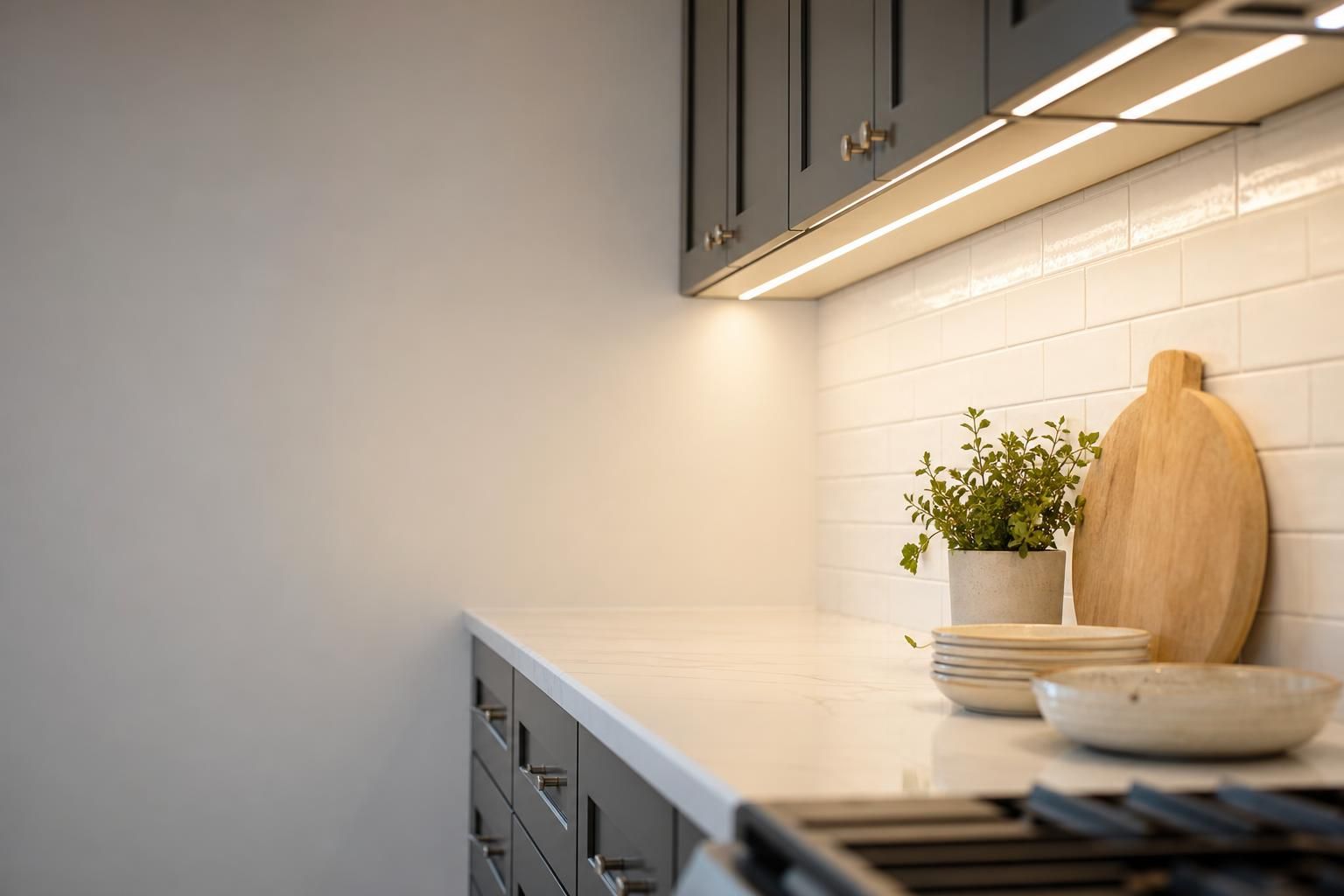
Choose under cabinet lighting by matching three things: light type (LED strip, puck, or linear bar), color temperature (2700K–3000K for warm kitchens, 3500K–4000K for task-heavy prep zones), and mounting method that fits your cabinet depth and wiring access. For most kitchens, a dimmable LED strip rated for damp locations gives the most even light with the fewest shadows, and hardwired or plug-in direct-wire kits last longer than battery pucks.
Key takeaways
- LED strip lighting with a diffuser lens gives the most even, shadow-free countertop light for everyday cooking and prep.
- Pick 2700K–3000K for a warm island-home feel, or 3500K–4000K if the counter doubles as a reading or detailed-task surface.
- In Hawaii's humid kitchens, look for a damp-location rating and sealed connections, especially near sinks and open lanai-facing windows.
Decide Which Light Type Fits Your Cabinets
Three main types dominate residential kitchens: LED strip (tape) lighting, puck lights, and linear bar fixtures. Strip lighting runs continuously along the underside of the cabinet and spreads light evenly across the backsplash and counter, which is why it has become the default choice in most new cabinet installs. Puck lights are small, round, and spaced individually — they create pools of light with visible gaps unless you install more of them than feels economical. Linear bars sit between the two, offering a solid light source in a rigid housing that's easier to service than taped strips but less flexible for curved or angled cabinet runs.
If your cabinets have a shallow reveal or a decorative edge, check the physical depth available before ordering fixtures, since some bar fixtures need more clearance than a thin LED strip.
Match Color Temperature to How You Use the Kitchen
Color temperature, measured in Kelvin, determines whether light reads warm (yellowish) or cool (bluish-white). A 2700K–3000K light mimics incandescent bulbs and suits kitchens with wood tones or warm stone counters, while 3500K–4000K reads crisper and is better for chopping, reading labels, or working with fine detail. The U.S. Department of Energy notes that LED color temperature is a key factor in how a space feels, independent of brightness — two bulbs with identical lumen output can look very different depending on Kelvin rating. If you're also choosing a backsplash color to pair with white cabinets, test the light temperature against a tile sample before buying, since warm light can shift how white grout and glossy tile actually read on the wall.
Check Brightness, Not Just Wattage
LED output is measured in lumens, not watts, and wattage alone tells you almost nothing about how bright a fixture will actually be. For task lighting under cabinets, aim for roughly 150–200 lumens per linear foot of fixture as a working benchmark; less than that can leave the counter looking dim even with the light on. Dimmable drivers are worth the small added cost — they let you drop the light down for ambient evening use without buying a second fixture.
Plan for Hawaii's Humidity and Power Setup
Kitchens near open windows, lanai doors, or humid bathrooms see more moisture exposure than mainland installs, and that matters for electrical fixtures mounted close to a sink or stove. Look for a fixture rated for damp locations under UL's safety listing standards, which cover enclosures and wiring meant to handle occasional moisture without corroding contacts. Hardwired, direct-wire kits connected to a dedicated low-voltage transformer tend to outlast plug-in puck lights with battery packs, since batteries corrode faster in salt-air environments and need more frequent replacement. If you're planning a full cabinet refresh, it's worth having an electrician run the wiring at the same time a cabinet installer handles hinges and hardware — see our guide on choosing cabinet door hinges for humid climates for related hardware considerations that come up in the same renovation.
Decide Between Hardwired and Plug-In Installation
Hardwired systems connect to your home's electrical circuit through a junction box and a dimmer switch on the wall, giving a clean, permanent installation with no visible cords. Plug-in direct-wire kits run on a low-voltage transformer that plugs into a nearby outlet, which is simpler for a renovation that isn't opening up the wall anyway. Battery-operated pucks are the easiest to install but the least reliable long-term option, since they require manual battery swaps and tend to dim unevenly as batteries age. For a full kitchen remodel where cabinets are being replaced, hardwiring during construction avoids retrofitting wires later and keeps the under-cabinet gap cleaner.
Think About Placement and Spacing
Mount the fixture toward the front edge of the cabinet rather than the back, so the light falls onto the counter and backsplash rather than straight down against the cabinet face. For continuous LED strips, run the light the full length of the cabinet run rather than only over the sink or stove, since gaps create visible dark zones once the kitchen is in daily use. If you're working with a kitchen designer on a full renovation, under-cabinet lighting decisions typically happen at the same stage as outlet placement and cabinet layout — something a custom kitchen cabinet designer in Oahu can coordinate alongside electrical rough-in so the wiring doesn't need to be exposed or patched later. Industry guidance from the National Kitchen & Bath Association recommends layering under-cabinet task lighting with general ceiling lighting rather than relying on either alone, since task lighting alone can leave shadows on the floor and upper cabinet faces.
Frequently Asked Questions
Q: What color temperature is best for under cabinet lighting?
Most kitchens work well with 2700K–3000K for a warm, residential feel, while 3500K–4000K suits counters used heavily for detailed prep work or reading. Testing a sample against your actual counter and backsplash color before buying is the most reliable way to decide.
Q: Is LED strip lighting better than puck lights?
LED strip lighting generally gives more even coverage because it runs continuously along the cabinet, while puck lights create individual pools of light with gaps between them. Strips also tend to use fewer total fixtures and wiring connections, which simplifies installation.
Q: Do under cabinet lights need to be hardwired?
No — plug-in direct-wire kits and battery-operated pucks are both common alternatives, though hardwired systems generally last longer and avoid visible cords or battery maintenance. Hardwiring is easiest to plan during a full cabinet or kitchen renovation.
Q: How many lumens do I need for under cabinet task lighting?
A common working benchmark is 150–200 lumens per linear foot of fixture for effective task lighting. Dimmable fixtures let you reduce that output for ambient use without needing a separate lower-wattage fixture.
Q: Does humidity affect under cabinet lighting in Hawaii homes?
Yes — fixtures near sinks, open lanai doors, or other moisture-prone areas benefit from a damp-location safety rating, since standard indoor-only fixtures can corrode faster in humid, salt-air conditions. Hardwired fixtures with sealed connections typically hold up better long-term than battery-powered pucks in these environments.