Natural Stone Backsplash Ideas for Hawaii Kitchens
Key takeaway
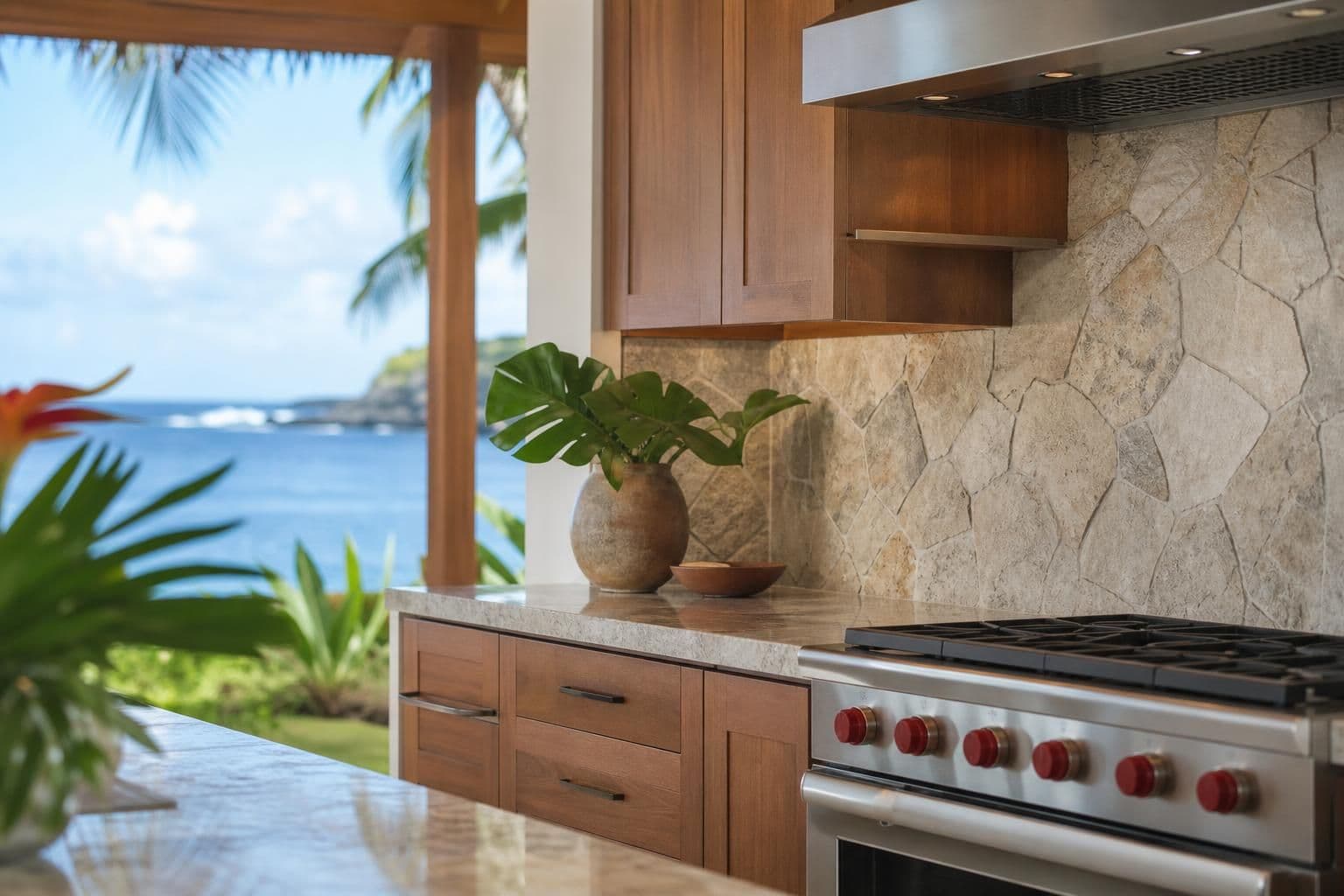
The best natural stone backsplash ideas for Hawaii kitchens use dense, low-porosity stones like granite, quartzite, or polished basalt, paired with a penetrating sealer and epoxy-based grout to resist the island's humidity and salt air. Popular looks include a full-height stone slab behind the range, a mosaic accent strip in lava rock or pebble tile, and book-matched quartzite panels that echo the countertop. The stone you choose matters more in Hawaii than almost anywhere else, since porous materials that work fine on the mainland can absorb moisture and stain faster here.
Key takeaways
- Choose stones rated low-porosity (granite, quartzite, polished basalt) over porous options like unsealed limestone or travertine.
- Use epoxy or urethane grout instead of standard cement grout to resist mold and mildew in humid kitchens.
- Reseal natural stone backsplashes every 1-2 years in Hawaii, roughly twice as often as recommended in drier mainland climates.
Why Stone Choice Matters More in a Humid Climate
Honolulu's average relative humidity sits well above mainland norms for most of the year, and coastal homes add salt-laden air on top of that. Porous stones like tumbled travertine or soft limestone have tiny surface pockets that pull in moisture, grease, and cooking steam, which speeds up staining and can encourage mildew growth behind the tile if grout lines aren't sealed properly. The EPA's guidance on mold and moisture control notes that persistent moisture against a porous surface is one of the main drivers of indoor mold growth, which is exactly the condition a kitchen backsplash faces daily near a sink or range.
Granite and quartzite are quartz-based stones with very tight mineral structures, so they take on far less water than limestone or slate. Polished basalt, a volcanic stone common in the Pacific, is dense enough that many Hawaii fabricators recommend it specifically for wet areas like backsplashes and shower walls.
Backsplash Styles That Work Well on Oahu
A few layouts show up again and again in island kitchens because they balance style with practicality:
- Full-height slab backsplash — a single piece of granite or quartzite runs from the counter to the upper cabinets behind the cooktop, eliminating grout lines where grease and moisture would otherwise collect.
- Lava rock mosaic accent — a narrow band of textured basalt or lava stone tile breaks up a plain quartz counter and nods to local materials without covering the whole wall.
- Book-matched quartzite panels — two slabs cut from the same block are mirrored so their veining lines up, creating a dramatic focal point above a range.
- Pebble or river stone strip — smooth stones set in sheets add texture near open shelving or a wet bar, common in vacation-rental kitchens going for a resort feel.
If you're planning the whole kitchen around one of these looks, it helps to work out counter height, sink placement, and appliance clearances first — a guide on designing a kitchen layout covers the sequence most remodelers follow before backsplash and countertop selection.
Pairing Stone Backsplashes With Countertops
Matching a natural stone backsplash to an engineered quartz countertop is one of the most requested combinations in Oahu kitchens, since quartz brings consistent color and near-zero maintenance while the backsplash adds the natural veining and texture people want to see. Engineered quartz is made from crushed quartz crystal bound with resin, which is why it resists staining and doesn't need sealing the way natural stone does — a breakdown of what quartz is actually made of explains the manufacturing process in more detail. For a backsplash, sticking with a real stone slab or tile rather than quartz lets you get the one-of-a-kind veining that a full slab of granite or quartzite offers, since quartz backsplashes tend to look more uniform.
Sealing, Grout, and Long-Term Care
Natural stone backsplashes need periodic sealing because the sealer fills microscopic pores in the stone surface, slowing water and oil absorption without changing the look of the material. In a humid climate, most fabricators suggest testing the surface every year by dripping water on it — if it darkens within a few minutes instead of beading up, it's time to reseal.
Grout choice affects performance as much as the stone itself. Standard cement-based grout is porous and can trap moisture behind tile, while epoxy grout resists water and mildew far better in steamy kitchens and bathrooms. A detailed walkthrough on choosing grout for Hawaii's climate covers which grout types hold up best behind a range or sink, and a companion guide on sealing tile grout walks through the actual sealing steps for existing installations.
The Natural Stone Institute, a trade organization for the stone industry, publishes care guidance recommending pH-neutral cleaners on natural stone surfaces, since acidic or abrasive cleaners can etch polished granite and quartzite finishes over time.
Cost Considerations, Briefly
Natural stone backsplash material and installation costs in Hawaii typically run higher than mainland averages, largely because slabs and tile are shipped in and skilled fabrication labor commands island rates. Rather than rely on national price guides, it's worth requesting a local quote once you know which stone and layout you want, since slab yield, edge finishing, and cutouts around outlets all affect the final number.
Frequently Asked Questions
Q: What is the most durable natural stone for a Hawaii kitchen backsplash?
Granite and quartzite are generally the most durable choices because their dense mineral structure resists water absorption and scratching better than softer stones like marble, limestone, or travertine.
Q: Do natural stone backsplashes need to be sealed in Hawaii?
Yes. Because of the islands' high humidity, most natural stone backsplashes need resealing every 1-2 years, more frequently than the 2-3 year intervals often recommended in drier climates.
Q: Can I use natural stone behind a stove without it staining?
A sealed, low-porosity stone like granite or polished basalt resists grease staining well behind a range, but softer or unsealed stones can absorb oil splatter and discolor over time.
Q: Is lava rock a practical backsplash material?
Polished or honed basalt (often marketed as lava stone) is dense and holds up well as a backsplash accent, though rough, unsealed lava rock textures can trap grease in their pores and are better suited to smaller accent areas than full wet-zone coverage.
Q: How do I match a stone backsplash to a quartz countertop?
Choose a backsplash stone that shares one or two dominant colors or veining tones with the quartz slab, then use the backsplash for the natural texture and movement that engineered quartz doesn't have on its own.